

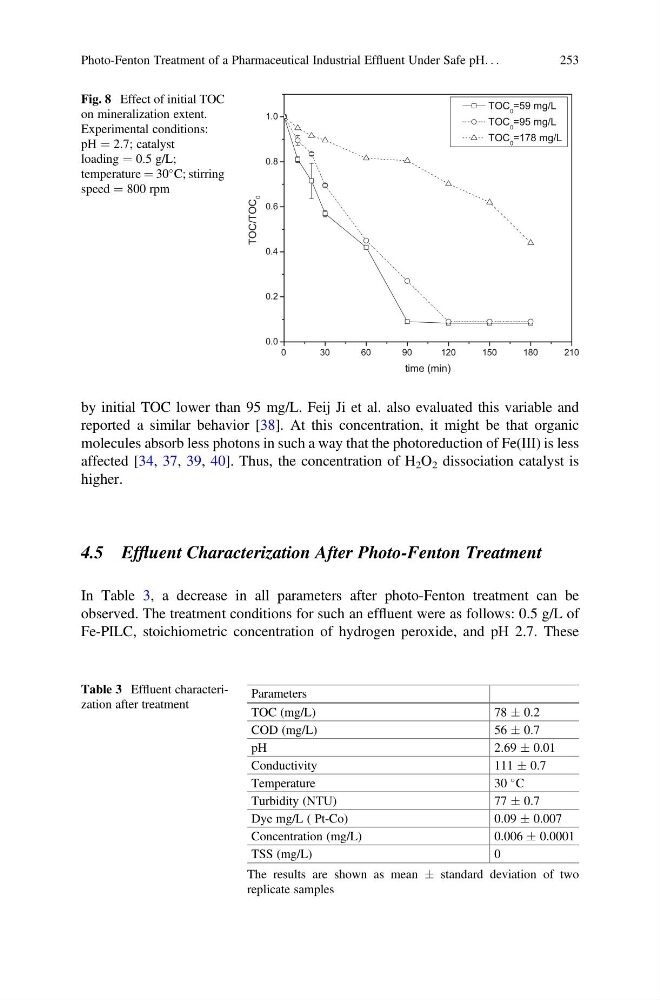
by initial TOC lower than 95 mg/L. Feij Ji et al. also evaluated this variable and
reported a similar behavior [38]. At this concentration, it might be that organic
molecules absorb less photons in such a way that the photoreduction of Fe(III) is less
affected [34, 37, 39, 40]. Thus, the concentration of H 2 O 2 dissociation catalyst is
higher.
4.5 Effluent Characterization After Photo-Fenton Treatment
In Table 3, a decrease in all parameters after photo-Fenton treatment can be
observed. The treatment conditions for such an effluent were as follows: 0.5 g/L of
Fe-PILC, stoichiometric concentration of hydrogen peroxide, and pH 2.7. These
0
30
60
90
120
150
180
210
0.0
0.2
0.4
0.6
0.8
1.0
C
O
T
/
C
O
T
0
time (min)
TOC 0 =59 mg/L
TOC 0 =95 mg/L
TOC 0 =178 mg/L
Fig. 8 Effect of initial TOC
on mineralization extent.
Experimental conditions:
pH ¼ 2.7; catalyst
loading ¼ 0.5 g/L;
temperature ¼ 30
C; stirring
speed ¼ 800 rpm
Table 3 Effluent characterization after treatment
Parameters
TOC (mg/L)
78 Æ 0.2
COD (mg/L)
56 Æ 0.7
pH
2.69 Æ 0.01
Conductivity
111 Æ 0.7
Temperature
30
C
Turbidity (NTU)
77 Æ 0.7
Dye mg/L ( Pt-Co)
0.09 Æ 0.007
Concentration (mg/L)
0.006 Æ 0.0001
TSS (mg/L)
0
The results are shown as mean Æ standard deviation of two
replicate samples
Photo-Fenton Treatment of a Pharmaceutical Industrial Effluent Under Safe pH. . .
253
reported a similar behavior [38]. At this concentration, it might be that organic
molecules absorb less photons in such a way that the photoreduction of Fe(III) is less
affected [34, 37, 39, 40]. Thus, the concentration of H 2 O 2 dissociation catalyst is
higher.
4.5 Effluent Characterization After Photo-Fenton Treatment
In Table 3, a decrease in all parameters after photo-Fenton treatment can be
observed. The treatment conditions for such an effluent were as follows: 0.5 g/L of
Fe-PILC, stoichiometric concentration of hydrogen peroxide, and pH 2.7. These
0
30
60
90
120
150
180
210
0.0
0.2
0.4
0.6
0.8
1.0
C
O
T
/
C
O
T
0
time (min)
TOC 0 =59 mg/L
TOC 0 =95 mg/L
TOC 0 =178 mg/L
Fig. 8 Effect of initial TOC
on mineralization extent.
Experimental conditions:
pH ¼ 2.7; catalyst
loading ¼ 0.5 g/L;
temperature ¼ 30
C; stirring
speed ¼ 800 rpm
Table 3 Effluent characterization after treatment
Parameters
TOC (mg/L)
78 Æ 0.2
COD (mg/L)
56 Æ 0.7
pH
2.69 Æ 0.01
Conductivity
111 Æ 0.7
Temperature
30
C
Turbidity (NTU)
77 Æ 0.7
Dye mg/L ( Pt-Co)
0.09 Æ 0.007
Concentration (mg/L)
0.006 Æ 0.0001
TSS (mg/L)
0
The results are shown as mean Æ standard deviation of two
replicate samples
Photo-Fenton Treatment of a Pharmaceutical Industrial Effluent Under Safe pH. . .
253