

water reclamation and improved understanding on the impacts of NSAIDs in
reclaimed water, technologies for the treatment and/or removal of NSAIDs will
need to be developed. In this chapter, contemporary technologies for the treatment
and/or removal of NSAIDs are reviewed and discussed. In particular, integrated
processes (i.e., combination of biological, physical, and chemical process) for
NSAID removal are described.
2 Contemporary Methods for Nonsteroidal
Anti-inflammatory Drug Removal
2.1 Biological Methods
2.1.1 Bacterial-Based Process
Microbial consortia currently play a significant role in conventional activated sludge
(CAS), carrying out soluble organic matter removal, nitrification–denitrification,
luxury uptake of phosphorus, and volatile fatty acid degradation. Bacteria (the
major component of the microbial consortia) with such diverse metabolic capacities
are employed in a series of (or single) chambers with differential redox conditions
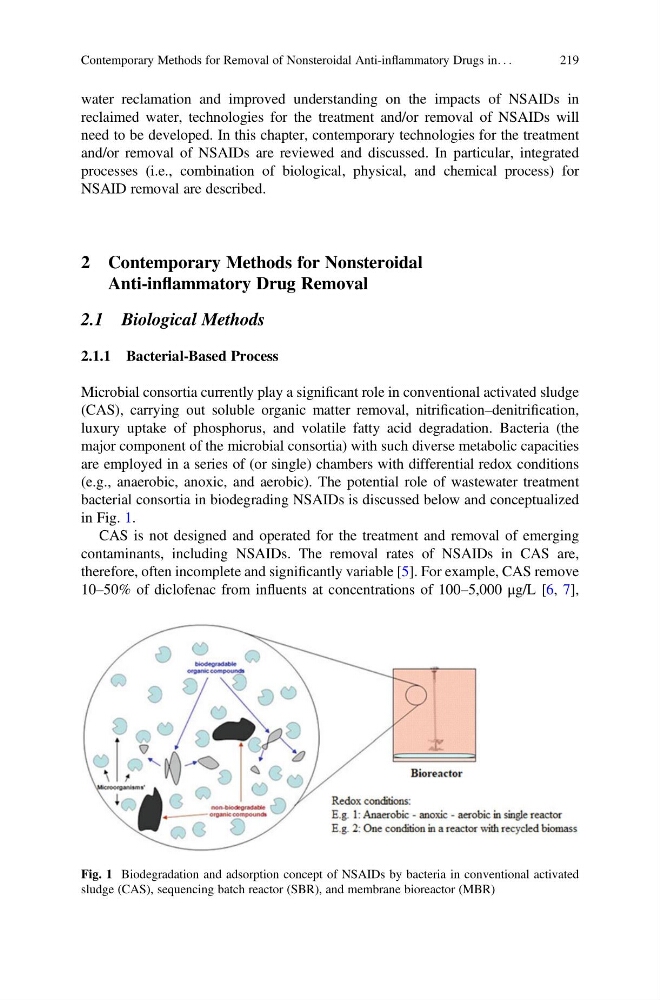
(e.g., anaerobic, anoxic, and aerobic). The potential role of wastewater treatment
bacterial consortia in biodegrading NSAIDs is discussed below and conceptualized
in Fig. 1.
CAS is not designed and operated for the treatment and removal of emerging
contaminants, including NSAIDs. The removal rates of NSAIDs in CAS are,
therefore, often incomplete and significantly variable [5]. For example, CAS remove
10–50% of diclofenac from influents at concentrations of 100–5,000 μg/L [6, 7],
Fig. 1 Biodegradation and adsorption concept of NSAIDs by bacteria in conventional activated
sludge (CAS), sequencing batch reactor (SBR), and membrane bioreactor (MBR)
Contemporary Methods for Removal of Nonsteroidal Anti-inflammatory Drugs in. . .
219
reclaimed water, technologies for the treatment and/or removal of NSAIDs will
need to be developed. In this chapter, contemporary technologies for the treatment
and/or removal of NSAIDs are reviewed and discussed. In particular, integrated
processes (i.e., combination of biological, physical, and chemical process) for
NSAID removal are described.
2 Contemporary Methods for Nonsteroidal
Anti-inflammatory Drug Removal
2.1 Biological Methods
2.1.1 Bacterial-Based Process
Microbial consortia currently play a significant role in conventional activated sludge
(CAS), carrying out soluble organic matter removal, nitrification–denitrification,
luxury uptake of phosphorus, and volatile fatty acid degradation. Bacteria (the
major component of the microbial consortia) with such diverse metabolic capacities
are employed in a series of (or single) chambers with differential redox conditions
(e.g., anaerobic, anoxic, and aerobic). The potential role of wastewater treatment
bacterial consortia in biodegrading NSAIDs is discussed below and conceptualized
in Fig. 1.
CAS is not designed and operated for the treatment and removal of emerging
contaminants, including NSAIDs. The removal rates of NSAIDs in CAS are,
therefore, often incomplete and significantly variable [5]. For example, CAS remove
10–50% of diclofenac from influents at concentrations of 100–5,000 μg/L [6, 7],
Fig. 1 Biodegradation and adsorption concept of NSAIDs by bacteria in conventional activated
sludge (CAS), sequencing batch reactor (SBR), and membrane bioreactor (MBR)
Contemporary Methods for Removal of Nonsteroidal Anti-inflammatory Drugs in. . .
219