

while Kimura et al. [8] found that ketoprofen and naproxen are not eliminated at all
in CAS. In contrast, Tran et al. [9] found that nitrifying bacteria cultures achieved
10–30% improvement in the removal of diclofenac, ibuprofen, and naproxen in
comparison to CAS. Biodegradation of NSAIDs in CAS can be affected by microbial community structure and their associated metabolic capabilities [4, 10,
11]. Microbial community composition and functionality are influenced by various
operating conditions, such as pH, temperature, dissolved oxygen concentration,
hydraulic/solid retention time, and the type and concentration of growth substrates.
For example, high removals of NSAIDs were observed in CAS systems with higher
nitrifying activity [12]. Higher removal efficiency of some NSAIDs could also be
attributed to adsorption to sludge biomass [13]. However, compounds which are
relatively hydrophilic (log D < 3.2, acetaminophen, naproxen, ibuprofen,
diclofenac) show limited sorption to sludge [14]. Therefore, physicochemical properties of a compound can greatly influence its fate and removal during CAS
treatment.
Membrane bioreactor (MBR) is a combination of a membrane filtration process
with a suspended growth bioreactor. MBR provides effective removal of both
organic and inorganic contaminants from municipal and/or industrial wastewaters.
MBR produces a more consistent effluent quality compared to that of CAS. The
combination of activated sludge and membrane filtration has made MBR a reliable
and popular technology for treating many types of wastewaters, particularly those
that contain emerging contaminants such as NSAIDs [15–19]. However, the removal
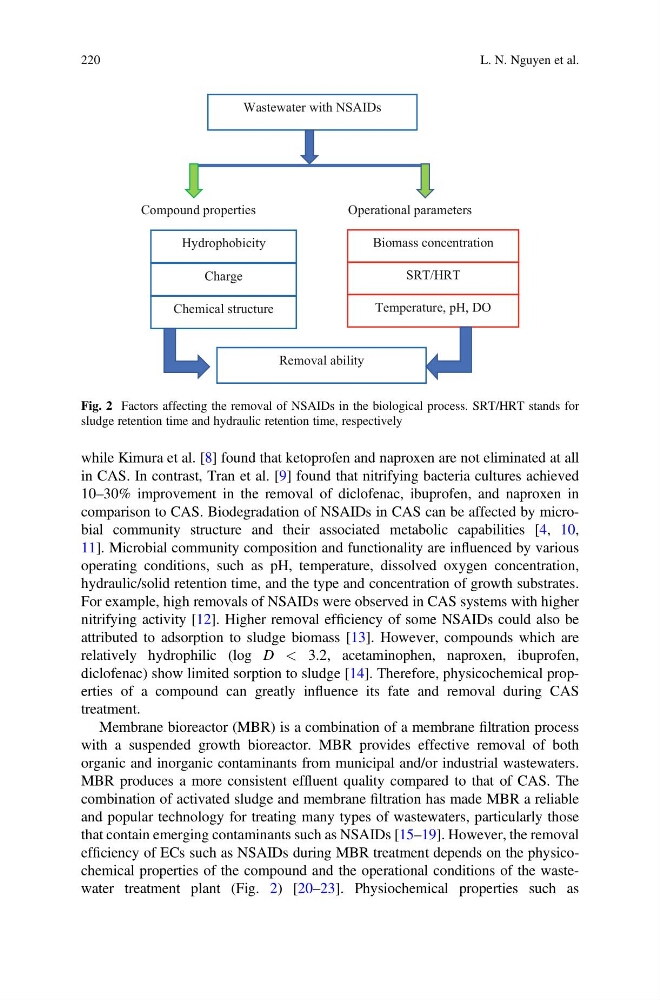
efficiency of ECs such as NSAIDs during MBR treatment depends on the physicochemical properties of the compound and the operational conditions of the wastewater treatment plant (Fig. 2) [20–23]. Physiochemical properties such as
Wastewater with NSAIDs
Compound properties
Charge
Chemical structure
Hydrophobicity
Operational parameters
Biomass concentration
SRT/HRT
Temperature, pH, DO
Removal ability
Fig. 2 Factors affecting the removal of NSAIDs in the biological process. SRT/HRT stands for
sludge retention time and hydraulic retention time, respectively
220
L. N. Nguyen et al.
in CAS. In contrast, Tran et al. [9] found that nitrifying bacteria cultures achieved
10–30% improvement in the removal of diclofenac, ibuprofen, and naproxen in
comparison to CAS. Biodegradation of NSAIDs in CAS can be affected by microbial community structure and their associated metabolic capabilities [4, 10,
11]. Microbial community composition and functionality are influenced by various
operating conditions, such as pH, temperature, dissolved oxygen concentration,
hydraulic/solid retention time, and the type and concentration of growth substrates.
For example, high removals of NSAIDs were observed in CAS systems with higher
nitrifying activity [12]. Higher removal efficiency of some NSAIDs could also be
attributed to adsorption to sludge biomass [13]. However, compounds which are
relatively hydrophilic (log D < 3.2, acetaminophen, naproxen, ibuprofen,
diclofenac) show limited sorption to sludge [14]. Therefore, physicochemical properties of a compound can greatly influence its fate and removal during CAS
treatment.
Membrane bioreactor (MBR) is a combination of a membrane filtration process
with a suspended growth bioreactor. MBR provides effective removal of both
organic and inorganic contaminants from municipal and/or industrial wastewaters.
MBR produces a more consistent effluent quality compared to that of CAS. The
combination of activated sludge and membrane filtration has made MBR a reliable
and popular technology for treating many types of wastewaters, particularly those
that contain emerging contaminants such as NSAIDs [15–19]. However, the removal
efficiency of ECs such as NSAIDs during MBR treatment depends on the physicochemical properties of the compound and the operational conditions of the wastewater treatment plant (Fig. 2) [20–23]. Physiochemical properties such as
Wastewater with NSAIDs
Compound properties
Charge
Chemical structure
Hydrophobicity
Operational parameters
Biomass concentration
SRT/HRT
Temperature, pH, DO
Removal ability
Fig. 2 Factors affecting the removal of NSAIDs in the biological process. SRT/HRT stands for
sludge retention time and hydraulic retention time, respectively
220
L. N. Nguyen et al.