

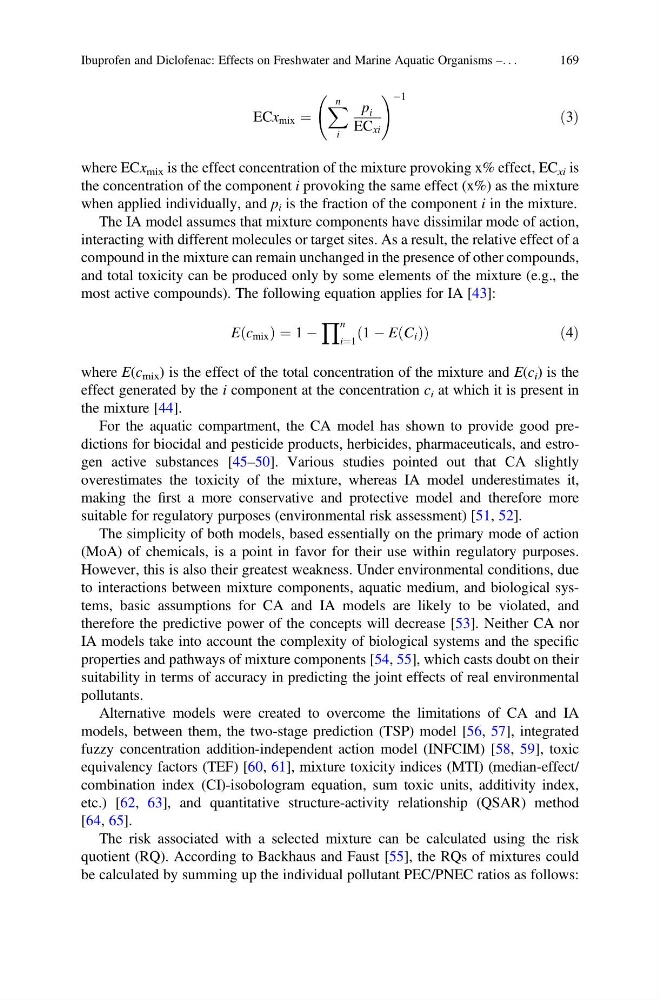
ECx mix ¼
X n
i
p i
EC xi
! À1
ð3Þ
where ECx mix is the effect concentration of the mixture provoking x% effect, EC xi is
the concentration of the component i provoking the same effect (x%) as the mixture
when applied individually, and p i is the fraction of the component i in the mixture.
The IA model assumes that mixture components have dissimilar mode of action,
interacting with different molecules or target sites. As a result, the relative effect of a
compound in the mixture can remain unchanged in the presence of other compounds,
and total toxicity can be produced only by some elements of the mixture (e.g., the
most active compounds). The following equation applies for IA [43]:
E c mix
ð
Þ ¼ 1 À
Y n
i¼1
1 À E C i
ð Þ
ð
Þ
ð 4Þ
where E(c mix ) is the effect of the total concentration of the mixture and E(c i ) is the
effect generated by the i component at the concentration c i at which it is present in
the mixture [44].
For the aquatic compartment, the CA model has shown to provide good predictions for biocidal and pesticide products, herbicides, pharmaceuticals, and estrogen active substances [45–50]. Various studies pointed out that CA slightly
overestimates the toxicity of the mixture, whereas IA model underestimates it,
making the first a more conservative and protective model and therefore more
suitable for regulatory purposes (environmental risk assessment) [51, 52].
The simplicity of both models, based essentially on the primary mode of action
(MoA) of chemicals, is a point in favor for their use within regulatory purposes.
However, this is also their greatest weakness. Under environmental conditions, due
to interactions between mixture components, aquatic medium, and biological systems, basic assumptions for CA and IA models are likely to be violated, and
therefore the predictive power of the concepts will decrease [53]. Neither CA nor
IA models take into account the complexity of biological systems and the specific
properties and pathways of mixture components [54, 55], which casts doubt on their
suitability in terms of accuracy in predicting the joint effects of real environmental
pollutants.
Alternative models were created to overcome the limitations of CA and IA
models, between them, the two-stage prediction (TSP) model [56, 57], integrated
fuzzy concentration addition-independent action model (INFCIM) [58, 59], toxic
equivalency factors (TEF) [60, 61], mixture toxicity indices (MTI) (median-effect/
combination index (CI)-isobologram equation, sum toxic units, additivity index,
etc.) [62, 63], and quantitative structure-activity relationship (QSAR) method
[64, 65].
The risk associated with a selected mixture can be calculated using the risk
quotient (RQ). According to Backhaus and Faust [55], the RQs of mixtures could
be calculated by summing up the individual pollutant PEC/PNEC ratios as follows:
Ibuprofen and Diclofenac: Effects on Freshwater and Marine Aquatic Organisms –. . .
169
X n
i
p i
EC xi
! À1
ð3Þ
where ECx mix is the effect concentration of the mixture provoking x% effect, EC xi is
the concentration of the component i provoking the same effect (x%) as the mixture
when applied individually, and p i is the fraction of the component i in the mixture.
The IA model assumes that mixture components have dissimilar mode of action,
interacting with different molecules or target sites. As a result, the relative effect of a
compound in the mixture can remain unchanged in the presence of other compounds,
and total toxicity can be produced only by some elements of the mixture (e.g., the
most active compounds). The following equation applies for IA [43]:
E c mix
ð
Þ ¼ 1 À
Y n
i¼1
1 À E C i
ð Þ
ð
Þ
ð 4Þ
where E(c mix ) is the effect of the total concentration of the mixture and E(c i ) is the
effect generated by the i component at the concentration c i at which it is present in
the mixture [44].
For the aquatic compartment, the CA model has shown to provide good predictions for biocidal and pesticide products, herbicides, pharmaceuticals, and estrogen active substances [45–50]. Various studies pointed out that CA slightly
overestimates the toxicity of the mixture, whereas IA model underestimates it,
making the first a more conservative and protective model and therefore more
suitable for regulatory purposes (environmental risk assessment) [51, 52].
The simplicity of both models, based essentially on the primary mode of action
(MoA) of chemicals, is a point in favor for their use within regulatory purposes.
However, this is also their greatest weakness. Under environmental conditions, due
to interactions between mixture components, aquatic medium, and biological systems, basic assumptions for CA and IA models are likely to be violated, and
therefore the predictive power of the concepts will decrease [53]. Neither CA nor
IA models take into account the complexity of biological systems and the specific
properties and pathways of mixture components [54, 55], which casts doubt on their
suitability in terms of accuracy in predicting the joint effects of real environmental
pollutants.
Alternative models were created to overcome the limitations of CA and IA
models, between them, the two-stage prediction (TSP) model [56, 57], integrated
fuzzy concentration addition-independent action model (INFCIM) [58, 59], toxic
equivalency factors (TEF) [60, 61], mixture toxicity indices (MTI) (median-effect/
combination index (CI)-isobologram equation, sum toxic units, additivity index,
etc.) [62, 63], and quantitative structure-activity relationship (QSAR) method
[64, 65].
The risk associated with a selected mixture can be calculated using the risk
quotient (RQ). According to Backhaus and Faust [55], the RQs of mixtures could
be calculated by summing up the individual pollutant PEC/PNEC ratios as follows:
Ibuprofen and Diclofenac: Effects on Freshwater and Marine Aquatic Organisms –. . .
169