

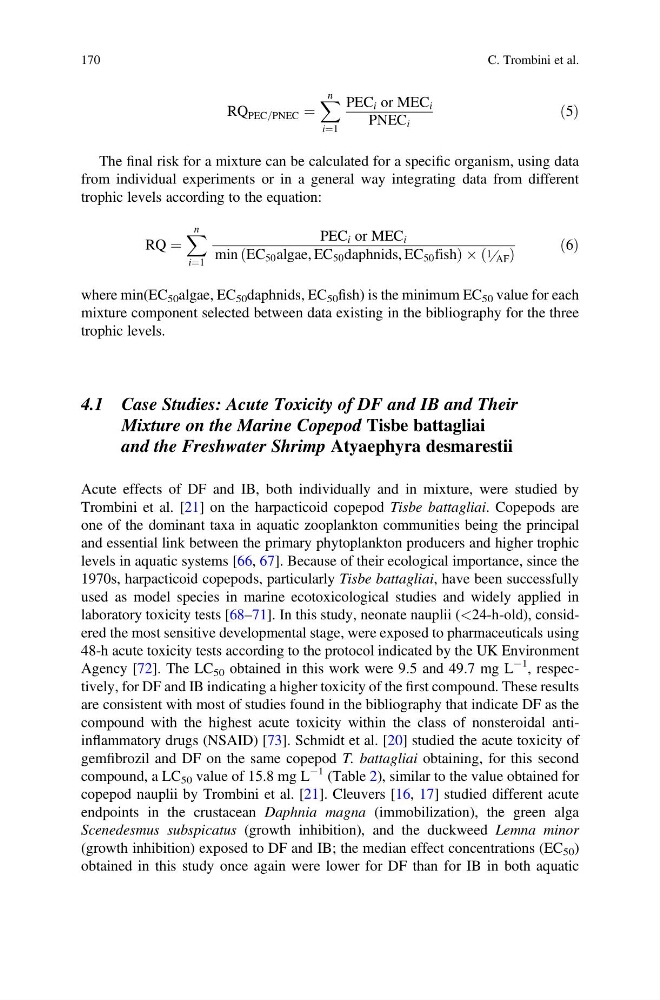
RQ PEC=PNEC ¼
X n
i¼1
PEC i or MEC i
PNEC i
ð5Þ
The final risk for a mixture can be calculated for a specific organism, using data
from individual experiments or in a general way integrating data from different
trophic levels according to the equation:
RQ ¼
X n
i¼1
PEC i or MEC i
min EC 50 algae, EC 50 daphnids, EC 50 fish
ð
Þ Â 1 = AF
ð
Þ
ð6Þ
where min(EC 50 algae, EC 50 daphnids, EC 50 fish) is the minimum EC 50 value for each
mixture component selected between data existing in the bibliography for the three
trophic levels.
4.1 Case Studies: Acute Toxicity of DF and IB and Their
Mixture on the Marine Copepod Tisbe battagliai
and the Freshwater Shrimp Atyaephyra desmarestii
Acute effects of DF and IB, both individually and in mixture, were studied by
Trombini et al. [21] on the harpacticoid copepod Tisbe battagliai. Copepods are
one of the dominant taxa in aquatic zooplankton communities being the principal
and essential link between the primary phytoplankton producers and higher trophic
levels in aquatic systems [66, 67]. Because of their ecological importance, since the
1970s, harpacticoid copepods, particularly Tisbe battagliai, have been successfully
used as model species in marine ecotoxicological studies and widely applied in
laboratory toxicity tests [68–71]. In this study, neonate nauplii (<24-h-old), considered the most sensitive developmental stage, were exposed to pharmaceuticals using
48-h acute toxicity tests according to the protocol indicated by the UK Environment
Agency [72]. The LC 50 obtained in this work were 9.5 and 49.7 mg L
À1 , respectively, for DF and IB indicating a higher toxicity of the first compound. These results
are consistent with most of studies found in the bibliography that indicate DF as the
compound with the highest acute toxicity within the class of nonsteroidal antiinflammatory drugs (NSAID) [73]. Schmidt et al. [20] studied the acute toxicity of
gemfibrozil and DF on the same copepod T. battagliai obtaining, for this second
compound, a LC 50 value of 15.8 mg L
À1 (Table 2), similar to the value obtained for
copepod nauplii by Trombini et al. [21]. Cleuvers [16, 17] studied different acute
endpoints in the crustacean Daphnia magna (immobilization), the green alga
Scenedesmus subspicatus (growth inhibition), and the duckweed Lemna minor
(growth inhibition) exposed to DF and IB; the median effect concentrations (EC 50 )
obtained in this study once again were lower for DF than for IB in both aquatic
170
C. Trombini et al.
X n
i¼1
PEC i or MEC i
PNEC i
ð5Þ
The final risk for a mixture can be calculated for a specific organism, using data
from individual experiments or in a general way integrating data from different
trophic levels according to the equation:
RQ ¼
X n
i¼1
PEC i or MEC i
min EC 50 algae, EC 50 daphnids, EC 50 fish
ð
Þ Â 1 = AF
ð
Þ
ð6Þ
where min(EC 50 algae, EC 50 daphnids, EC 50 fish) is the minimum EC 50 value for each
mixture component selected between data existing in the bibliography for the three
trophic levels.
4.1 Case Studies: Acute Toxicity of DF and IB and Their
Mixture on the Marine Copepod Tisbe battagliai
and the Freshwater Shrimp Atyaephyra desmarestii
Acute effects of DF and IB, both individually and in mixture, were studied by
Trombini et al. [21] on the harpacticoid copepod Tisbe battagliai. Copepods are
one of the dominant taxa in aquatic zooplankton communities being the principal
and essential link between the primary phytoplankton producers and higher trophic
levels in aquatic systems [66, 67]. Because of their ecological importance, since the
1970s, harpacticoid copepods, particularly Tisbe battagliai, have been successfully
used as model species in marine ecotoxicological studies and widely applied in
laboratory toxicity tests [68–71]. In this study, neonate nauplii (<24-h-old), considered the most sensitive developmental stage, were exposed to pharmaceuticals using
48-h acute toxicity tests according to the protocol indicated by the UK Environment
Agency [72]. The LC 50 obtained in this work were 9.5 and 49.7 mg L
À1 , respectively, for DF and IB indicating a higher toxicity of the first compound. These results
are consistent with most of studies found in the bibliography that indicate DF as the
compound with the highest acute toxicity within the class of nonsteroidal antiinflammatory drugs (NSAID) [73]. Schmidt et al. [20] studied the acute toxicity of
gemfibrozil and DF on the same copepod T. battagliai obtaining, for this second
compound, a LC 50 value of 15.8 mg L
À1 (Table 2), similar to the value obtained for
copepod nauplii by Trombini et al. [21]. Cleuvers [16, 17] studied different acute
endpoints in the crustacean Daphnia magna (immobilization), the green alga
Scenedesmus subspicatus (growth inhibition), and the duckweed Lemna minor
(growth inhibition) exposed to DF and IB; the median effect concentrations (EC 50 )
obtained in this study once again were lower for DF than for IB in both aquatic
170
C. Trombini et al.