

recorded there. However, the calculation of the ratio between PEC and PNEC can be
considered as initial approach to establish the potential risk.
4 Drug Mixture: Prediction of Effects and Risk Assessment
The contaminants in natural systems rarely occur as individual chemicals, but
usually as complex mixtures. The joint presence of various compounds implies
toxic effects different from those associated with the individual compounds because
interactions between them can alter the magnitude of their impacts on exposed
organisms. The main toxicological interactions are synergism (when the mixture
effect is greater than the effect estimated by the sum of the individual effects of each
mixture component), antagonism (when the combined effect of different chemicals
is less than the sum of each chemical considered individually), potentiation (when a
chemical that does not have toxic effect alone, increase the effect of a second
chemical), inhibition (when a component that does not have a toxic effect alone
reduce the apparent effect of a second chemical), and masking (when the components produce opposite or functionally competing effects on the same system and
reduce the effects of each other, or one overrides the effect of the other) [37, 38]. Consequently, mixtures may have high toxicity even when their components are present
at very low concentrations; below their individual no observed effect concentration
(NOEC) [39] and water quality investigated by individual substances may lead to
underestimation in aquatic environmental risk assessment [40].
To analyze the possible effects of a pollutant mixture, models based on toxicity
data obtained in studies with individual compounds are used. Two classical models
which are widely accepted in pharmacology and whose use has been extended to the
field of ecotoxicology are based on the concepts of concentration addition (CA) and
independent action (IA) [38, 39, 41, 42]. CA model is based on the assumption that
all mixture components have similar mode of action acting on the same biochemical
pathways and target sites (mixture toxicity increases each time a component is
added, additive effects) and is computed by equation [43]:
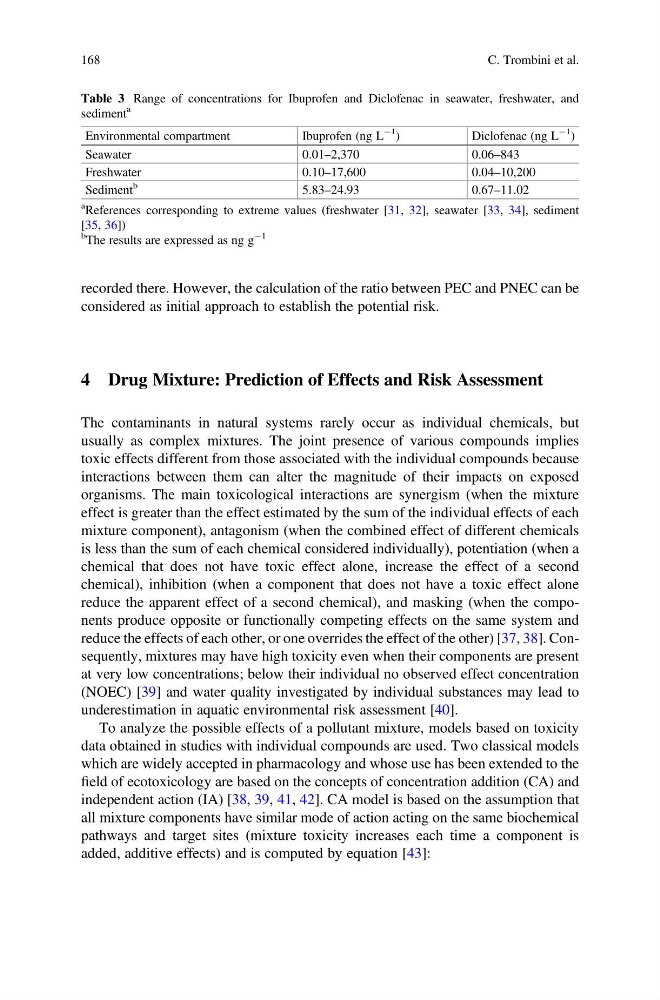
Table 3 Range of concentrations for Ibuprofen and Diclofenac in seawater, freshwater, and
sediment
a
Environmental compartment
Ibuprofen (ng L
À1
)
Diclofenac (ng L
À1
)
Seawater
0.01–2,370
0.06–843
Freshwater
0.10–17,600
0.04–10,200
Sediment
b
5.83–24.93
0.67–11.02
a References corresponding to extreme values (freshwater [31, 32], seawater [33, 34], sediment
[35, 36])
b
The results are expressed as ng g
À1
168
C. Trombini et al.
considered as initial approach to establish the potential risk.
4 Drug Mixture: Prediction of Effects and Risk Assessment
The contaminants in natural systems rarely occur as individual chemicals, but
usually as complex mixtures. The joint presence of various compounds implies
toxic effects different from those associated with the individual compounds because
interactions between them can alter the magnitude of their impacts on exposed
organisms. The main toxicological interactions are synergism (when the mixture
effect is greater than the effect estimated by the sum of the individual effects of each
mixture component), antagonism (when the combined effect of different chemicals
is less than the sum of each chemical considered individually), potentiation (when a
chemical that does not have toxic effect alone, increase the effect of a second
chemical), inhibition (when a component that does not have a toxic effect alone
reduce the apparent effect of a second chemical), and masking (when the components produce opposite or functionally competing effects on the same system and
reduce the effects of each other, or one overrides the effect of the other) [37, 38]. Consequently, mixtures may have high toxicity even when their components are present
at very low concentrations; below their individual no observed effect concentration
(NOEC) [39] and water quality investigated by individual substances may lead to
underestimation in aquatic environmental risk assessment [40].
To analyze the possible effects of a pollutant mixture, models based on toxicity
data obtained in studies with individual compounds are used. Two classical models
which are widely accepted in pharmacology and whose use has been extended to the
field of ecotoxicology are based on the concepts of concentration addition (CA) and
independent action (IA) [38, 39, 41, 42]. CA model is based on the assumption that
all mixture components have similar mode of action acting on the same biochemical
pathways and target sites (mixture toxicity increases each time a component is
added, additive effects) and is computed by equation [43]:
Table 3 Range of concentrations for Ibuprofen and Diclofenac in seawater, freshwater, and
sediment
a
Environmental compartment
Ibuprofen (ng L
À1
)
Diclofenac (ng L
À1
)
Seawater
0.01–2,370
0.06–843
Freshwater
0.10–17,600
0.04–10,200
Sediment
b
5.83–24.93
0.67–11.02
a References corresponding to extreme values (freshwater [31, 32], seawater [33, 34], sediment
[35, 36])
b
The results are expressed as ng g
À1
168
C. Trombini et al.