

Table 2 has not included the data for Paracentrotus lividus [28] with EC 50
0.01 μg L
À1 for IB. Application of the highest AF (1000) results in PNECs ranging
between 6.3 and >100 and 13.3 and 342 μg L
À1 , respectively, representing this
factor the most conservative and protective approach. With the condition that
PEC/PNEC > 1 for a compound to be environmentally safe, acceptable environmental concentrations must not exceed 100 and 342 μg L
À1 for DF and IB,
respectively.
Considering different test organisms, we can observe that there are significant
differences in the obtained LC 50 values and, hence, sensitivities of the organisms
toward the pharmaceuticals. Within the same species, susceptibility to suffer effects
of exposure to contaminants also varies, being generally the developing and earlylife stages the most vulnerable.
3 Species Sensitivity Distributions DF and IB
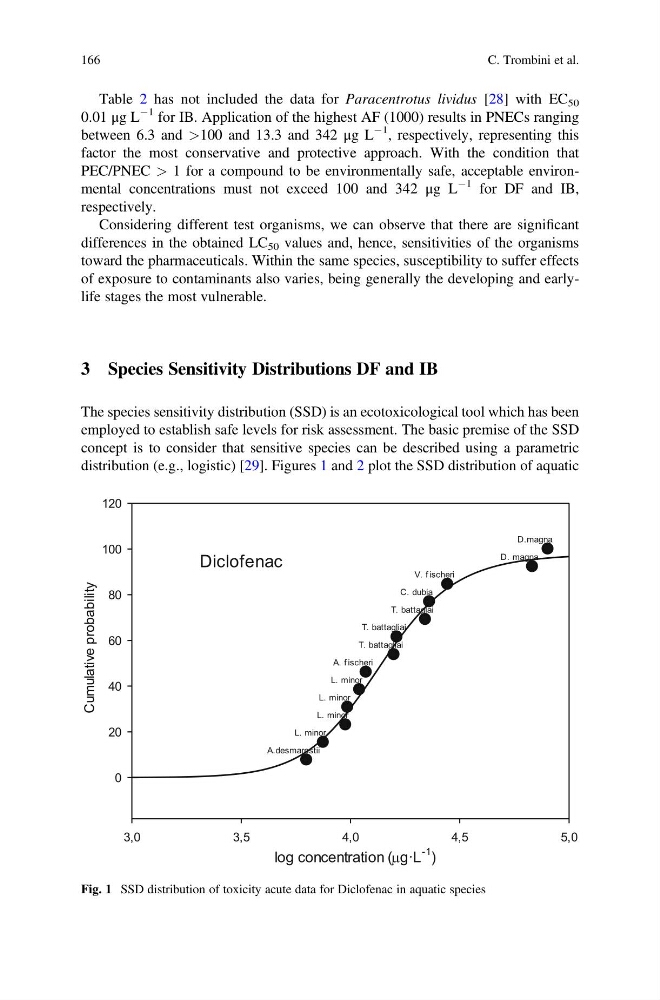
The species sensitivity distribution (SSD) is an ecotoxicological tool which has been
employed to establish safe levels for risk assessment. The basic premise of the SSD
concept is to consider that sensitive species can be described using a parametric
distribution (e.g., logistic) [29]. Figures 1 and 2 plot the SSD distribution of aquatic
Diclofenac
log concentration ( g·L
-1
)
3,0
3,5
4,0
4,5
5,0
0
20
40
60
80
100
120
A.desmarestii
L. minor
L. minor
L. minor
L. minor
A. f ischeri
T. battagliai
T. battagliai
T. battaglai
C. dubia
V. f ischeri
D. magna
D.magna
Cumulative probability
Fig. 1 SSD distribution of toxicity acute data for Diclofenac in aquatic species
166
C. Trombini et al.
0.01 μg L
À1 for IB. Application of the highest AF (1000) results in PNECs ranging
between 6.3 and >100 and 13.3 and 342 μg L
À1 , respectively, representing this
factor the most conservative and protective approach. With the condition that
PEC/PNEC > 1 for a compound to be environmentally safe, acceptable environmental concentrations must not exceed 100 and 342 μg L
À1 for DF and IB,
respectively.
Considering different test organisms, we can observe that there are significant
differences in the obtained LC 50 values and, hence, sensitivities of the organisms
toward the pharmaceuticals. Within the same species, susceptibility to suffer effects
of exposure to contaminants also varies, being generally the developing and earlylife stages the most vulnerable.
3 Species Sensitivity Distributions DF and IB
The species sensitivity distribution (SSD) is an ecotoxicological tool which has been
employed to establish safe levels for risk assessment. The basic premise of the SSD
concept is to consider that sensitive species can be described using a parametric
distribution (e.g., logistic) [29]. Figures 1 and 2 plot the SSD distribution of aquatic
Diclofenac
log concentration ( g·L
-1
)
3,0
3,5
4,0
4,5
5,0
0
20
40
60
80
100
120
A.desmarestii
L. minor
L. minor
L. minor
L. minor
A. f ischeri
T. battagliai
T. battagliai
T. battaglai
C. dubia
V. f ischeri
D. magna
D.magna
Cumulative probability
Fig. 1 SSD distribution of toxicity acute data for Diclofenac in aquatic species
166
C. Trombini et al.