

These approximations are useful for range definition of effects to be observed and to
perform an initial risk evaluation of the compound in question. In this sense, the
recent and increasing detection of pharmaceuticals in aquatic environments [5, 11]
has triggered an increase in the studies on the effects of various pharmaceuticals in
nontarget organisms [12–14] in acute exposure experiments.
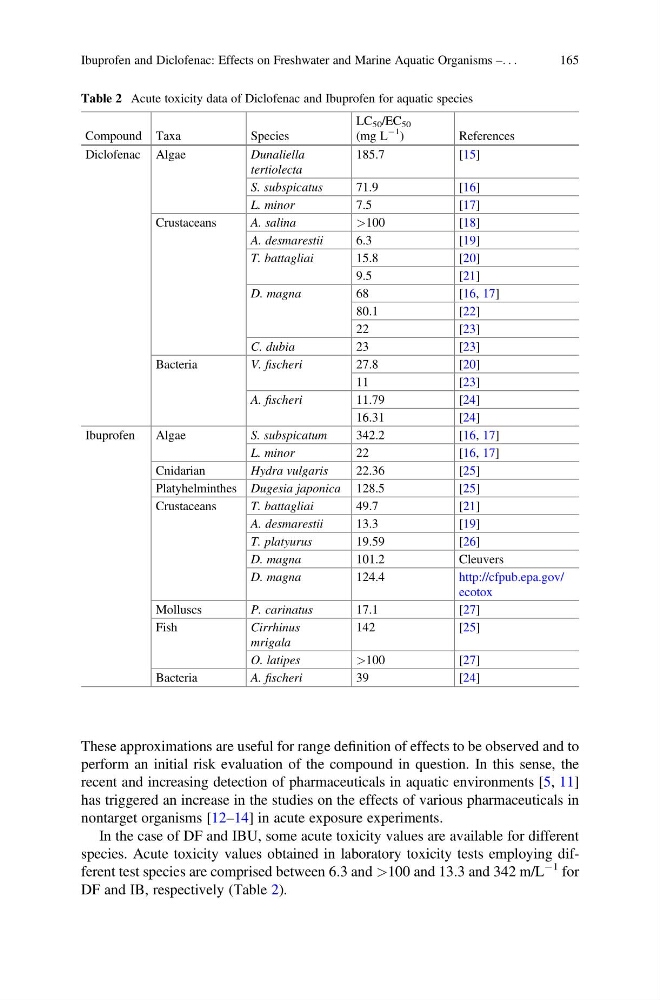
In the case of DF and IBU, some acute toxicity values are available for different
species. Acute toxicity values obtained in laboratory toxicity tests employing different test species are comprised between 6.3 and >100 and 13.3 and 342 m/L
À1 for
DF and IB, respectively (Table 2).
Table 2 Acute toxicity data of Diclofenac and Ibuprofen for aquatic species
Compound Taxa
Species
LC 50 /EC 50
(mg L
À1
)
References
Diclofenac Algae
Dunaliella
tertiolecta
185.7
[15]
S. subspicatus
71.9
[16]
L. minor
7.5
[17]
Crustaceans
A. salina
>100
[18]
A. desmarestii
6.3
[19]
T. battagliai
15.8
[20]
9.5
[21]
D. magna
68
[16, 17]
80.1
[22]
22
[23]
C. dubia
23
[23]
Bacteria
V. fischeri
27.8
[20]
11
[23]
A. fischeri
11.79
[24]
16.31
[24]
Ibuprofen
Algae
S. subspicatum
342.2
[16, 17]
L. minor
22
[16, 17]
Cnidarian
Hydra vulgaris
22.36
[25]
Platyhelminthes Dugesia japonica 128.5
[25]
Crustaceans
T. battagliai
49.7
[21]
A. desmarestii
13.3
[19]
T. platyurus
19.59
[26]
D. magna
101.2
Cleuvers
D. magna
124.4
http://cfpub.epa.gov/
ecotox
Molluscs
P. carinatus
17.1
[27]
Fish
Cirrhinus
mrigala
142
[25]
O. latipes
>100
[27]
Bacteria
A. fischeri
39
[24]
Ibuprofen and Diclofenac: Effects on Freshwater and Marine Aquatic Organisms –. . .
165
perform an initial risk evaluation of the compound in question. In this sense, the
recent and increasing detection of pharmaceuticals in aquatic environments [5, 11]
has triggered an increase in the studies on the effects of various pharmaceuticals in
nontarget organisms [12–14] in acute exposure experiments.
In the case of DF and IBU, some acute toxicity values are available for different
species. Acute toxicity values obtained in laboratory toxicity tests employing different test species are comprised between 6.3 and >100 and 13.3 and 342 m/L
À1 for
DF and IB, respectively (Table 2).
Table 2 Acute toxicity data of Diclofenac and Ibuprofen for aquatic species
Compound Taxa
Species
LC 50 /EC 50
(mg L
À1
)
References
Diclofenac Algae
Dunaliella
tertiolecta
185.7
[15]
S. subspicatus
71.9
[16]
L. minor
7.5
[17]
Crustaceans
A. salina
>100
[18]
A. desmarestii
6.3
[19]
T. battagliai
15.8
[20]
9.5
[21]
D. magna
68
[16, 17]
80.1
[22]
22
[23]
C. dubia
23
[23]
Bacteria
V. fischeri
27.8
[20]
11
[23]
A. fischeri
11.79
[24]
16.31
[24]
Ibuprofen
Algae
S. subspicatum
342.2
[16, 17]
L. minor
22
[16, 17]
Cnidarian
Hydra vulgaris
22.36
[25]
Platyhelminthes Dugesia japonica 128.5
[25]
Crustaceans
T. battagliai
49.7
[21]
A. desmarestii
13.3
[19]
T. platyurus
19.59
[26]
D. magna
101.2
Cleuvers
D. magna
124.4
http://cfpub.epa.gov/
ecotox
Molluscs
P. carinatus
17.1
[27]
Fish
Cirrhinus
mrigala
142
[25]
O. latipes
>100
[27]
Bacteria
A. fischeri
39
[24]
Ibuprofen and Diclofenac: Effects on Freshwater and Marine Aquatic Organisms –. . .
165