

single-species laboratory tests from which toxicity parameters such as LC 50 , EC 50 ,
or NOECs can be derived using generally an assessment factor (AF) approach.
PNEC ¼
NOEC or LC 50 or EC 50
AF
ð2Þ
Several different assessment factors have been proposed, depending on the nature
of the toxicity parameters derived in the laboratory study, with higher values for
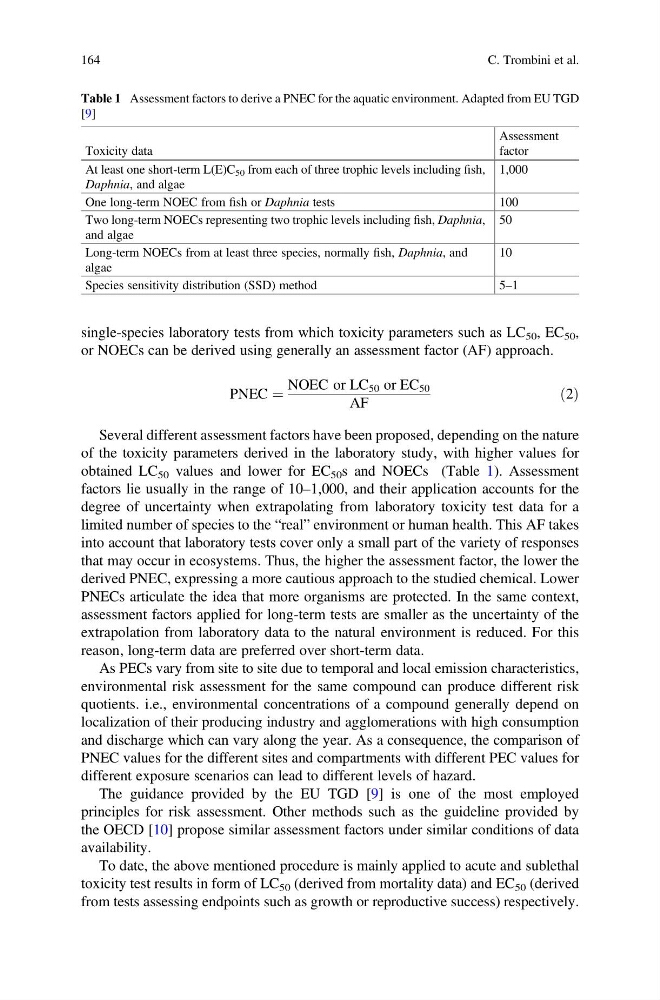
obtained LC 50 values and lower for EC 50 s and NOECs (Table 1). Assessment
factors lie usually in the range of 10–1,000, and their application accounts for the
degree of uncertainty when extrapolating from laboratory toxicity test data for a
limited number of species to the “real” environment or human health. This AF takes
into account that laboratory tests cover only a small part of the variety of responses
that may occur in ecosystems. Thus, the higher the assessment factor, the lower the
derived PNEC, expressing a more cautious approach to the studied chemical. Lower
PNECs articulate the idea that more organisms are protected. In the same context,
assessment factors applied for long-term tests are smaller as the uncertainty of the
extrapolation from laboratory data to the natural environment is reduced. For this
reason, long-term data are preferred over short-term data.
As PECs vary from site to site due to temporal and local emission characteristics,
environmental risk assessment for the same compound can produce different risk
quotients. i.e., environmental concentrations of a compound generally depend on
localization of their producing industry and agglomerations with high consumption
and discharge which can vary along the year. As a consequence, the comparison of
PNEC values for the different sites and compartments with different PEC values for
different exposure scenarios can lead to different levels of hazard.
The guidance provided by the EU TGD [9] is one of the most employed
principles for risk assessment. Other methods such as the guideline provided by
the OECD [10] propose similar assessment factors under similar conditions of data
availability.
To date, the above mentioned procedure is mainly applied to acute and sublethal
toxicity test results in form of LC 50 (derived from mortality data) and EC 50 (derived
from tests assessing endpoints such as growth or reproductive success) respectively.
Table 1 Assessment factors to derive a PNEC for the aquatic environment. Adapted from EU TGD
[9]
Toxicity data
Assessment
factor
At least one short-term L(E)C 50 from each of three trophic levels including fish,
Daphnia, and algae
1,000
One long-term NOEC from fish or Daphnia tests
100
Two long-term NOECs representing two trophic levels including fish, Daphnia,
and algae
50
Long-term NOECs from at least three species, normally fish, Daphnia, and
algae
10
Species sensitivity distribution (SSD) method
5–1
164
C. Trombini et al.
or NOECs can be derived using generally an assessment factor (AF) approach.
PNEC ¼
NOEC or LC 50 or EC 50
AF
ð2Þ
Several different assessment factors have been proposed, depending on the nature
of the toxicity parameters derived in the laboratory study, with higher values for
obtained LC 50 values and lower for EC 50 s and NOECs (Table 1). Assessment
factors lie usually in the range of 10–1,000, and their application accounts for the
degree of uncertainty when extrapolating from laboratory toxicity test data for a
limited number of species to the “real” environment or human health. This AF takes
into account that laboratory tests cover only a small part of the variety of responses
that may occur in ecosystems. Thus, the higher the assessment factor, the lower the
derived PNEC, expressing a more cautious approach to the studied chemical. Lower
PNECs articulate the idea that more organisms are protected. In the same context,
assessment factors applied for long-term tests are smaller as the uncertainty of the
extrapolation from laboratory data to the natural environment is reduced. For this
reason, long-term data are preferred over short-term data.
As PECs vary from site to site due to temporal and local emission characteristics,
environmental risk assessment for the same compound can produce different risk
quotients. i.e., environmental concentrations of a compound generally depend on
localization of their producing industry and agglomerations with high consumption
and discharge which can vary along the year. As a consequence, the comparison of
PNEC values for the different sites and compartments with different PEC values for
different exposure scenarios can lead to different levels of hazard.
The guidance provided by the EU TGD [9] is one of the most employed
principles for risk assessment. Other methods such as the guideline provided by
the OECD [10] propose similar assessment factors under similar conditions of data
availability.
To date, the above mentioned procedure is mainly applied to acute and sublethal
toxicity test results in form of LC 50 (derived from mortality data) and EC 50 (derived
from tests assessing endpoints such as growth or reproductive success) respectively.
Table 1 Assessment factors to derive a PNEC for the aquatic environment. Adapted from EU TGD
[9]
Toxicity data
Assessment
factor
At least one short-term L(E)C 50 from each of three trophic levels including fish,
Daphnia, and algae
1,000
One long-term NOEC from fish or Daphnia tests
100
Two long-term NOECs representing two trophic levels including fish, Daphnia,
and algae
50
Long-term NOECs from at least three species, normally fish, Daphnia, and
algae
10
Species sensitivity distribution (SSD) method
5–1
164
C. Trombini et al.