

work by inhibiting the activity of cyclooxygenase enzymes (COX-1 and/or COX-2). In
cells, these enzymes are involved in the synthesis of key biological mediators, namely,
prostaglandins, which are involved in inflammation processes, and thromboxanes,
which are involved in blood clotting. Side effects in humans depend on the specific
drug but largely include an increased risk of gastrointestinal ulcers and bleeds, heart
attack, and kidney disease.
In the case of NSAIDS, the growing use and abuse mainly due to the fact that no
prescription is required for their purchase in combination with their limited removal
during wastewater treatment has dramatically increased their concentration in receiving waters and has triggered scientific research into the effects that exposure to
environmentally relevant concentrations may cause in nontarget organisms in order
to evaluate the risk that their presence may have on populations and ecosystems.
2 Risk Assessment
Environmental risk assessment comprises a series of steps in order to identify
acceptable or unacceptable levels of environmentally present chemical substances
to human health and the environment. These steps include:
(a) Identification of a substance able to cause adverse effects (hazard identification)
(b) Estimation of the relationship between the dose and the incidence and severity of
an effect (dose-response assessment)
(c) Assessment of the levels to which humans or ecosystems are exposed to the
compound to
(d) identify if there is a risk or not
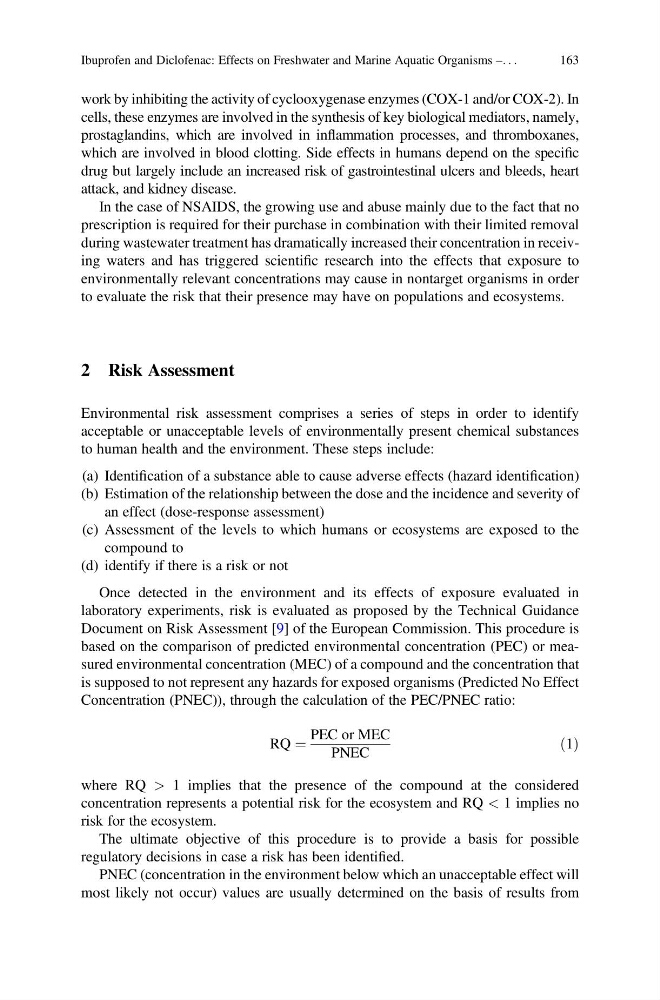
Once detected in the environment and its effects of exposure evaluated in
laboratory experiments, risk is evaluated as proposed by the Technical Guidance
Document on Risk Assessment [9] of the European Commission. This procedure is
based on the comparison of predicted environmental concentration (PEC) or measured environmental concentration (MEC) of a compound and the concentration that
is supposed to not represent any hazards for exposed organisms (Predicted No Effect
Concentration (PNEC)), through the calculation of the PEC/PNEC ratio:
RQ ¼
PEC or MEC
PNEC
ð1Þ
where RQ > 1 implies that the presence of the compound at the considered
concentration represents a potential risk for the ecosystem and RQ < 1 implies no
risk for the ecosystem.
The ultimate objective of this procedure is to provide a basis for possible
regulatory decisions in case a risk has been identified.
PNEC (concentration in the environment below which an unacceptable effect will
most likely not occur) values are usually determined on the basis of results from
Ibuprofen and Diclofenac: Effects on Freshwater and Marine Aquatic Organisms –. . .
163
cells, these enzymes are involved in the synthesis of key biological mediators, namely,
prostaglandins, which are involved in inflammation processes, and thromboxanes,
which are involved in blood clotting. Side effects in humans depend on the specific
drug but largely include an increased risk of gastrointestinal ulcers and bleeds, heart
attack, and kidney disease.
In the case of NSAIDS, the growing use and abuse mainly due to the fact that no
prescription is required for their purchase in combination with their limited removal
during wastewater treatment has dramatically increased their concentration in receiving waters and has triggered scientific research into the effects that exposure to
environmentally relevant concentrations may cause in nontarget organisms in order
to evaluate the risk that their presence may have on populations and ecosystems.
2 Risk Assessment
Environmental risk assessment comprises a series of steps in order to identify
acceptable or unacceptable levels of environmentally present chemical substances
to human health and the environment. These steps include:
(a) Identification of a substance able to cause adverse effects (hazard identification)
(b) Estimation of the relationship between the dose and the incidence and severity of
an effect (dose-response assessment)
(c) Assessment of the levels to which humans or ecosystems are exposed to the
compound to
(d) identify if there is a risk or not
Once detected in the environment and its effects of exposure evaluated in
laboratory experiments, risk is evaluated as proposed by the Technical Guidance
Document on Risk Assessment [9] of the European Commission. This procedure is
based on the comparison of predicted environmental concentration (PEC) or measured environmental concentration (MEC) of a compound and the concentration that
is supposed to not represent any hazards for exposed organisms (Predicted No Effect
Concentration (PNEC)), through the calculation of the PEC/PNEC ratio:
RQ ¼
PEC or MEC
PNEC
ð1Þ
where RQ > 1 implies that the presence of the compound at the considered
concentration represents a potential risk for the ecosystem and RQ < 1 implies no
risk for the ecosystem.
The ultimate objective of this procedure is to provide a basis for possible
regulatory decisions in case a risk has been identified.
PNEC (concentration in the environment below which an unacceptable effect will
most likely not occur) values are usually determined on the basis of results from
Ibuprofen and Diclofenac: Effects on Freshwater and Marine Aquatic Organisms –. . .
163