

2.5 Aerosols in Mining Environments
51
the most common. When it is heated to 867 °C, it is transformed into tridymite and
into cristobalite at 1470 °C. Effects on health depend on the type of polymorph.
Regarding silica, OSHA recommends a PEL-TWA of 0.05 mg m
−3 for Respirable
Crystalline Silica (RCS), while the ACGIH recommends a TLV-TWA of 0.025 mg
m
−3 . EU Directive 2017/2398 indicates a BOELV of 0.1 mg m
−3 TWA. Silica has
been classified as carcinogenic to humans by the International Agency for Research
on Cancer (IARC).
In Spain, the daily exposure limits (Spanish: Valores Límites Ambientales de
Exposición Diaria, VLA-ED) in the breathable fraction are 0.05 mg m
−3 for quartz
and 0.05 mg m
−3 for cristobalite (INSHT 2018). In addition, the free silica contained
in the breathable dust fraction must not be higher than 0.1 mg m
−3 , and the respirable
dust fraction must not exceed 3 mg m
−3 (ITC2585/2007).
2.5.1 Measures Against Dust
Although in the past it was common to use dry dust collection systems, the apparatuses
used were often affected by the hardness of the mining environment. Moreover, they
required considerable maintenance, and they were also impractical due to their large
dimensions. Nowadays, airborne dust prevention and suppression usually involve
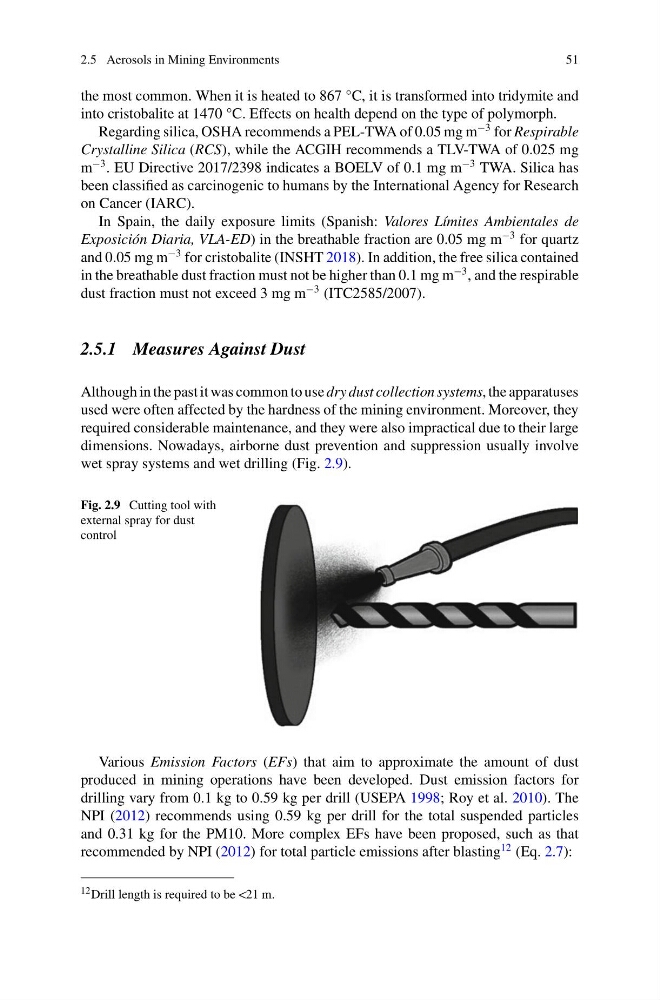
wet spray systems and wet drilling (Fig. 2.9).
Fig. 2.9 Cutting tool with
external spray for dust
control
Various Emission Factors (EFs) that aim to approximate the amount of dust
produced in mining operations have been developed. Dust emission factors for
drilling vary from 0.1 kg to 0.59 kg per drill (USEPA 1998; Roy et al. 2010). The
NPI (2012) recommends using 0.59 kg per drill for the total suspended particles
and 0.31 kg for the PM10. More complex EFs have been proposed, such as that
recommended by NPI (2012) for total particle emissions after blasting
12 (Eq. 2.7):
12 Drill length is required to be <21 m.
51
the most common. When it is heated to 867 °C, it is transformed into tridymite and
into cristobalite at 1470 °C. Effects on health depend on the type of polymorph.
Regarding silica, OSHA recommends a PEL-TWA of 0.05 mg m
−3 for Respirable
Crystalline Silica (RCS), while the ACGIH recommends a TLV-TWA of 0.025 mg
m
−3 . EU Directive 2017/2398 indicates a BOELV of 0.1 mg m
−3 TWA. Silica has
been classified as carcinogenic to humans by the International Agency for Research
on Cancer (IARC).
In Spain, the daily exposure limits (Spanish: Valores Límites Ambientales de
Exposición Diaria, VLA-ED) in the breathable fraction are 0.05 mg m
−3 for quartz
and 0.05 mg m
−3 for cristobalite (INSHT 2018). In addition, the free silica contained
in the breathable dust fraction must not be higher than 0.1 mg m
−3 , and the respirable
dust fraction must not exceed 3 mg m
−3 (ITC2585/2007).
2.5.1 Measures Against Dust
Although in the past it was common to use dry dust collection systems, the apparatuses
used were often affected by the hardness of the mining environment. Moreover, they
required considerable maintenance, and they were also impractical due to their large
dimensions. Nowadays, airborne dust prevention and suppression usually involve
wet spray systems and wet drilling (Fig. 2.9).
Fig. 2.9 Cutting tool with
external spray for dust
control
Various Emission Factors (EFs) that aim to approximate the amount of dust
produced in mining operations have been developed. Dust emission factors for
drilling vary from 0.1 kg to 0.59 kg per drill (USEPA 1998; Roy et al. 2010). The
NPI (2012) recommends using 0.59 kg per drill for the total suspended particles
and 0.31 kg for the PM10. More complex EFs have been proposed, such as that
recommended by NPI (2012) for total particle emissions after blasting
12 (Eq. 2.7):
12 Drill length is required to be <21 m.