

52
2 Environmental Conditions in the Mine
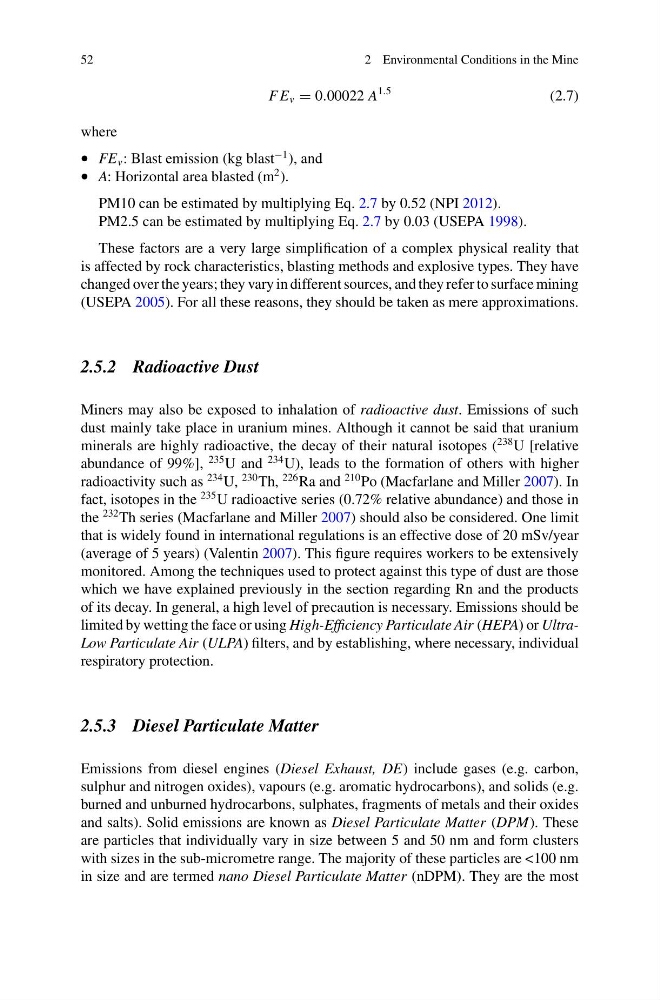
F E v = 0.00022 A
1.5
(2.7)
where
• FE v : Blast emission (kg blast
−1 ), and
• A: Horizontal area blasted (m
2 ).
PM10 can be estimated by multiplying Eq. 2.7 by 0.52 (NPI 2012).
PM2.5 can be estimated by multiplying Eq. 2.7 by 0.03 (USEPA 1998).
These factors are a very large simplification of a complex physical reality that
is affected by rock characteristics, blasting methods and explosive types. They have
changed over the years; they vary in different sources, and they refer to surface mining
(USEPA 2005). For all these reasons, they should be taken as mere approximations.
2.5.2 Radioactive Dust
Miners may also be exposed to inhalation of radioactive dust. Emissions of such
dust mainly take place in uranium mines. Although it cannot be said that uranium
minerals are highly radioactive, the decay of their natural isotopes (
238 U [relative
abundance of 99%],
235 U and
234 U), leads to the formation of others with higher
radioactivity such as
234 U,
230 Th,
226 Ra and
210 Po (Macfarlane and Miller 2007). In
fact, isotopes in the
235 U radioactive series (0.72% relative abundance) and those in
the
232 Th series (Macfarlane and Miller 2007) should also be considered. One limit
that is widely found in international regulations is an effective dose of 20 mSv/year
(average of 5 years) (Valentin 2007). This figure requires workers to be extensively
monitored. Among the techniques used to protect against this type of dust are those
which we have explained previously in the section regarding Rn and the products
of its decay. In general, a high level of precaution is necessary. Emissions should be
limited by wetting the face or using High-Efficiency Particulate Air (HEPA) or UltraLow Particulate Air (ULPA) filters, and by establishing, where necessary, individual
respiratory protection.
2.5.3 Diesel Particulate Matter
Emissions from diesel engines (Diesel Exhaust, DE) include gases (e.g. carbon,
sulphur and nitrogen oxides), vapours (e.g. aromatic hydrocarbons), and solids (e.g.
burned and unburned hydrocarbons, sulphates, fragments of metals and their oxides
and salts). Solid emissions are known as Diesel Particulate Matter (DPM). These
are particles that individually vary in size between 5 and 50 nm and form clusters
with sizes in the sub-micrometre range. The majority of these particles are <100 nm
in size and are termed nano Diesel Particulate Matter (nDPM). They are the most
2 Environmental Conditions in the Mine
F E v = 0.00022 A
1.5
(2.7)
where
• FE v : Blast emission (kg blast
−1 ), and
• A: Horizontal area blasted (m
2 ).
PM10 can be estimated by multiplying Eq. 2.7 by 0.52 (NPI 2012).
PM2.5 can be estimated by multiplying Eq. 2.7 by 0.03 (USEPA 1998).
These factors are a very large simplification of a complex physical reality that
is affected by rock characteristics, blasting methods and explosive types. They have
changed over the years; they vary in different sources, and they refer to surface mining
(USEPA 2005). For all these reasons, they should be taken as mere approximations.
2.5.2 Radioactive Dust
Miners may also be exposed to inhalation of radioactive dust. Emissions of such
dust mainly take place in uranium mines. Although it cannot be said that uranium
minerals are highly radioactive, the decay of their natural isotopes (
238 U [relative
abundance of 99%],
235 U and
234 U), leads to the formation of others with higher
radioactivity such as
234 U,
230 Th,
226 Ra and
210 Po (Macfarlane and Miller 2007). In
fact, isotopes in the
235 U radioactive series (0.72% relative abundance) and those in
the
232 Th series (Macfarlane and Miller 2007) should also be considered. One limit
that is widely found in international regulations is an effective dose of 20 mSv/year
(average of 5 years) (Valentin 2007). This figure requires workers to be extensively
monitored. Among the techniques used to protect against this type of dust are those
which we have explained previously in the section regarding Rn and the products
of its decay. In general, a high level of precaution is necessary. Emissions should be
limited by wetting the face or using High-Efficiency Particulate Air (HEPA) or UltraLow Particulate Air (ULPA) filters, and by establishing, where necessary, individual
respiratory protection.
2.5.3 Diesel Particulate Matter
Emissions from diesel engines (Diesel Exhaust, DE) include gases (e.g. carbon,
sulphur and nitrogen oxides), vapours (e.g. aromatic hydrocarbons), and solids (e.g.
burned and unburned hydrocarbons, sulphates, fragments of metals and their oxides
and salts). Solid emissions are known as Diesel Particulate Matter (DPM). These
are particles that individually vary in size between 5 and 50 nm and form clusters
with sizes in the sub-micrometre range. The majority of these particles are <100 nm
in size and are termed nano Diesel Particulate Matter (nDPM). They are the most