

2.2 Gases and Hygiene
37
• Short-Term Exposure Level (TLV-STEL): Exposure at or above this level should
not last more than fifteen minutes; such exposure should not be repeated more
than four times per day, and there should be a break of at least an hour between
such exposures.
Since the 1970s, the Occupational Safety and Health Administration (OSHA)
of the United States has set Permissible Exposure Limits (PEL); there is a legal
requirement for workplaces to comply with these. The PEL values are divided into
two categories:
(a) Ceiling values (PEL-C), and
(b) Average values for eight-hour workday (PEL-TWA).
These standards are contained in Sect. 1910.1000 of the Code of Federal Regulations
(CFR). The OSHA recommends the most restrictive values set by the ACGIH, though
this is not considered to be a legal requirement. Another important reference is the
Immediately Dangerous for Life or Health (IDLH) values offered by the National
Institute for Occupational Safety and Health (NIOSH).
The European Union’s equivalents to OSHA’s mandatory values are the Binding
Occupational Exposure Limit Value (BOELV ), which must be adopted directly or
assumed in a more restrictive manner by EU Member States (Council Directive
98/24/EC). In addition, EU Directive 2017/164 establishes Indicative Occupational
Exposure Limit Values (IOELV). Member States are obliged to establish national
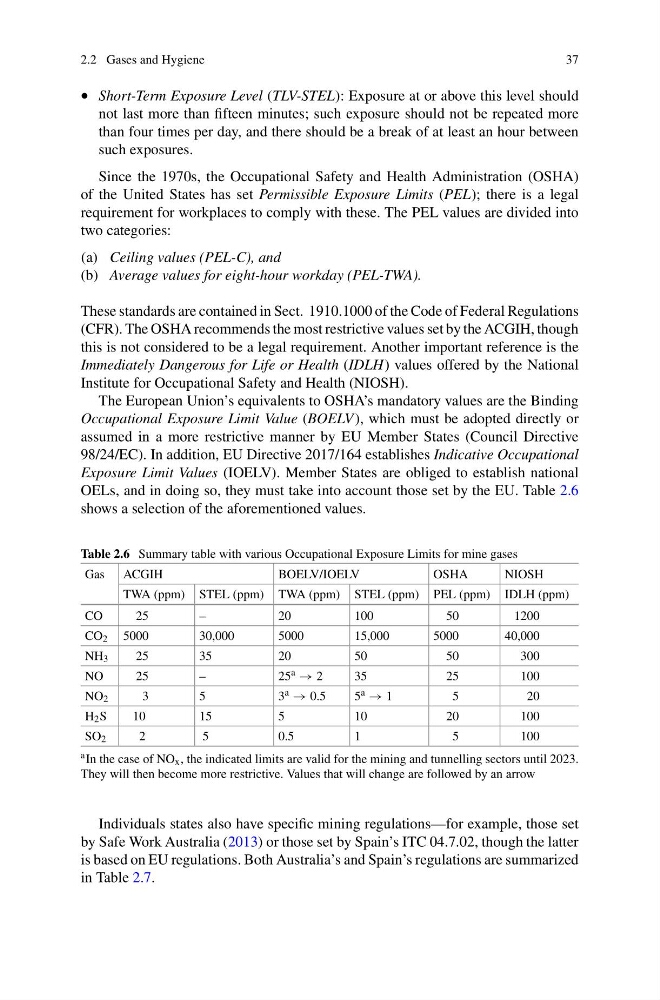
OELs, and in doing so, they must take into account those set by the EU. Table 2.6
shows a selection of the aforementioned values.
Table 2.6 Summary table with various Occupational Exposure Limits for mine gases
Gas ACGIH
BOELV/IOELV
OSHA
NIOSH
TWA (ppm) STEL (ppm) TWA (ppm) STEL (ppm) PEL (ppm) IDLH (ppm)
CO
25
–
20
100
50
1200
CO 2 5000
30,000
5000
15,000
5000
40,000
NH 3
25
35
20
50
50
300
NO
25
–
25 a → 2
35
25
100
NO 2
3
5
3 a → 0.5
5 a → 1
5
20
H 2 S
10
15
5
10
20
100
SO 2
2
5
0.5
1
5
100
a In the case of NO x , the indicated limits are valid for the mining and tunnelling sectors until 2023.
They will then become more restrictive. Values that will change are followed by an arrow
Individuals states also have specific mining regulations—for example, those set
by Safe Work Australia (2013) or those set by Spain’s ITC 04.7.02, though the latter
is based on EU regulations. Both Australia’s and Spain’s regulations are summarized
in Table 2.7.
37
• Short-Term Exposure Level (TLV-STEL): Exposure at or above this level should
not last more than fifteen minutes; such exposure should not be repeated more
than four times per day, and there should be a break of at least an hour between
such exposures.
Since the 1970s, the Occupational Safety and Health Administration (OSHA)
of the United States has set Permissible Exposure Limits (PEL); there is a legal
requirement for workplaces to comply with these. The PEL values are divided into
two categories:
(a) Ceiling values (PEL-C), and
(b) Average values for eight-hour workday (PEL-TWA).
These standards are contained in Sect. 1910.1000 of the Code of Federal Regulations
(CFR). The OSHA recommends the most restrictive values set by the ACGIH, though
this is not considered to be a legal requirement. Another important reference is the
Immediately Dangerous for Life or Health (IDLH) values offered by the National
Institute for Occupational Safety and Health (NIOSH).
The European Union’s equivalents to OSHA’s mandatory values are the Binding
Occupational Exposure Limit Value (BOELV ), which must be adopted directly or
assumed in a more restrictive manner by EU Member States (Council Directive
98/24/EC). In addition, EU Directive 2017/164 establishes Indicative Occupational
Exposure Limit Values (IOELV). Member States are obliged to establish national
OELs, and in doing so, they must take into account those set by the EU. Table 2.6
shows a selection of the aforementioned values.
Table 2.6 Summary table with various Occupational Exposure Limits for mine gases
Gas ACGIH
BOELV/IOELV
OSHA
NIOSH
TWA (ppm) STEL (ppm) TWA (ppm) STEL (ppm) PEL (ppm) IDLH (ppm)
CO
25
–
20
100
50
1200
CO 2 5000
30,000
5000
15,000
5000
40,000
NH 3
25
35
20
50
50
300
NO
25
–
25 a → 2
35
25
100
NO 2
3
5
3 a → 0.5
5 a → 1
5
20
H 2 S
10
15
5
10
20
100
SO 2
2
5
0.5
1
5
100
a In the case of NO x , the indicated limits are valid for the mining and tunnelling sectors until 2023.
They will then become more restrictive. Values that will change are followed by an arrow
Individuals states also have specific mining regulations—for example, those set
by Safe Work Australia (2013) or those set by Spain’s ITC 04.7.02, though the latter
is based on EU regulations. Both Australia’s and Spain’s regulations are summarized
in Table 2.7.