

8.14 Discrete Solution (Step by Step Method)
345
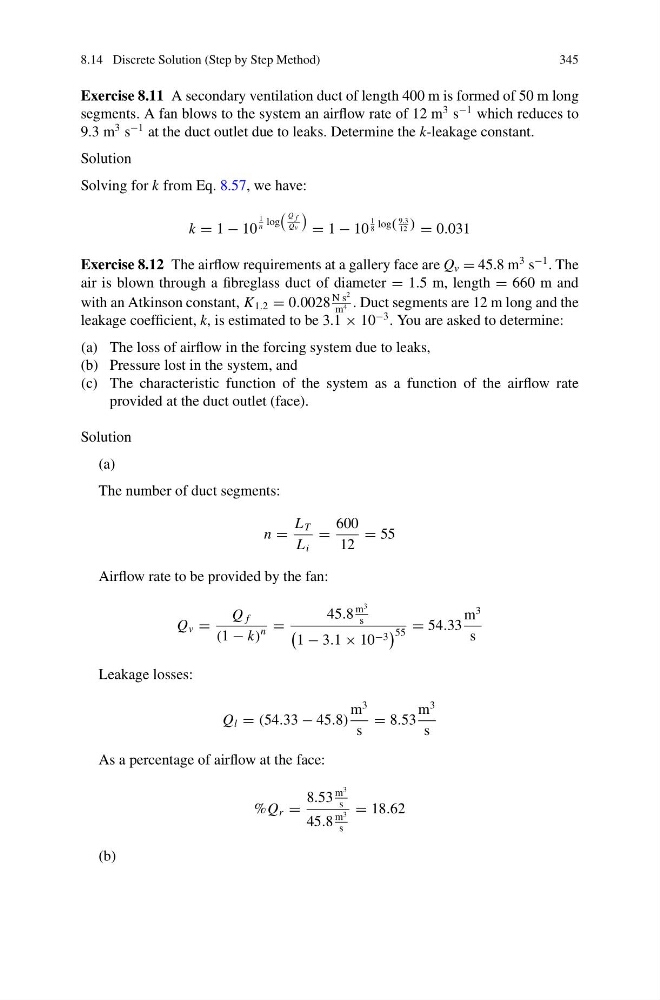
Exercise 8.11 A secondary ventilation duct of length 400 m is formed of 50 m long
segments. A fan blows to the system an airflow rate of 12 m
3 s
−1 which reduces to
9.3 m
3 s
−1 at the duct outlet due to leaks. Determine the k-leakage constant.
Solution
Solving for k from Eq. 8.57, we have:
k = 1 − 10
1
n log
Q f
Qv
= 1 − 10
1
8 log(
9.3
12 ) = 0.031
Exercise 8.12 The airflow requirements at a gallery face are Q v = 45.8 m
3 s
−1 . The
air is blown through a fibreglass duct of diameter = 1.5 m, length = 660 m and
with an Atkinson constant, K 1.2 = 0.0028
N s
2
m 4 . Duct segments are 12 m long and the
leakage coefficient, k, is estimated to be 3.1 × 10
−3 . You are asked to determine:
(a) The loss of airflow in the forcing system due to leaks,
(b) Pressure lost in the system, and
(c) The characteristic function of the system as a function of the airflow rate
provided at the duct outlet (face).
Solution
(a)
The number of duct segments:
n =
L T
L i
=
600
12
= 55
Airflow rate to be provided by the fan:
Q v =
Q f
(1 − k)
n =
45.8
m
3
s
1 − 3.1 × 10 −3
55 = 54.33
m
3
s
Leakage losses:
Q l = (54.33 − 45.8)
m
3
s
= 8.53
m
3
s
As a percentage of airflow at the face:
%Q r =
8.53
m
3
s
45.8
m 3
s
= 18.62
(b)
345
Exercise 8.11 A secondary ventilation duct of length 400 m is formed of 50 m long
segments. A fan blows to the system an airflow rate of 12 m
3 s
−1 which reduces to
9.3 m
3 s
−1 at the duct outlet due to leaks. Determine the k-leakage constant.
Solution
Solving for k from Eq. 8.57, we have:
k = 1 − 10
1
n log
Q f
Qv
= 1 − 10
1
8 log(
9.3
12 ) = 0.031
Exercise 8.12 The airflow requirements at a gallery face are Q v = 45.8 m
3 s
−1 . The
air is blown through a fibreglass duct of diameter = 1.5 m, length = 660 m and
with an Atkinson constant, K 1.2 = 0.0028
N s
2
m 4 . Duct segments are 12 m long and the
leakage coefficient, k, is estimated to be 3.1 × 10
−3 . You are asked to determine:
(a) The loss of airflow in the forcing system due to leaks,
(b) Pressure lost in the system, and
(c) The characteristic function of the system as a function of the airflow rate
provided at the duct outlet (face).
Solution
(a)
The number of duct segments:
n =
L T
L i
=
600
12
= 55
Airflow rate to be provided by the fan:
Q v =
Q f
(1 − k)
n =
45.8
m
3
s
1 − 3.1 × 10 −3
55 = 54.33
m
3
s
Leakage losses:
Q l = (54.33 − 45.8)
m
3
s
= 8.53
m
3
s
As a percentage of airflow at the face:
%Q r =
8.53
m
3
s
45.8
m 3
s
= 18.62
(b)