

344
8 Secondary Ventilation
(b)
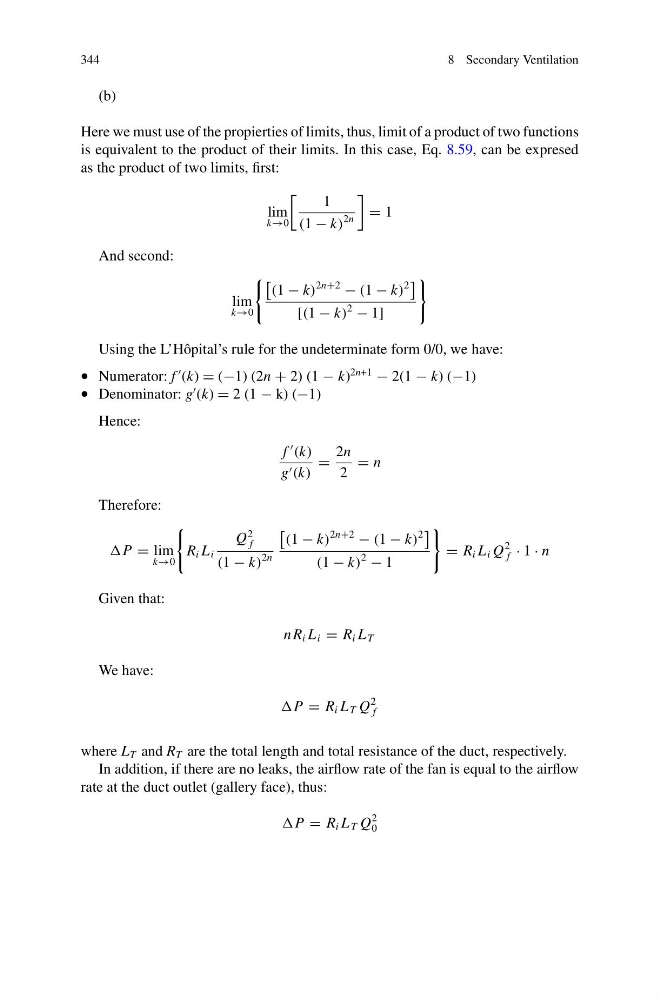
Here we must use of the propierties of limits, thus, limit of a product of two functions
is equivalent to the product of their limits. In this case, Eq. 8.59, can be expresed
as the product of two limits, first:
lim
k→0
1
(1 − k)
2n
= 1
And second:
lim
k→0
(1 − k)
2n+2
− (1 − k)
2
[(1 − k)
2
− 1]
Using the L’Hôpital’s rule for the undeterminate form 0/0, we have:
• Numerator: f
(k) = (−1) (2n + 2) (1 − k)
2n+1
− 2(1 − k) (−1)
• Denominator: g
(k) = 2 (1 − k) (−1)
Hence:
f
(k)
g (k)
=
2n
2
= n
Therefore:
P = lim
k→0
R i L i
Q
2
f
(1 − k)
2n
(1 − k)
2n+2
− (1 − k)
2
(1 − k)
2
− 1
= R i L i Q
2
f · 1 · n
Given that:
n R i L i = R i L T
We have:
P = R i L T Q
2
f
where L T and R T are the total length and total resistance of the duct, respectively.
In addition, if there are no leaks, the airflow rate of the fan is equal to the airflow
rate at the duct outlet (gallery face), thus:
P = R i L T Q
2
0
8 Secondary Ventilation
(b)
Here we must use of the propierties of limits, thus, limit of a product of two functions
is equivalent to the product of their limits. In this case, Eq. 8.59, can be expresed
as the product of two limits, first:
lim
k→0
1
(1 − k)
2n
= 1
And second:
lim
k→0
(1 − k)
2n+2
− (1 − k)
2
[(1 − k)
2
− 1]
Using the L’Hôpital’s rule for the undeterminate form 0/0, we have:
• Numerator: f
(k) = (−1) (2n + 2) (1 − k)
2n+1
− 2(1 − k) (−1)
• Denominator: g
(k) = 2 (1 − k) (−1)
Hence:
f
(k)
g (k)
=
2n
2
= n
Therefore:
P = lim
k→0
R i L i
Q
2
f
(1 − k)
2n
(1 − k)
2n+2
− (1 − k)
2
(1 − k)
2
− 1
= R i L i Q
2
f · 1 · n
Given that:
n R i L i = R i L T
We have:
P = R i L T Q
2
f
where L T and R T are the total length and total resistance of the duct, respectively.
In addition, if there are no leaks, the airflow rate of the fan is equal to the airflow
rate at the duct outlet (gallery face), thus:
P = R i L T Q
2
0