

332
8 Secondary Ventilation
8.13.3 Special Solution for Turbulent Conditions
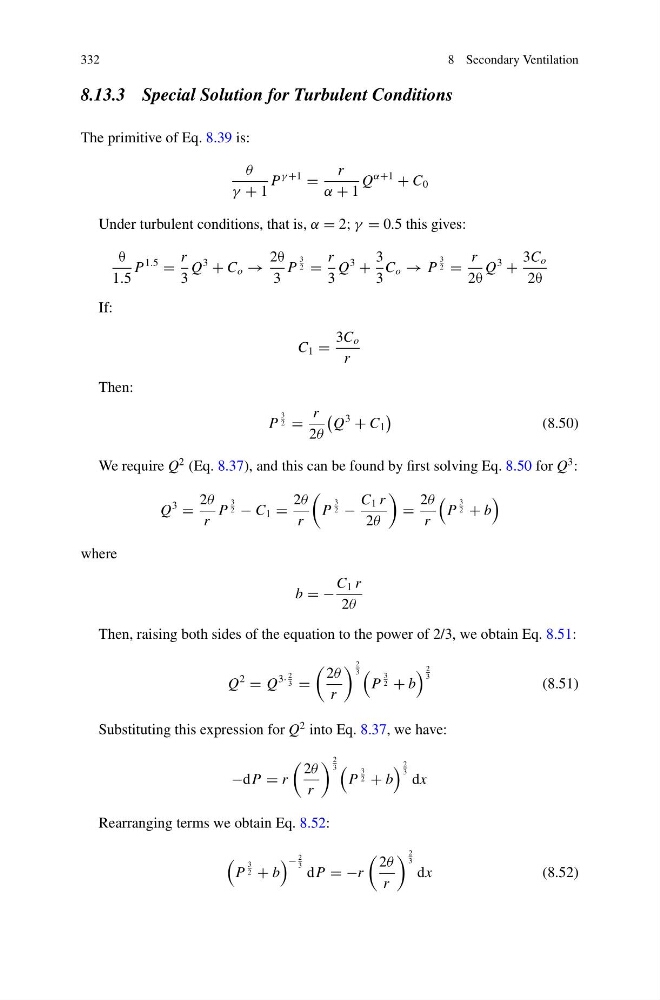
The primitive of Eq. 8.39 is:
θ
γ + 1
P
γ +1
=
r
α + 1
Q
α+1
+ C 0
Under turbulent conditions, that is, α = 2; γ = 0.5 this gives:
θ
1.5
P
1.5
=
r
3
Q
3
+ C o →
2θ
3
P
3
2 =
r
3
Q
3
+
3
3
C o → P
3
2 =
r
2θ
Q
3
+
3C o
2θ
If:
C 1 =
3C o
r
Then:
P
3
2 =
r
2θ
Q
3
+ C 1
(8.50)
We require Q
2 (Eq. 8.37), and this can be found by first solving Eq. 8.50 for Q
3 :
Q
3
=
2θ
r
P
3
2 − C 1 =
2θ
r
P
3
2 −
C 1 r
2θ
=
2θ
r
P
3
2 + b
where
b = −
C 1 r
2θ
Then, raising both sides of the equation to the power of 2/3, we obtain Eq. 8.51:
Q
2
= Q
3·
2
3 =
2θ
r
2
3
P
3
2 + b
2
3
(8.51)
Substituting this expression for Q
2 into Eq. 8.37, we have:
−dP = r
2θ
r
2
3
P
3
2 + b
2
3 dx
Rearranging terms we obtain Eq. 8.52:
P
3
2 + b
−
2
3 dP = −r
2θ
r
2
3
dx
(8.52)
8 Secondary Ventilation
8.13.3 Special Solution for Turbulent Conditions
The primitive of Eq. 8.39 is:
θ
γ + 1
P
γ +1
=
r
α + 1
Q
α+1
+ C 0
Under turbulent conditions, that is, α = 2; γ = 0.5 this gives:
θ
1.5
P
1.5
=
r
3
Q
3
+ C o →
2θ
3
P
3
2 =
r
3
Q
3
+
3
3
C o → P
3
2 =
r
2θ
Q
3
+
3C o
2θ
If:
C 1 =
3C o
r
Then:
P
3
2 =
r
2θ
Q
3
+ C 1
(8.50)
We require Q
2 (Eq. 8.37), and this can be found by first solving Eq. 8.50 for Q
3 :
Q
3
=
2θ
r
P
3
2 − C 1 =
2θ
r
P
3
2 −
C 1 r
2θ
=
2θ
r
P
3
2 + b
where
b = −
C 1 r
2θ
Then, raising both sides of the equation to the power of 2/3, we obtain Eq. 8.51:
Q
2
= Q
3·
2
3 =
2θ
r
2
3
P
3
2 + b
2
3
(8.51)
Substituting this expression for Q
2 into Eq. 8.37, we have:
−dP = r
2θ
r
2
3
P
3
2 + b
2
3 dx
Rearranging terms we obtain Eq. 8.52:
P
3
2 + b
−
2
3 dP = −r
2θ
r
2
3
dx
(8.52)