

8.13 Calculating Losses Along a Duct Using the Integral Method
333
Whose integral form is Eq. 8.53:
P
3
2 + b
−
2
3 dP = −r
2θ
r
2
3
dx
(8.53)
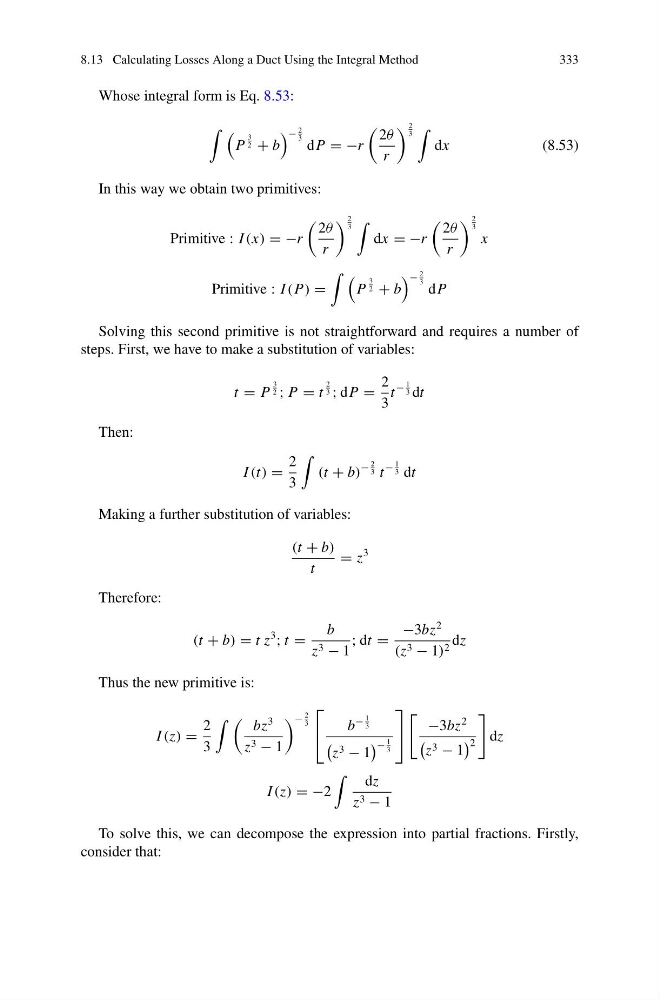
In this way we obtain two primitives:
Primitive : I (x) = −r
2θ
r
2
3
dx = −r
2θ
r
2
3
x
Primitive : I (P) =
P
3
2 + b
−
2
3 dP
Solving this second primitive is not straightforward and requires a number of
steps. First, we have to make a substitution of variables:
t = P
3
2 ; P = t
2
3 ; dP =
2
3
t
−
1
3 dt
Then:
I (t) =
2
3
(t + b)
−
2
3 t
−
1
3 dt
Making a further substitution of variables:
(t + b)
t
= z
3
Therefore:
(t + b) = t z
3
; t =
b
z 3 − 1
; dt =
−3bz
2
(z 3 − 1) 2 dz
Thus the new primitive is:
I (z) =
2
3
bz
3
z 3 − 1
−
2
3
⎡
⎣
b
−
1
3
z 3 − 1
−
1
3
⎤
⎦
−3bz
2
z 3 − 1
2
dz
I (z) = −2
dz
z 3 − 1
To solve this, we can decompose the expression into partial fractions. Firstly,
consider that:
333
Whose integral form is Eq. 8.53:
P
3
2 + b
−
2
3 dP = −r
2θ
r
2
3
dx
(8.53)
In this way we obtain two primitives:
Primitive : I (x) = −r
2θ
r
2
3
dx = −r
2θ
r
2
3
x
Primitive : I (P) =
P
3
2 + b
−
2
3 dP
Solving this second primitive is not straightforward and requires a number of
steps. First, we have to make a substitution of variables:
t = P
3
2 ; P = t
2
3 ; dP =
2
3
t
−
1
3 dt
Then:
I (t) =
2
3
(t + b)
−
2
3 t
−
1
3 dt
Making a further substitution of variables:
(t + b)
t
= z
3
Therefore:
(t + b) = t z
3
; t =
b
z 3 − 1
; dt =
−3bz
2
(z 3 − 1) 2 dz
Thus the new primitive is:
I (z) =
2
3
bz
3
z 3 − 1
−
2
3
⎡
⎣
b
−
1
3
z 3 − 1
−
1
3
⎤
⎦
−3bz
2
z 3 − 1
2
dz
I (z) = −2
dz
z 3 − 1
To solve this, we can decompose the expression into partial fractions. Firstly,
consider that: