

8.13 Calculating Losses Along a Duct Using the Integral Method
331
Solution
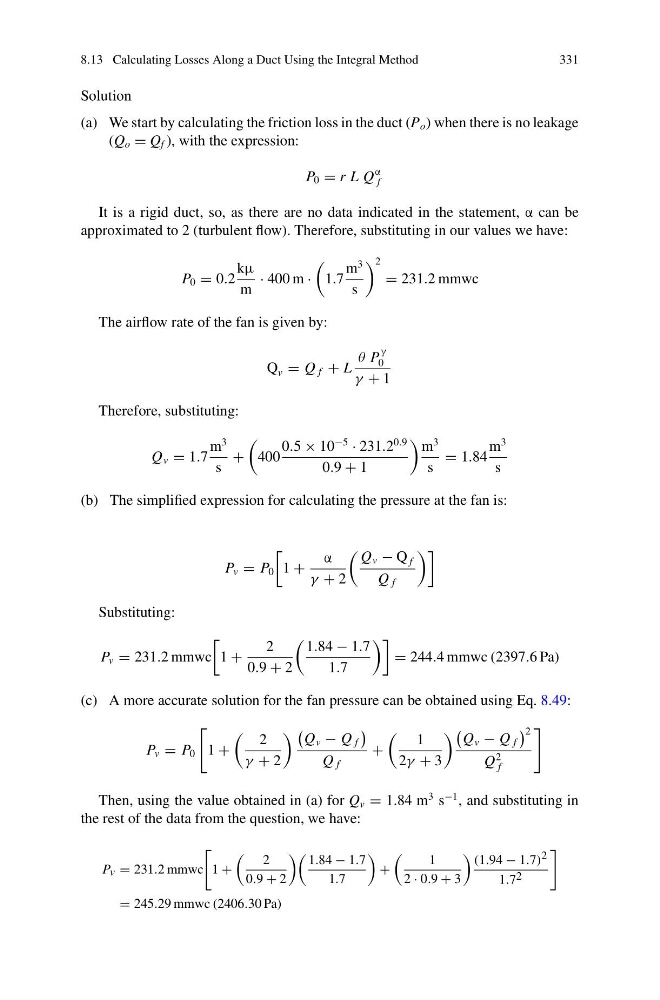
(a) We start by calculating the friction loss in the duct (P o ) when there is no leakage
(Q o = Q f ), with the expression:
P 0 = r L Q
α
f
It is a rigid duct, so, as there are no data indicated in the statement, α can be
approximated to 2 (turbulent flow). Therefore, substituting in our values we have:
P 0 = 0.2
kμ
m
· 400 m ·
1.7
m
3
s
2
= 231.2 mmwc
The airflow rate of the fan is given by:
Q v = Q f + L
θ P
γ
0
γ + 1
Therefore, substituting:
Q v = 1.7
m
3
s
+
400
0.5 × 10
−5
· 231.2
0.9
0.9 + 1
m
3
s
= 1.84
m
3
s
(b) The simplified expression for calculating the pressure at the fan is:
P v = P 0
1 +
α
γ + 2
Q v − Q f
Q f
Substituting:
P v = 231.2 mmwc
1 +
2
0.9 + 2
1.84 − 1.7
1.7
= 244.4 mmwc (2397.6 Pa)
(c) A more accurate solution for the fan pressure can be obtained using Eq. 8.49:
P v = P 0
1 +
2
γ + 2
Q v − Q f
Q f
+
1
2γ + 3
Q v − Q f
2
Q
2
f
Then, using the value obtained in (a) for Q v = 1.84 m
3 s
−1 , and substituting in
the rest of the data from the question, we have:
P v = 231.2 mmwc
1 +
2
0.9 + 2
1.84 − 1.7
1.7
+
1
2 · 0.9 + 3
(1.94 − 1.7) 2
1.7 2
= 245.29 mmwc (2406.30 Pa)
331
Solution
(a) We start by calculating the friction loss in the duct (P o ) when there is no leakage
(Q o = Q f ), with the expression:
P 0 = r L Q
α
f
It is a rigid duct, so, as there are no data indicated in the statement, α can be
approximated to 2 (turbulent flow). Therefore, substituting in our values we have:
P 0 = 0.2
kμ
m
· 400 m ·
1.7
m
3
s
2
= 231.2 mmwc
The airflow rate of the fan is given by:
Q v = Q f + L
θ P
γ
0
γ + 1
Therefore, substituting:
Q v = 1.7
m
3
s
+
400
0.5 × 10
−5
· 231.2
0.9
0.9 + 1
m
3
s
= 1.84
m
3
s
(b) The simplified expression for calculating the pressure at the fan is:
P v = P 0
1 +
α
γ + 2
Q v − Q f
Q f
Substituting:
P v = 231.2 mmwc
1 +
2
0.9 + 2
1.84 − 1.7
1.7
= 244.4 mmwc (2397.6 Pa)
(c) A more accurate solution for the fan pressure can be obtained using Eq. 8.49:
P v = P 0
1 +
2
γ + 2
Q v − Q f
Q f
+
1
2γ + 3
Q v − Q f
2
Q
2
f
Then, using the value obtained in (a) for Q v = 1.84 m
3 s
−1 , and substituting in
the rest of the data from the question, we have:
P v = 231.2 mmwc
1 +
2
0.9 + 2
1.84 − 1.7
1.7
+
1
2 · 0.9 + 3
(1.94 − 1.7) 2
1.7 2
= 245.29 mmwc (2406.30 Pa)