

8.13 Calculating Losses Along a Duct Using the Integral Method
329
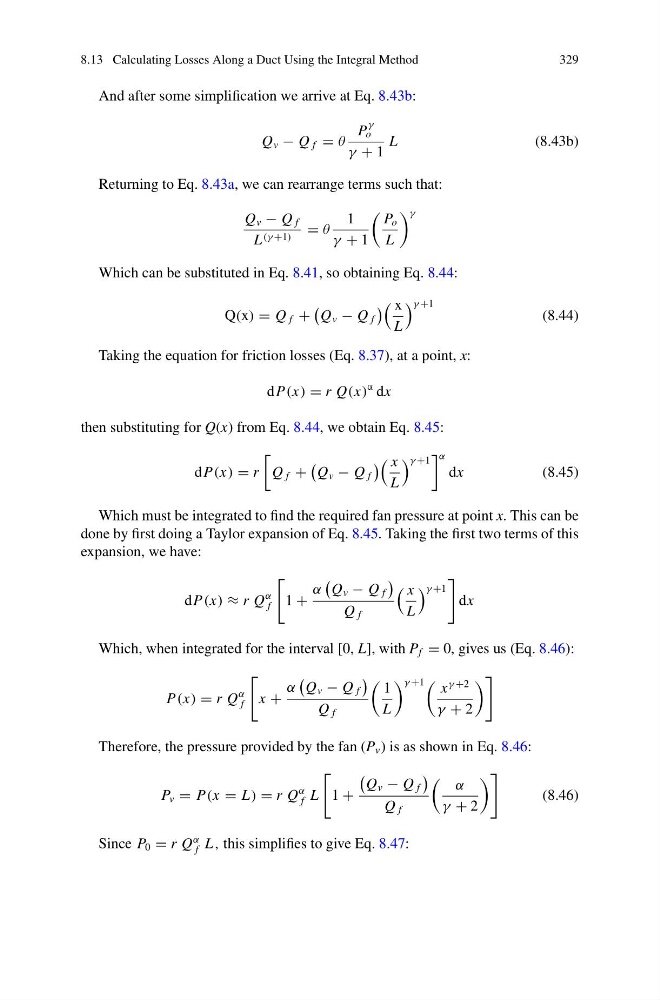
And after some simplification we arrive at Eq. 8.43b:
Q v − Q f = θ
P
γ
o
γ + 1
L
(8.43b)
Returning to Eq. 8.43a, we can rearrange terms such that:
Q v − Q f
L (γ +1) = θ
1
γ + 1
P o
L
γ
Which can be substituted in Eq. 8.41, so obtaining Eq. 8.44:
Q(x) = Q f +
Q v − Q f
x
L
γ +1
(8.44)
Taking the equation for friction losses (Eq. 8.37), at a point, x:
dP(x) = r Q(x)
α dx
then substituting for Q(x) from Eq. 8.44, we obtain Eq. 8.45:
dP(x) = r
Q f +
Q v − Q f
x
L
γ +1
α
dx
(8.45)
Which must be integrated to find the required fan pressure at point x. This can be
done by first doing a Taylor expansion of Eq. 8.45. Taking the first two terms of this
expansion, we have:
dP(x) ≈ r Q
α
f
1 +
α
Q v − Q f
Q f
x
L
γ +1
dx
Which, when integrated for the interval [0, L], with P f = 0, gives us (Eq. 8.46):
P(x) = r Q
α
f
x +
α
Q v − Q f
Q f
1
L
γ +1
x
γ +2
γ + 2
Therefore, the pressure provided by the fan (P v ) is as shown in Eq. 8.46:
P v = P(x = L) = r Q
α
f L
1 +
Q v − Q f
Q f
α
γ + 2
(8.46)
Since P 0 = r Q
α
f L , this simplifies to give Eq. 8.47:
329
And after some simplification we arrive at Eq. 8.43b:
Q v − Q f = θ
P
γ
o
γ + 1
L
(8.43b)
Returning to Eq. 8.43a, we can rearrange terms such that:
Q v − Q f
L (γ +1) = θ
1
γ + 1
P o
L
γ
Which can be substituted in Eq. 8.41, so obtaining Eq. 8.44:
Q(x) = Q f +
Q v − Q f
x
L
γ +1
(8.44)
Taking the equation for friction losses (Eq. 8.37), at a point, x:
dP(x) = r Q(x)
α dx
then substituting for Q(x) from Eq. 8.44, we obtain Eq. 8.45:
dP(x) = r
Q f +
Q v − Q f
x
L
γ +1
α
dx
(8.45)
Which must be integrated to find the required fan pressure at point x. This can be
done by first doing a Taylor expansion of Eq. 8.45. Taking the first two terms of this
expansion, we have:
dP(x) ≈ r Q
α
f
1 +
α
Q v − Q f
Q f
x
L
γ +1
dx
Which, when integrated for the interval [0, L], with P f = 0, gives us (Eq. 8.46):
P(x) = r Q
α
f
x +
α
Q v − Q f
Q f
1
L
γ +1
x
γ +2
γ + 2
Therefore, the pressure provided by the fan (P v ) is as shown in Eq. 8.46:
P v = P(x = L) = r Q
α
f L
1 +
Q v − Q f
Q f
α
γ + 2
(8.46)
Since P 0 = r Q
α
f L , this simplifies to give Eq. 8.47: