

328
8 Secondary Ventilation
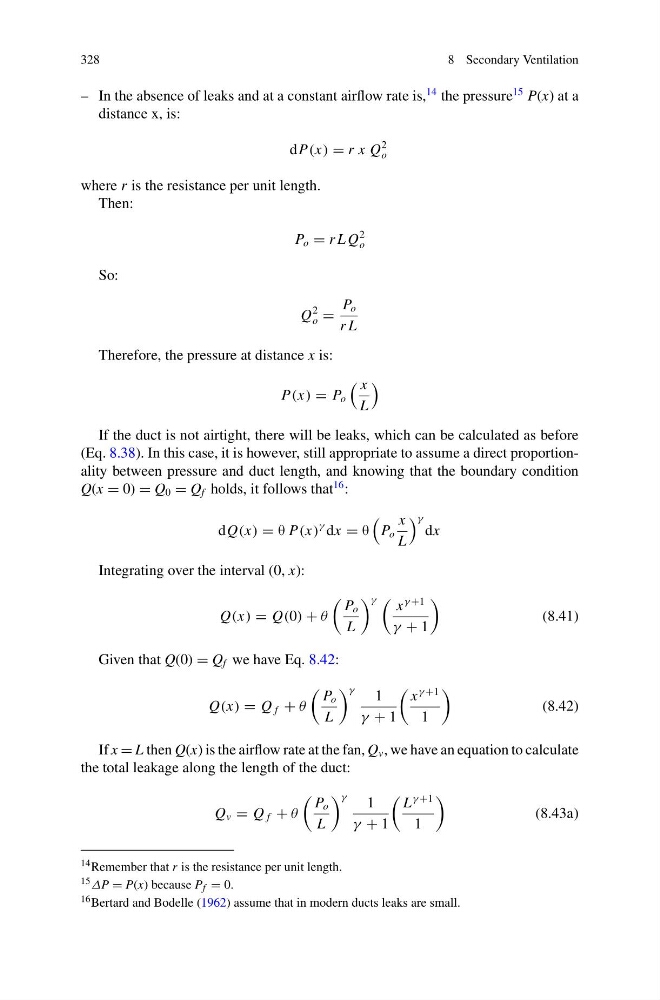
– In the absence of leaks and at a constant airflow rate is,
14 the pressure
15 P(x) at a
distance x, is:
dP(x) = r x Q
2
o
where r is the resistance per unit length.
Then:
P o = r L Q
2
o
So:
Q
2
o =
P o
r L
Therefore, the pressure at distance x is:
P(x) = P o
x
L
If the duct is not airtight, there will be leaks, which can be calculated as before
(Eq. 8.38). In this case, it is however, still appropriate to assume a direct proportionality between pressure and duct length, and knowing that the boundary condition
Q(x = 0) = Q 0 = Q f holds, it follows that
16 :
dQ(x) = θ P(x)
γ dx = θ
P o
x
L
γ
dx
Integrating over the interval (0, x):
Q(x) = Q(0) + θ
P o
L
γ
x
γ +1
γ + 1
(8.41)
Given that Q(0) = Q f we have Eq. 8.42:
Q(x) = Q f + θ
P o
L
γ 1
γ + 1
x
γ +1
1
(8.42)
If x = L then Q(x) is the airflow rate at the fan, Q v , we have an equation to calculate
the total leakage along the length of the duct:
Q v = Q f + θ
P o
L
γ 1
γ + 1
L
γ +1
1
(8.43a)
14 Remember that r is the resistance per unit length.
15 ΔP = P(x) because P f = 0.
16 Bertard and Bodelle (1962) assume that in modern ducts leaks are small.
8 Secondary Ventilation
– In the absence of leaks and at a constant airflow rate is,
14 the pressure
15 P(x) at a
distance x, is:
dP(x) = r x Q
2
o
where r is the resistance per unit length.
Then:
P o = r L Q
2
o
So:
Q
2
o =
P o
r L
Therefore, the pressure at distance x is:
P(x) = P o
x
L
If the duct is not airtight, there will be leaks, which can be calculated as before
(Eq. 8.38). In this case, it is however, still appropriate to assume a direct proportionality between pressure and duct length, and knowing that the boundary condition
Q(x = 0) = Q 0 = Q f holds, it follows that
16 :
dQ(x) = θ P(x)
γ dx = θ
P o
x
L
γ
dx
Integrating over the interval (0, x):
Q(x) = Q(0) + θ
P o
L
γ
x
γ +1
γ + 1
(8.41)
Given that Q(0) = Q f we have Eq. 8.42:
Q(x) = Q f + θ
P o
L
γ 1
γ + 1
x
γ +1
1
(8.42)
If x = L then Q(x) is the airflow rate at the fan, Q v , we have an equation to calculate
the total leakage along the length of the duct:
Q v = Q f + θ
P o
L
γ 1
γ + 1
L
γ +1
1
(8.43a)
14 Remember that r is the resistance per unit length.
15 ΔP = P(x) because P f = 0.
16 Bertard and Bodelle (1962) assume that in modern ducts leaks are small.