

8.6 Advection-Diffusion Method
313
Measuring
station
Concentration
Time
Plume
Plume
Explosion
x
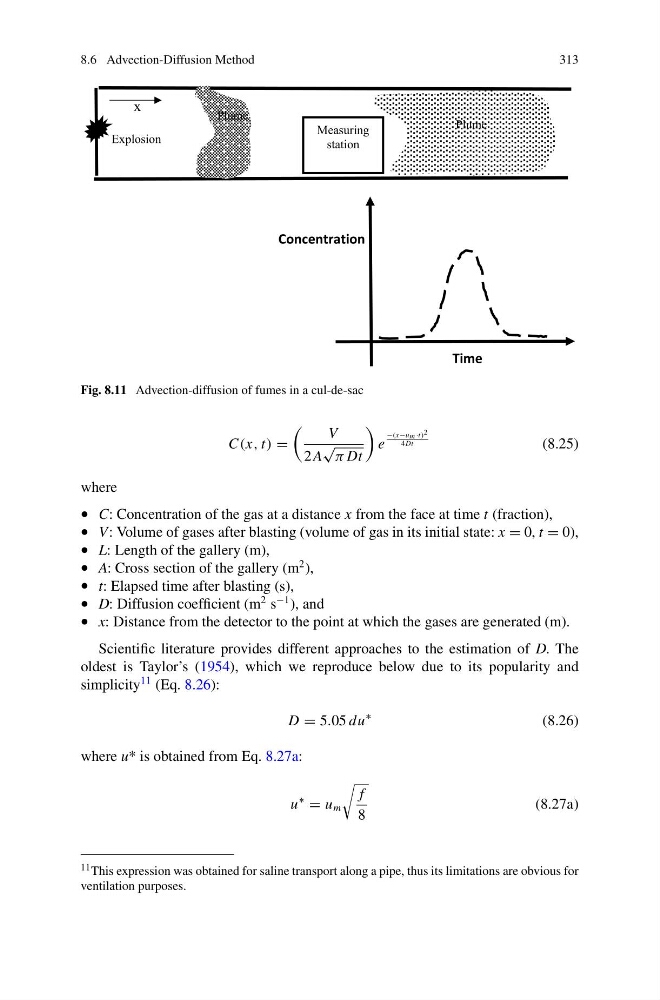
Fig. 8.11 Advection-diffusion of fumes in a cul-de-sac
C(x, t) =
V
2 A
√
π Dt
e
−(x−um ·t) 2
4Dt
(8.25)
where
• C: Concentration of the gas at a distance x from the face at time t (fraction),
• V: Volume of gases after blasting (volume of gas in its initial state: x = 0, t = 0),
• L: Length of the gallery (m),
• A: Cross section of the gallery (m
2 ),
• t: Elapsed time after blasting (s),
• D: Diffusion coefficient (m
2 s
−1 ), and
• x: Distance from the detector to the point at which the gases are generated (m).
Scientific literature provides different approaches to the estimation of D. The
oldest is Taylor’s (1954), which we reproduce below due to its popularity and
simplicity
11 (Eq. 8.26):
D = 5.05 du
∗
(8.26)
where u* is obtained from Eq. 8.27a:
u
∗
= u m
f
8
(8.27a)
11 This expression was obtained for saline transport along a pipe, thus its limitations are obvious for
ventilation purposes.
313
Measuring
station
Concentration
Time
Plume
Plume
Explosion
x
Fig. 8.11 Advection-diffusion of fumes in a cul-de-sac
C(x, t) =
V
2 A
√
π Dt
e
−(x−um ·t) 2
4Dt
(8.25)
where
• C: Concentration of the gas at a distance x from the face at time t (fraction),
• V: Volume of gases after blasting (volume of gas in its initial state: x = 0, t = 0),
• L: Length of the gallery (m),
• A: Cross section of the gallery (m
2 ),
• t: Elapsed time after blasting (s),
• D: Diffusion coefficient (m
2 s
−1 ), and
• x: Distance from the detector to the point at which the gases are generated (m).
Scientific literature provides different approaches to the estimation of D. The
oldest is Taylor’s (1954), which we reproduce below due to its popularity and
simplicity
11 (Eq. 8.26):
D = 5.05 du
∗
(8.26)
where u* is obtained from Eq. 8.27a:
u
∗
= u m
f
8
(8.27a)
11 This expression was obtained for saline transport along a pipe, thus its limitations are obvious for
ventilation purposes.