

312
8 Secondary Ventilation
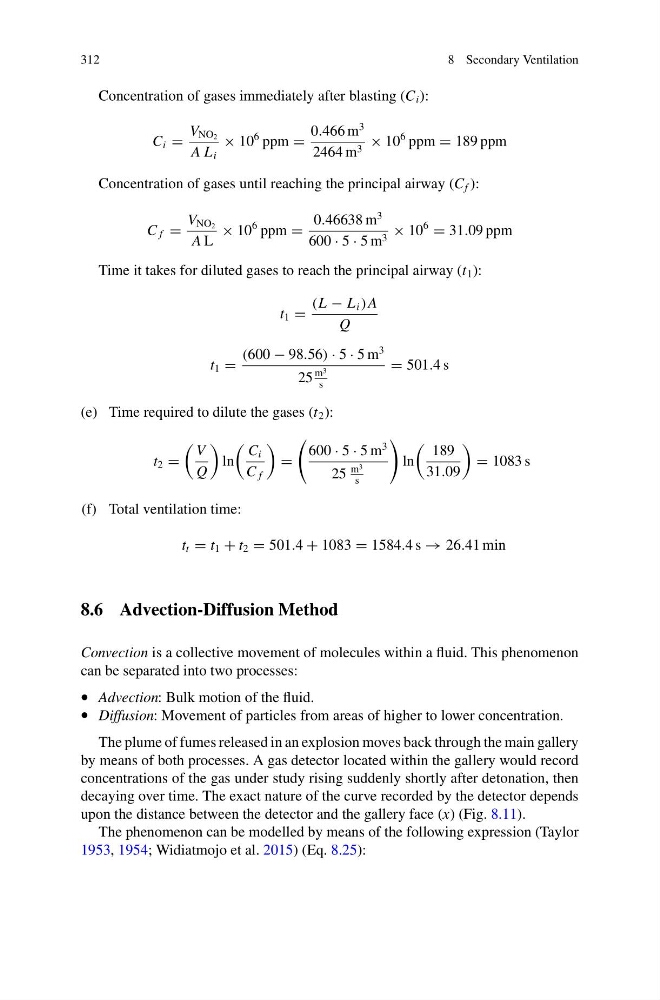
Concentration of gases immediately after blasting (C i ):
C i =
V NO 2
A L i
× 10
6 ppm =
0.466 m
3
2464 m 3 × 10
6 ppm = 189 ppm
Concentration of gases until reaching the principal airway (C f ):
C f =
V NO 2
A L
× 10
6 ppm =
0.46638 m
3
600 · 5 · 5 m 3 × 10
6
= 31.09 ppm
Time it takes for diluted gases to reach the principal airway (t 1 ):
t 1 =
(L − L i )A
Q
t 1 =
(600 − 98.56) · 5 · 5 m
3
25
m 3
s
= 501.4 s
(e) Time required to dilute the gases (t 2 ):
t 2 =
V
Q
ln
C i
C f
=
600 · 5 · 5 m
3
25
m 3
s
ln
189
31.09
= 1083 s
(f) Total ventilation time:
t t = t 1 + t 2 = 501.4 + 1083 = 1584.4 s → 26.41 min
8.6 Advection-Diffusion Method
Convection is a collective movement of molecules within a fluid. This phenomenon
can be separated into two processes:
• Advection: Bulk motion of the fluid.
• Diffusion: Movement of particles from areas of higher to lower concentration.
The plume of fumes released in an explosion moves back through the main gallery
by means of both processes. A gas detector located within the gallery would record
concentrations of the gas under study rising suddenly shortly after detonation, then
decaying over time. The exact nature of the curve recorded by the detector depends
upon the distance between the detector and the gallery face (x) (Fig. 8.11).
The phenomenon can be modelled by means of the following expression (Taylor
1953, 1954; Widiatmojo et al. 2015) (Eq. 8.25):
8 Secondary Ventilation
Concentration of gases immediately after blasting (C i ):
C i =
V NO 2
A L i
× 10
6 ppm =
0.466 m
3
2464 m 3 × 10
6 ppm = 189 ppm
Concentration of gases until reaching the principal airway (C f ):
C f =
V NO 2
A L
× 10
6 ppm =
0.46638 m
3
600 · 5 · 5 m 3 × 10
6
= 31.09 ppm
Time it takes for diluted gases to reach the principal airway (t 1 ):
t 1 =
(L − L i )A
Q
t 1 =
(600 − 98.56) · 5 · 5 m
3
25
m 3
s
= 501.4 s
(e) Time required to dilute the gases (t 2 ):
t 2 =
V
Q
ln
C i
C f
=
600 · 5 · 5 m
3
25
m 3
s
ln
189
31.09
= 1083 s
(f) Total ventilation time:
t t = t 1 + t 2 = 501.4 + 1083 = 1584.4 s → 26.41 min
8.6 Advection-Diffusion Method
Convection is a collective movement of molecules within a fluid. This phenomenon
can be separated into two processes:
• Advection: Bulk motion of the fluid.
• Diffusion: Movement of particles from areas of higher to lower concentration.
The plume of fumes released in an explosion moves back through the main gallery
by means of both processes. A gas detector located within the gallery would record
concentrations of the gas under study rising suddenly shortly after detonation, then
decaying over time. The exact nature of the curve recorded by the detector depends
upon the distance between the detector and the gallery face (x) (Fig. 8.11).
The phenomenon can be modelled by means of the following expression (Taylor
1953, 1954; Widiatmojo et al. 2015) (Eq. 8.25):