

314
8 Secondary Ventilation
where
• d: Duct diameter (m),
• u m : Average air velocity (m s
−1 ), and
• f : Coefficient of friction (dimensionless) that can be obtained, for example, from
the Colebrook equation.
Exercise 8.6 A gallery of cross section 9 m
2 whose current length is 330 m is under
construction. The excavation is taking place by drilling and blasting, employing
150 kg of ANFO-type explosive in each cycle. The velocity of the throwback gases
is estimated to be 0.6 m s
−1 . Determine:
(a) The volume of gases formed at the face immediately after detonation.
(b) NO 2 concentration 3 min after blasting at a distance of 50 m from the face.
(c) The point in the gallery where the highest concentration of NO 2 is found 3 min
after the blasting. What is this concentration?
(d) The function of the distribution of the NO 2 pollution along the gallery 3 min
after the blasting.
You may take the turbulent diffusion coefficient for NO 2 in this gallery to be
17 m
2 s
−1 .
Solution
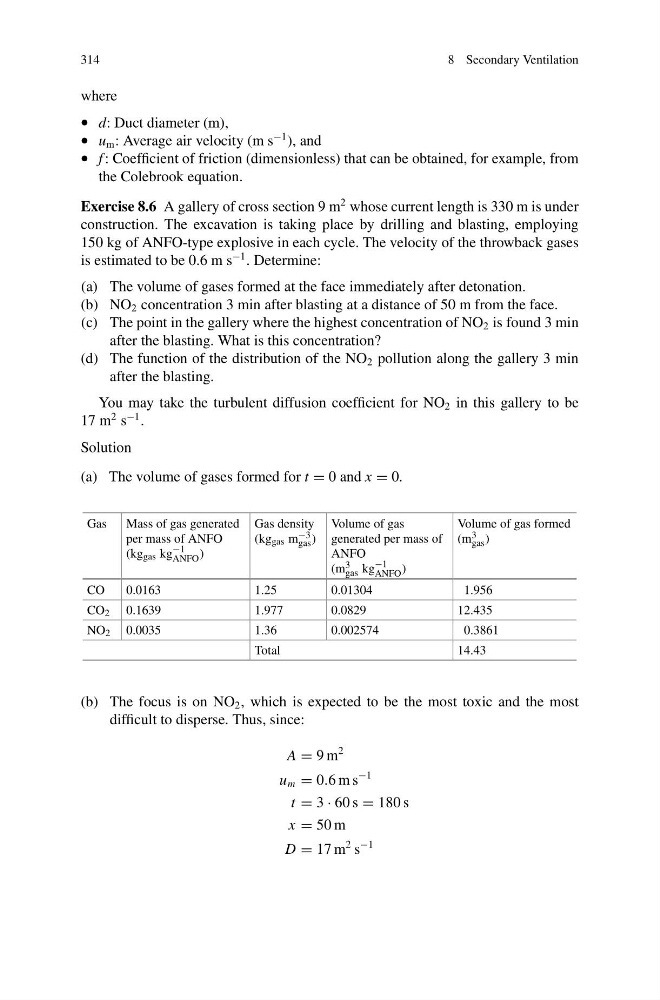
(a) The volume of gases formed for t = 0 and x = 0.
Gas
Mass of gas generated
per mass of ANFO
(kg gas kg
−1
ANFO )
Gas density
(kg gas m −3
gas )
Volume of gas
generated per mass of
ANFO
(m 3
gas kg
−1
ANFO )
Volume of gas formed
(m 3
gas )
CO
0.0163
1.25
0.01304
1.956
CO 2 0.1639
1.977
0.0829
12.435
NO 2 0.0035
1.36
0.002574
0.3861
Total
14.43
(b) The focus is on NO 2 , which is expected to be the most toxic and the most
difficult to disperse. Thus, since:
A = 9 m
2
u m = 0.6 m s
−1
t = 3 · 60 s = 180 s
x = 50 m
D = 17 m
2 s
−1
8 Secondary Ventilation
where
• d: Duct diameter (m),
• u m : Average air velocity (m s
−1 ), and
• f : Coefficient of friction (dimensionless) that can be obtained, for example, from
the Colebrook equation.
Exercise 8.6 A gallery of cross section 9 m
2 whose current length is 330 m is under
construction. The excavation is taking place by drilling and blasting, employing
150 kg of ANFO-type explosive in each cycle. The velocity of the throwback gases
is estimated to be 0.6 m s
−1 . Determine:
(a) The volume of gases formed at the face immediately after detonation.
(b) NO 2 concentration 3 min after blasting at a distance of 50 m from the face.
(c) The point in the gallery where the highest concentration of NO 2 is found 3 min
after the blasting. What is this concentration?
(d) The function of the distribution of the NO 2 pollution along the gallery 3 min
after the blasting.
You may take the turbulent diffusion coefficient for NO 2 in this gallery to be
17 m
2 s
−1 .
Solution
(a) The volume of gases formed for t = 0 and x = 0.
Gas
Mass of gas generated
per mass of ANFO
(kg gas kg
−1
ANFO )
Gas density
(kg gas m −3
gas )
Volume of gas
generated per mass of
ANFO
(m 3
gas kg
−1
ANFO )
Volume of gas formed
(m 3
gas )
CO
0.0163
1.25
0.01304
1.956
CO 2 0.1639
1.977
0.0829
12.435
NO 2 0.0035
1.36
0.002574
0.3861
Total
14.43
(b) The focus is on NO 2 , which is expected to be the most toxic and the most
difficult to disperse. Thus, since:
A = 9 m
2
u m = 0.6 m s
−1
t = 3 · 60 s = 180 s
x = 50 m
D = 17 m
2 s
−1