

304
8 Secondary Ventilation
where
• t: Time (s),
• Q: Fresh airflow rate (m
3 s
−1 ),
• V: Volume of the working space (m
3 ),
• G: Dust generation rate (mg s
−1 ),
• B: Concentration of dust in clean air (mg m
−3 ),
• X: Dust concentration at time t (mg m
−3 ), and
• X 0 : Initial dust concentration (mg m
−3 ).
In the case of the steady state:
Q B + G − X Q = 0
Therefore, the airflow rate necessary to dilute the dust will be (Eq. 8.15):
Q =
G
X − B
(8.15)
where X will normally be the MAC for dust.
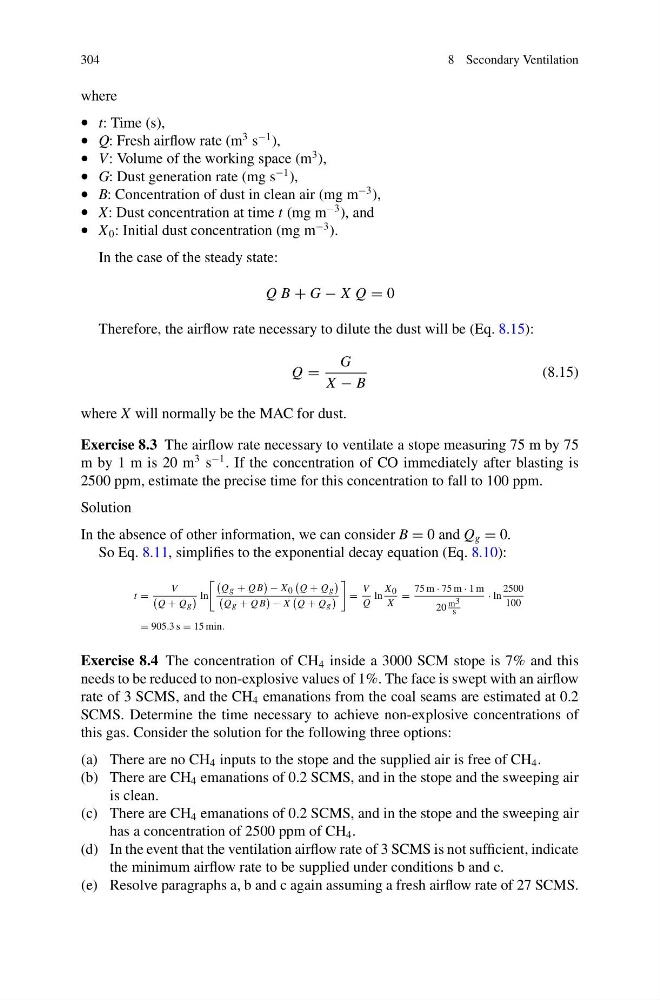
Exercise 8.3 The airflow rate necessary to ventilate a stope measuring 75 m by 75
m by 1 m is 20 m
3 s
−1 . If the concentration of CO immediately after blasting is
2500 ppm, estimate the precise time for this concentration to fall to 100 ppm.
Solution
In the absence of other information, we can consider B = 0 and Q g = 0.
So Eq. 8.11, simplifies to the exponential decay equation (Eq. 8.10):
t =
V
Q + Q g
ln
Q g + Q B
− X 0
Q + Q g
Q g + Q B
− X
Q + Q g
=
V
Q
ln
X 0
X
=
75 m · 75 m · 1 m
20 m 3
s
· ln
2500
100
= 905.3 s = 15 min.
Exercise 8.4 The concentration of CH 4 inside a 3000 SCM stope is 7% and this
needs to be reduced to non-explosive values of 1%. The face is swept with an airflow
rate of 3 SCMS, and the CH 4 emanations from the coal seams are estimated at 0.2
SCMS. Determine the time necessary to achieve non-explosive concentrations of
this gas. Consider the solution for the following three options:
(a) There are no CH 4 inputs to the stope and the supplied air is free of CH 4 .
(b) There are CH 4 emanations of 0.2 SCMS, and in the stope and the sweeping air
is clean.
(c) There are CH 4 emanations of 0.2 SCMS, and in the stope and the sweeping air
has a concentration of 2500 ppm of CH 4 .
(d) In the event that the ventilation airflow rate of 3 SCMS is not sufficient, indicate
the minimum airflow rate to be supplied under conditions b and c.
(e) Resolve paragraphs a, b and c again assuming a fresh airflow rate of 27 SCMS.
8 Secondary Ventilation
where
• t: Time (s),
• Q: Fresh airflow rate (m
3 s
−1 ),
• V: Volume of the working space (m
3 ),
• G: Dust generation rate (mg s
−1 ),
• B: Concentration of dust in clean air (mg m
−3 ),
• X: Dust concentration at time t (mg m
−3 ), and
• X 0 : Initial dust concentration (mg m
−3 ).
In the case of the steady state:
Q B + G − X Q = 0
Therefore, the airflow rate necessary to dilute the dust will be (Eq. 8.15):
Q =
G
X − B
(8.15)
where X will normally be the MAC for dust.
Exercise 8.3 The airflow rate necessary to ventilate a stope measuring 75 m by 75
m by 1 m is 20 m
3 s
−1 . If the concentration of CO immediately after blasting is
2500 ppm, estimate the precise time for this concentration to fall to 100 ppm.
Solution
In the absence of other information, we can consider B = 0 and Q g = 0.
So Eq. 8.11, simplifies to the exponential decay equation (Eq. 8.10):
t =
V
Q + Q g
ln
Q g + Q B
− X 0
Q + Q g
Q g + Q B
− X
Q + Q g
=
V
Q
ln
X 0
X
=
75 m · 75 m · 1 m
20 m 3
s
· ln
2500
100
= 905.3 s = 15 min.
Exercise 8.4 The concentration of CH 4 inside a 3000 SCM stope is 7% and this
needs to be reduced to non-explosive values of 1%. The face is swept with an airflow
rate of 3 SCMS, and the CH 4 emanations from the coal seams are estimated at 0.2
SCMS. Determine the time necessary to achieve non-explosive concentrations of
this gas. Consider the solution for the following three options:
(a) There are no CH 4 inputs to the stope and the supplied air is free of CH 4 .
(b) There are CH 4 emanations of 0.2 SCMS, and in the stope and the sweeping air
is clean.
(c) There are CH 4 emanations of 0.2 SCMS, and in the stope and the sweeping air
has a concentration of 2500 ppm of CH 4 .
(d) In the event that the ventilation airflow rate of 3 SCMS is not sufficient, indicate
the minimum airflow rate to be supplied under conditions b and c.
(e) Resolve paragraphs a, b and c again assuming a fresh airflow rate of 27 SCMS.