

8.4 Gas Dilution Models
303
Rearranging the expression in the denominator we find that:
Q B + Q g > X
Q + Q g
Given that we previously established the condition that B ≥ 0, it can be deduced
that the flow rate of polluted fresh air (QB) plus the contribution from the generated
gases (Q g ) is greater than the extraction capacity, given by (Q + Q g ) X. This condition,
although mathematically correct, would not be technically desirable.
(b) The numerator and denominator are both negative.
Since in the case of effective dilution X o > X, the most restrictive condition is
expressed in that containing the value X, i.e. the denominator:
Q B + Q g −X
Q + Q g
< 0
So, rearranging once more:
Q B + Q g < X
Q + Q g
According to this, the ventilation capacity is now greater than the incoming flow
rate of contaminants, hence ventilation actually occurs.
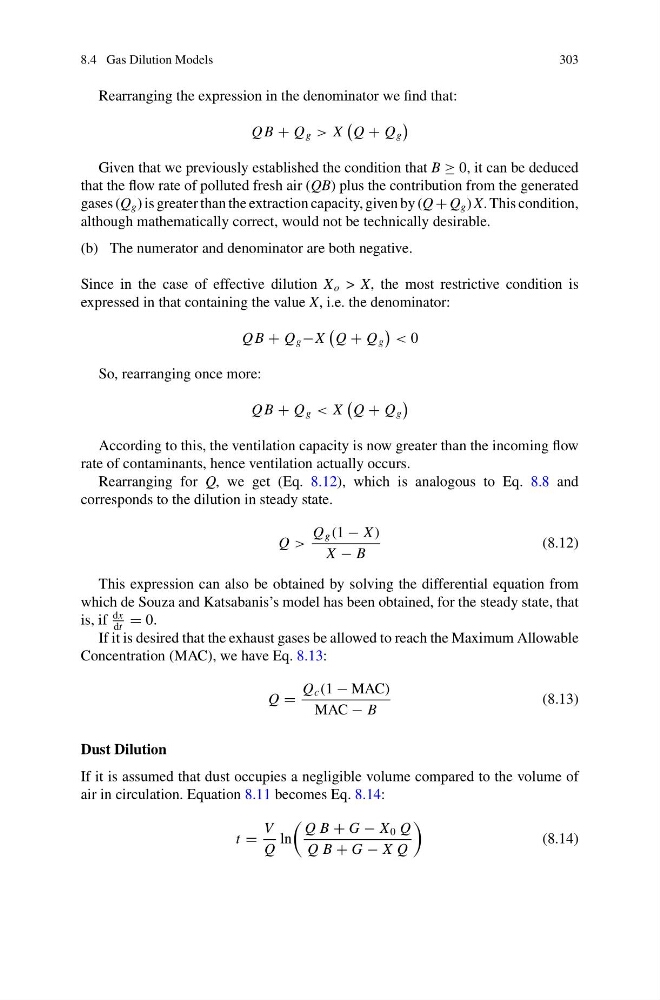
Rearranging for Q, we get (Eq. 8.12), which is analogous to Eq. 8.8 and
corresponds to the dilution in steady state.
Q >
Q g (1 − X )
X − B
(8.12)
This expression can also be obtained by solving the differential equation from
which de Souza and Katsabanis’s model has been obtained, for the steady state, that
is, if
dx
dt
= 0.
If it is desired that the exhaust gases be allowed to reach the Maximum Allowable
Concentration (MAC), we have Eq. 8.13:
Q =
Q c (1 − MAC)
MAC − B
(8.13)
Dust Dilution
If it is assumed that dust occupies a negligible volume compared to the volume of
air in circulation. Equation 8.11 becomes Eq. 8.14:
t =
V
Q
ln
Q B + G − X 0 Q
Q B + G − X Q
(8.14)
303
Rearranging the expression in the denominator we find that:
Q B + Q g > X
Q + Q g
Given that we previously established the condition that B ≥ 0, it can be deduced
that the flow rate of polluted fresh air (QB) plus the contribution from the generated
gases (Q g ) is greater than the extraction capacity, given by (Q + Q g ) X. This condition,
although mathematically correct, would not be technically desirable.
(b) The numerator and denominator are both negative.
Since in the case of effective dilution X o > X, the most restrictive condition is
expressed in that containing the value X, i.e. the denominator:
Q B + Q g −X
Q + Q g
< 0
So, rearranging once more:
Q B + Q g < X
Q + Q g
According to this, the ventilation capacity is now greater than the incoming flow
rate of contaminants, hence ventilation actually occurs.
Rearranging for Q, we get (Eq. 8.12), which is analogous to Eq. 8.8 and
corresponds to the dilution in steady state.
Q >
Q g (1 − X )
X − B
(8.12)
This expression can also be obtained by solving the differential equation from
which de Souza and Katsabanis’s model has been obtained, for the steady state, that
is, if
dx
dt
= 0.
If it is desired that the exhaust gases be allowed to reach the Maximum Allowable
Concentration (MAC), we have Eq. 8.13:
Q =
Q c (1 − MAC)
MAC − B
(8.13)
Dust Dilution
If it is assumed that dust occupies a negligible volume compared to the volume of
air in circulation. Equation 8.11 becomes Eq. 8.14:
t =
V
Q
ln
Q B + G − X 0 Q
Q B + G − X Q
(8.14)