

302
8 Secondary Ventilation
That is:
−1
Q + Q g
ln
Q g + Q B
− X
Q + Q g
Q g + Q B
− X o
Q + Q g
=
t
V
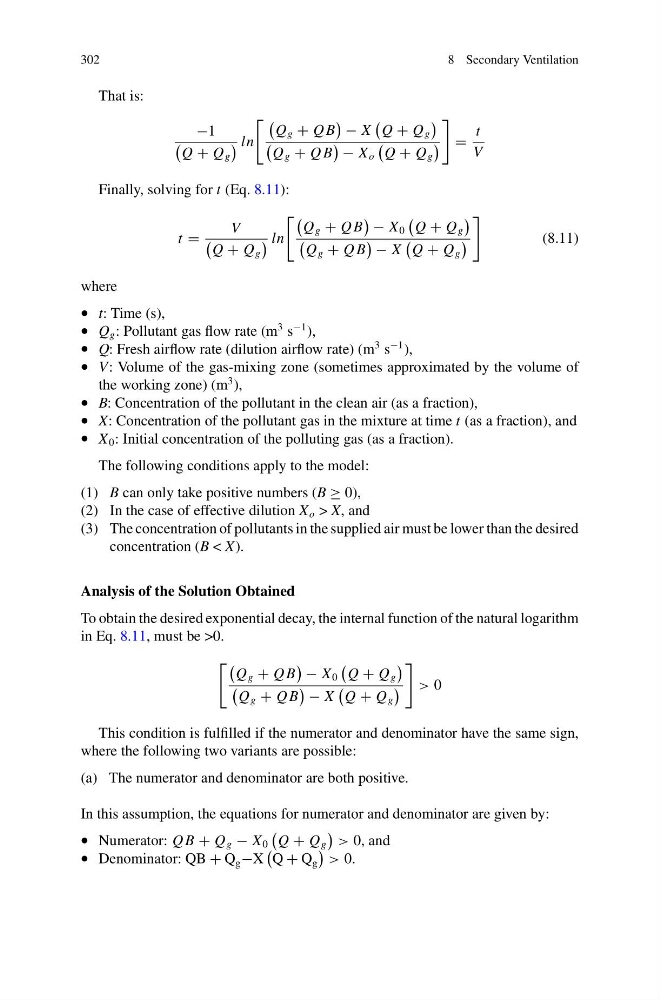
Finally, solving for t (Eq. 8.11):
t =
V
Q + Q g
ln
Q g + Q B
− X 0
Q + Q g
Q g + Q B
− X
Q + Q g
(8.11)
where
• t: Time (s),
• Q g : Pollutant gas flow rate (m
3 s
−1 ),
• Q: Fresh airflow rate (dilution airflow rate) (m
3 s
−1 ),
• V: Volume of the gas-mixing zone (sometimes approximated by the volume of
the working zone) (m
3 ),
• B: Concentration of the pollutant in the clean air (as a fraction),
• X: Concentration of the pollutant gas in the mixture at time t (as a fraction), and
• X 0 : Initial concentration of the polluting gas (as a fraction).
The following conditions apply to the model:
(1) B can only take positive numbers (B ≥ 0),
(2) In the case of effective dilution X o > X, and
(3) The concentration of pollutants in the supplied air must be lower than the desired
concentration (B < X).
Analysis of the Solution Obtained
To obtain the desired exponential decay, the internal function of the natural logarithm
in Eq. 8.11, must be >0.
Q g + Q B
− X 0
Q + Q g
Q g + Q B
− X
Q + Q g
> 0
This condition is fulfilled if the numerator and denominator have the same sign,
where the following two variants are possible:
(a) The numerator and denominator are both positive.
In this assumption, the equations for numerator and denominator are given by:
• Numerator: Q B + Q g − X 0
Q + Q g
> 0, and
• Denominator: QB + Q g −X
Q + Q g
> 0.
8 Secondary Ventilation
That is:
−1
Q + Q g
ln
Q g + Q B
− X
Q + Q g
Q g + Q B
− X o
Q + Q g
=
t
V
Finally, solving for t (Eq. 8.11):
t =
V
Q + Q g
ln
Q g + Q B
− X 0
Q + Q g
Q g + Q B
− X
Q + Q g
(8.11)
where
• t: Time (s),
• Q g : Pollutant gas flow rate (m
3 s
−1 ),
• Q: Fresh airflow rate (dilution airflow rate) (m
3 s
−1 ),
• V: Volume of the gas-mixing zone (sometimes approximated by the volume of
the working zone) (m
3 ),
• B: Concentration of the pollutant in the clean air (as a fraction),
• X: Concentration of the pollutant gas in the mixture at time t (as a fraction), and
• X 0 : Initial concentration of the polluting gas (as a fraction).
The following conditions apply to the model:
(1) B can only take positive numbers (B ≥ 0),
(2) In the case of effective dilution X o > X, and
(3) The concentration of pollutants in the supplied air must be lower than the desired
concentration (B < X).
Analysis of the Solution Obtained
To obtain the desired exponential decay, the internal function of the natural logarithm
in Eq. 8.11, must be >0.
Q g + Q B
− X 0
Q + Q g
Q g + Q B
− X
Q + Q g
> 0
This condition is fulfilled if the numerator and denominator have the same sign,
where the following two variants are possible:
(a) The numerator and denominator are both positive.
In this assumption, the equations for numerator and denominator are given by:
• Numerator: Q B + Q g − X 0
Q + Q g
> 0, and
• Denominator: QB + Q g −X
Q + Q g
> 0.