

8.4 Gas Dilution Models
301
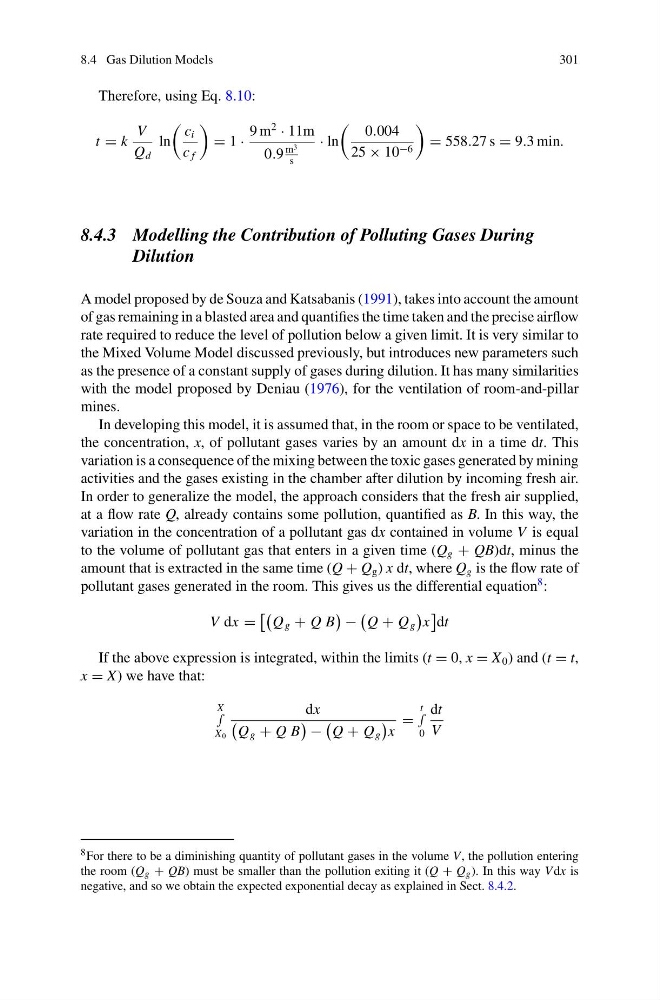
Therefore, using Eq. 8.10:
t = k
V
Q d
ln
c i
c f
= 1 ·
9 m
2
· 11m
0.9
m 3
s
· ln
0.004
25 × 10 −6
= 558.27 s = 9.3 min.
8.4.3 Modelling the Contribution of Polluting Gases During
Dilution
A model proposed by de Souza and Katsabanis (1991), takes into account the amount
of gas remaining in a blasted area and quantifies the time taken and the precise airflow
rate required to reduce the level of pollution below a given limit. It is very similar to
the Mixed Volume Model discussed previously, but introduces new parameters such
as the presence of a constant supply of gases during dilution. It has many similarities
with the model proposed by Deniau (1976), for the ventilation of room-and-pillar
mines.
In developing this model, it is assumed that, in the room or space to be ventilated,
the concentration, x, of pollutant gases varies by an amount dx in a time dt. This
variation is a consequence of the mixing between the toxic gases generated by mining
activities and the gases existing in the chamber after dilution by incoming fresh air.
In order to generalize the model, the approach considers that the fresh air supplied,
at a flow rate Q, already contains some pollution, quantified as B. In this way, the
variation in the concentration of a pollutant gas dx contained in volume V is equal
to the volume of pollutant gas that enters in a given time (Q g + QB)dt, minus the
amount that is extracted in the same time (Q + Q g ) x dt, where Q g is the flow rate of
pollutant gases generated in the room. This gives us the differential equation
8 :
V dx =
Q g + Q B
−
Q + Q g
x
dt
If the above expression is integrated, within the limits (t = 0, x = X 0 ) and (t = t,
x = X) we have that:
X
∫
X 0
dx
Q g + Q B
−
Q + Q g
x
=
t
∫
0
dt
V
8 For there to be a diminishing quantity of pollutant gases in the volume V, the pollution entering
the room (Q g + QB) must be smaller than the pollution exiting it (Q + Q g ). In this way V dx is
negative, and so we obtain the expected exponential decay as explained in Sect. 8.4.2.
301
Therefore, using Eq. 8.10:
t = k
V
Q d
ln
c i
c f
= 1 ·
9 m
2
· 11m
0.9
m 3
s
· ln
0.004
25 × 10 −6
= 558.27 s = 9.3 min.
8.4.3 Modelling the Contribution of Polluting Gases During
Dilution
A model proposed by de Souza and Katsabanis (1991), takes into account the amount
of gas remaining in a blasted area and quantifies the time taken and the precise airflow
rate required to reduce the level of pollution below a given limit. It is very similar to
the Mixed Volume Model discussed previously, but introduces new parameters such
as the presence of a constant supply of gases during dilution. It has many similarities
with the model proposed by Deniau (1976), for the ventilation of room-and-pillar
mines.
In developing this model, it is assumed that, in the room or space to be ventilated,
the concentration, x, of pollutant gases varies by an amount dx in a time dt. This
variation is a consequence of the mixing between the toxic gases generated by mining
activities and the gases existing in the chamber after dilution by incoming fresh air.
In order to generalize the model, the approach considers that the fresh air supplied,
at a flow rate Q, already contains some pollution, quantified as B. In this way, the
variation in the concentration of a pollutant gas dx contained in volume V is equal
to the volume of pollutant gas that enters in a given time (Q g + QB)dt, minus the
amount that is extracted in the same time (Q + Q g ) x dt, where Q g is the flow rate of
pollutant gases generated in the room. This gives us the differential equation
8 :
V dx =
Q g + Q B
−
Q + Q g
x
dt
If the above expression is integrated, within the limits (t = 0, x = X 0 ) and (t = t,
x = X) we have that:
X
∫
X 0
dx
Q g + Q B
−
Q + Q g
x
=
t
∫
0
dt
V
8 For there to be a diminishing quantity of pollutant gases in the volume V, the pollution entering
the room (Q g + QB) must be smaller than the pollution exiting it (Q + Q g ). In this way V dx is
negative, and so we obtain the expected exponential decay as explained in Sect. 8.4.2.