

300
8 Secondary Ventilation
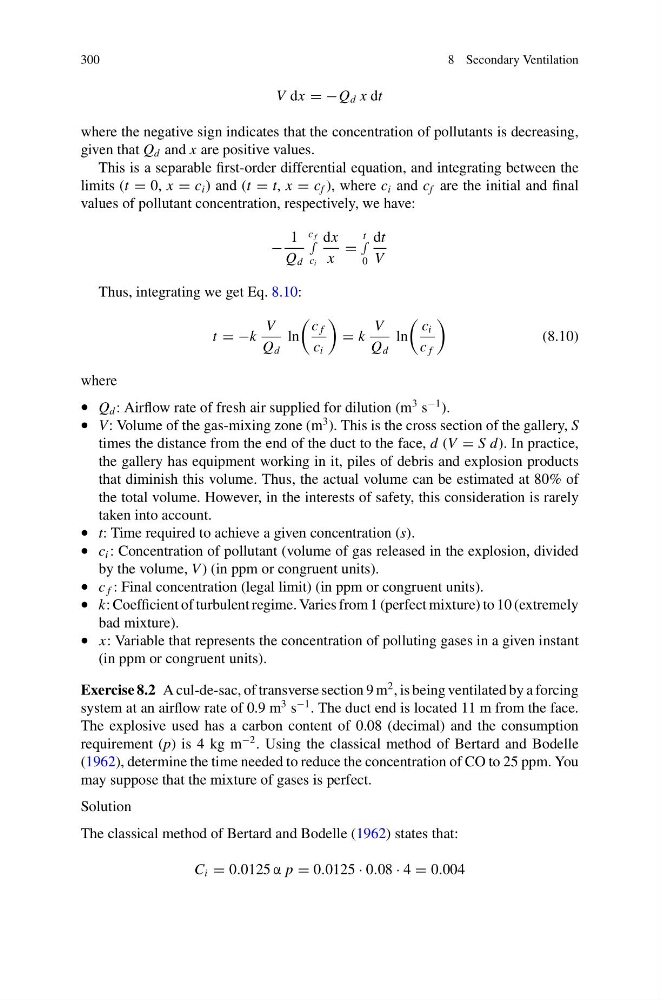
V dx = −Q d x dt
where the negative sign indicates that the concentration of pollutants is decreasing,
given that Q d and x are positive values.
This is a separable first-order differential equation, and integrating between the
limits (t = 0, x = c i ) and (t = t, x = c f ), where c i and c f are the initial and final
values of pollutant concentration, respectively, we have:
−
1
Q d
c f
∫
c i
dx
x
=
t
∫
0
dt
V
Thus, integrating we get Eq. 8.10:
t = −k
V
Q d
ln
c f
c i
= k
V
Q d
ln
c i
c f
(8.10)
where
• Q d : Airflow rate of fresh air supplied for dilution (m
3 s
−1 ).
• V: Volume of the gas-mixing zone (m
3 ). This is the cross section of the gallery, S
times the distance from the end of the duct to the face, d (V = S d). In practice,
the gallery has equipment working in it, piles of debris and explosion products
that diminish this volume. Thus, the actual volume can be estimated at 80% of
the total volume. However, in the interests of safety, this consideration is rarely
taken into account.
• t: Time required to achieve a given concentration (s).
• c i : Concentration of pollutant (volume of gas released in the explosion, divided
by the volume, V ) (in ppm or congruent units).
• c f : Final concentration (legal limit) (in ppm or congruent units).
• k: Coefficient of turbulent regime. Varies from 1 (perfect mixture) to 10 (extremely
bad mixture).
• x: Variable that represents the concentration of polluting gases in a given instant
(in ppm or congruent units).
Exercise 8.2 A cul-de-sac, of transverse section 9 m
2 , is being ventilated by a forcing
system at an airflow rate of 0.9 m
3 s
−1 . The duct end is located 11 m from the face.
The explosive used has a carbon content of 0.08 (decimal) and the consumption
requirement (p) is 4 kg m
−2 . Using the classical method of Bertard and Bodelle
(1962), determine the time needed to reduce the concentration of CO to 25 ppm. You
may suppose that the mixture of gases is perfect.
Solution
The classical method of Bertard and Bodelle (1962) states that:
C i = 0.0125 α p = 0.0125 · 0.08 · 4 = 0.004
8 Secondary Ventilation
V dx = −Q d x dt
where the negative sign indicates that the concentration of pollutants is decreasing,
given that Q d and x are positive values.
This is a separable first-order differential equation, and integrating between the
limits (t = 0, x = c i ) and (t = t, x = c f ), where c i and c f are the initial and final
values of pollutant concentration, respectively, we have:
−
1
Q d
c f
∫
c i
dx
x
=
t
∫
0
dt
V
Thus, integrating we get Eq. 8.10:
t = −k
V
Q d
ln
c f
c i
= k
V
Q d
ln
c i
c f
(8.10)
where
• Q d : Airflow rate of fresh air supplied for dilution (m
3 s
−1 ).
• V: Volume of the gas-mixing zone (m
3 ). This is the cross section of the gallery, S
times the distance from the end of the duct to the face, d (V = S d). In practice,
the gallery has equipment working in it, piles of debris and explosion products
that diminish this volume. Thus, the actual volume can be estimated at 80% of
the total volume. However, in the interests of safety, this consideration is rarely
taken into account.
• t: Time required to achieve a given concentration (s).
• c i : Concentration of pollutant (volume of gas released in the explosion, divided
by the volume, V ) (in ppm or congruent units).
• c f : Final concentration (legal limit) (in ppm or congruent units).
• k: Coefficient of turbulent regime. Varies from 1 (perfect mixture) to 10 (extremely
bad mixture).
• x: Variable that represents the concentration of polluting gases in a given instant
(in ppm or congruent units).
Exercise 8.2 A cul-de-sac, of transverse section 9 m
2 , is being ventilated by a forcing
system at an airflow rate of 0.9 m
3 s
−1 . The duct end is located 11 m from the face.
The explosive used has a carbon content of 0.08 (decimal) and the consumption
requirement (p) is 4 kg m
−2 . Using the classical method of Bertard and Bodelle
(1962), determine the time needed to reduce the concentration of CO to 25 ppm. You
may suppose that the mixture of gases is perfect.
Solution
The classical method of Bertard and Bodelle (1962) states that:
C i = 0.0125 α p = 0.0125 · 0.08 · 4 = 0.004