

8.4 Gas Dilution Models
299
that G represents the contaminant in the stream and not the airflow. That is to say, it
is equivalent to Q c .
8.4.2 Mixed Volume Model
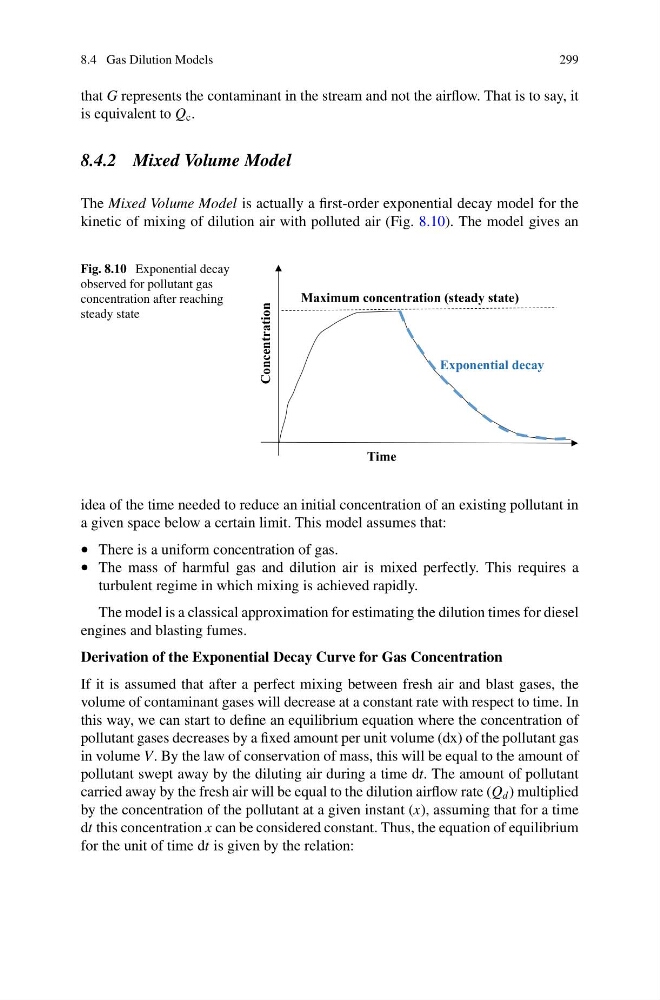
The Mixed Volume Model is actually a first-order exponential decay model for the
kinetic of mixing of dilution air with polluted air (Fig. 8.10). The model gives an
Fig. 8.10 Exponential decay
observed for pollutant gas
concentration after reaching
steady state
Concentration
Time
Maximum concentration (steady state)
Exponential decay
idea of the time needed to reduce an initial concentration of an existing pollutant in
a given space below a certain limit. This model assumes that:
• There is a uniform concentration of gas.
• The mass of harmful gas and dilution air is mixed perfectly. This requires a
turbulent regime in which mixing is achieved rapidly.
The model is a classical approximation for estimating the dilution times for diesel
engines and blasting fumes.
Derivation of the Exponential Decay Curve for Gas Concentration
If it is assumed that after a perfect mixing between fresh air and blast gases, the
volume of contaminant gases will decrease at a constant rate with respect to time. In
this way, we can start to define an equilibrium equation where the concentration of
pollutant gases decreases by a fixed amount per unit volume (dx) of the pollutant gas
in volume V. By the law of conservation of mass, this will be equal to the amount of
pollutant swept away by the diluting air during a time dt. The amount of pollutant
carried away by the fresh air will be equal to the dilution airflow rate (Q d ) multiplied
by the concentration of the pollutant at a given instant (x), assuming that for a time
dt this concentration x can be considered constant. Thus, the equation of equilibrium
for the unit of time dt is given by the relation:
299
that G represents the contaminant in the stream and not the airflow. That is to say, it
is equivalent to Q c .
8.4.2 Mixed Volume Model
The Mixed Volume Model is actually a first-order exponential decay model for the
kinetic of mixing of dilution air with polluted air (Fig. 8.10). The model gives an
Fig. 8.10 Exponential decay
observed for pollutant gas
concentration after reaching
steady state
Concentration
Time
Maximum concentration (steady state)
Exponential decay
idea of the time needed to reduce an initial concentration of an existing pollutant in
a given space below a certain limit. This model assumes that:
• There is a uniform concentration of gas.
• The mass of harmful gas and dilution air is mixed perfectly. This requires a
turbulent regime in which mixing is achieved rapidly.
The model is a classical approximation for estimating the dilution times for diesel
engines and blasting fumes.
Derivation of the Exponential Decay Curve for Gas Concentration
If it is assumed that after a perfect mixing between fresh air and blast gases, the
volume of contaminant gases will decrease at a constant rate with respect to time. In
this way, we can start to define an equilibrium equation where the concentration of
pollutant gases decreases by a fixed amount per unit volume (dx) of the pollutant gas
in volume V. By the law of conservation of mass, this will be equal to the amount of
pollutant swept away by the diluting air during a time dt. The amount of pollutant
carried away by the fresh air will be equal to the dilution airflow rate (Q d ) multiplied
by the concentration of the pollutant at a given instant (x), assuming that for a time
dt this concentration x can be considered constant. Thus, the equation of equilibrium
for the unit of time dt is given by the relation: