

298
8 Secondary Ventilation
Application of the Stationary Dilution Expression to Dust
The particles of the respirable fraction (<5 μm) sediment extraordinarily slowly,
so for dilution calculations, they can be considered as a gas. This is so, because
to reduce their concentration in air, what really matters is the airflow supply rate.
Besides, coarse particles have a greater tendency to sediment, with air velocity being
the most influential parameter for maintaining their concentration in the air, thus, the
higher the speed, the greater the number of particles in suspension.
7
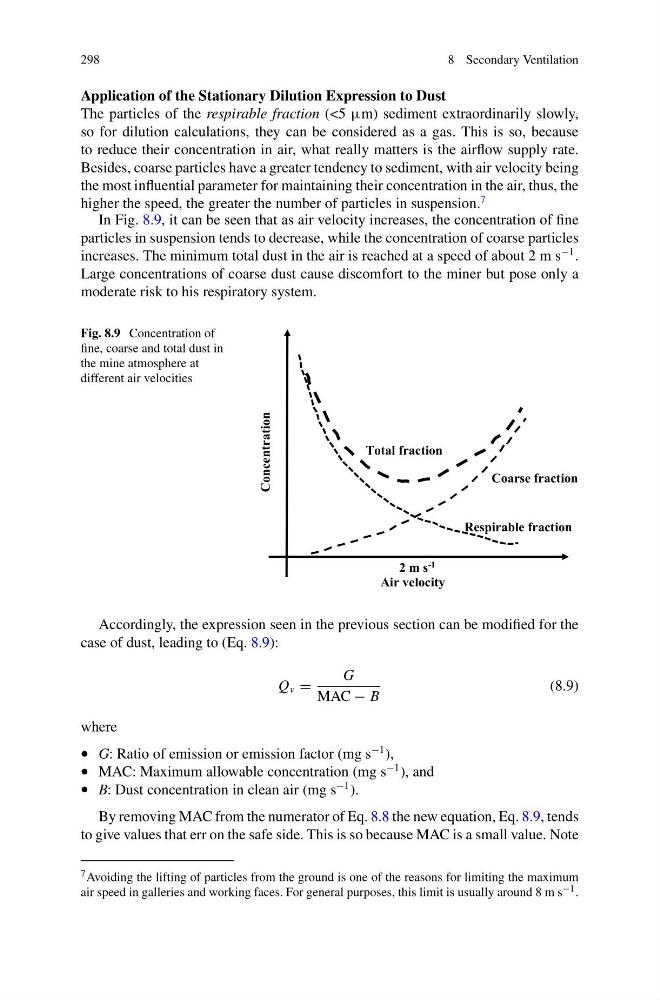
In Fig. 8.9, it can be seen that as air velocity increases, the concentration of fine
particles in suspension tends to decrease, while the concentration of coarse particles
increases. The minimum total dust in the air is reached at a speed of about 2 m s
−1 .
Large concentrations of coarse dust cause discomfort to the miner but pose only a
moderate risk to his respiratory system.
Fig. 8.9 Concentration of
fine, coarse and total dust in
the mine atmosphere at
different air velocities
Concentration
Air velocity
2 m s -1
Respirable fraction
Coarse fraction
Total fraction
Accordingly, the expression seen in the previous section can be modified for the
case of dust, leading to (Eq. 8.9):
Q v =
G
MAC − B
(8.9)
where
• G: Ratio of emission or emission factor (mg s
−1 ),
• MAC: Maximum allowable concentration (mg s
−1 ), and
• B: Dust concentration in clean air (mg s
−1 ).
By removing MAC from the numerator of Eq. 8.8 the new equation, Eq. 8.9, tends
to give values that err on the safe side. This is so because MAC is a small value. Note
7 Avoiding the lifting of particles from the ground is one of the reasons for limiting the maximum
air speed in galleries and working faces. For general purposes, this limit is usually around 8 m s −1 .
8 Secondary Ventilation
Application of the Stationary Dilution Expression to Dust
The particles of the respirable fraction (<5 μm) sediment extraordinarily slowly,
so for dilution calculations, they can be considered as a gas. This is so, because
to reduce their concentration in air, what really matters is the airflow supply rate.
Besides, coarse particles have a greater tendency to sediment, with air velocity being
the most influential parameter for maintaining their concentration in the air, thus, the
higher the speed, the greater the number of particles in suspension.
7
In Fig. 8.9, it can be seen that as air velocity increases, the concentration of fine
particles in suspension tends to decrease, while the concentration of coarse particles
increases. The minimum total dust in the air is reached at a speed of about 2 m s
−1 .
Large concentrations of coarse dust cause discomfort to the miner but pose only a
moderate risk to his respiratory system.
Fig. 8.9 Concentration of
fine, coarse and total dust in
the mine atmosphere at
different air velocities
Concentration
Air velocity
2 m s -1
Respirable fraction
Coarse fraction
Total fraction
Accordingly, the expression seen in the previous section can be modified for the
case of dust, leading to (Eq. 8.9):
Q v =
G
MAC − B
(8.9)
where
• G: Ratio of emission or emission factor (mg s
−1 ),
• MAC: Maximum allowable concentration (mg s
−1 ), and
• B: Dust concentration in clean air (mg s
−1 ).
By removing MAC from the numerator of Eq. 8.8 the new equation, Eq. 8.9, tends
to give values that err on the safe side. This is so because MAC is a small value. Note
7 Avoiding the lifting of particles from the ground is one of the reasons for limiting the maximum
air speed in galleries and working faces. For general purposes, this limit is usually around 8 m s −1 .