

8.4 Gas Dilution Models
297
In the above expression, it is common to refer to the pollutant flow rate as Q
c
under the assumption that the pollutant flow is composed of 100% pollutant with no
other gases present.
Keeping in mind that since we are considering a steady state, B and Q s will be
constants.
Moreover, if the outlet concentration is assumed to be at the maximum permitted
by law (Maximum Allowable Concentration, MAC), then the balance for the
hazardous gas remains (Fig. 8.8):
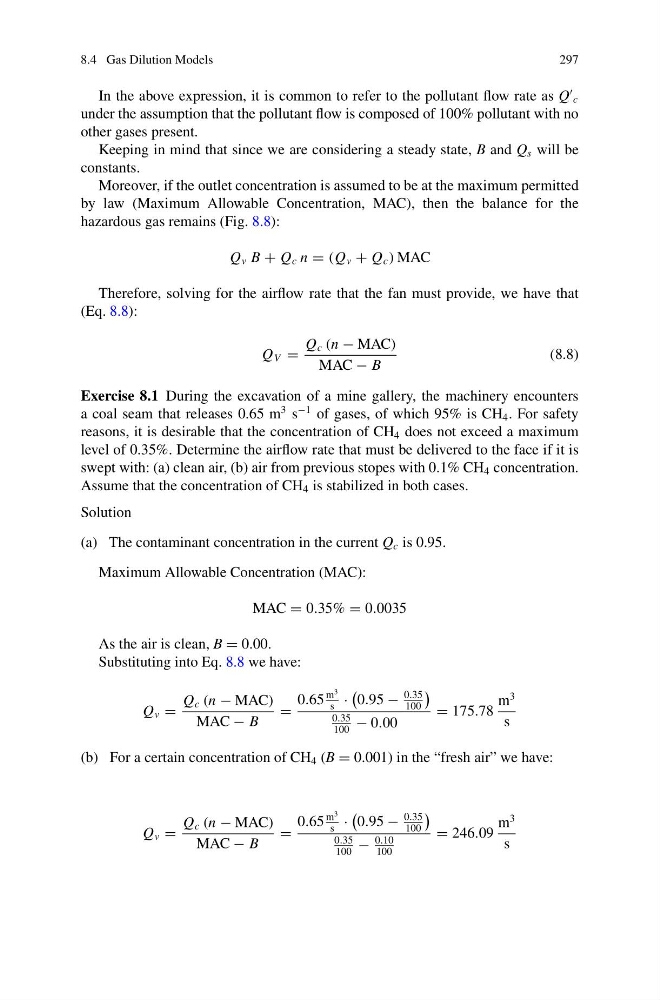
Q v B + Q c n = (Q v + Q c ) MAC
Therefore, solving for the airflow rate that the fan must provide, we have that
(Eq. 8.8):
Q V =
Q c (n − MAC)
MAC − B
(8.8)
Exercise 8.1 During the excavation of a mine gallery, the machinery encounters
a coal seam that releases 0.65 m
3 s
−1 of gases, of which 95% is CH 4 . For safety
reasons, it is desirable that the concentration of CH 4 does not exceed a maximum
level of 0.35%. Determine the airflow rate that must be delivered to the face if it is
swept with: (a) clean air, (b) air from previous stopes with 0.1% CH 4 concentration.
Assume that the concentration of CH 4 is stabilized in both cases.
Solution
(a) The contaminant concentration in the current Q c is 0.95.
Maximum Allowable Concentration (MAC):
MAC = 0.35% = 0.0035
As the air is clean, B = 0.00.
Substituting into Eq. 8.8 we have:
Q v =
Q c (n − MAC)
MAC − B
=
0.65
m
3
s
·
0.95 −
0.35
100
0.35
100
− 0.00
= 175.78
m
3
s
(b) For a certain concentration of CH 4 (B = 0.001) in the “fresh air” we have:
Q v =
Q c (n − MAC)
MAC − B
=
0.65
m
3
s
·
0.95 −
0.35
100
0.35
100
−
0.10
100
= 246.09
m
3
s
297
In the above expression, it is common to refer to the pollutant flow rate as Q
c
under the assumption that the pollutant flow is composed of 100% pollutant with no
other gases present.
Keeping in mind that since we are considering a steady state, B and Q s will be
constants.
Moreover, if the outlet concentration is assumed to be at the maximum permitted
by law (Maximum Allowable Concentration, MAC), then the balance for the
hazardous gas remains (Fig. 8.8):
Q v B + Q c n = (Q v + Q c ) MAC
Therefore, solving for the airflow rate that the fan must provide, we have that
(Eq. 8.8):
Q V =
Q c (n − MAC)
MAC − B
(8.8)
Exercise 8.1 During the excavation of a mine gallery, the machinery encounters
a coal seam that releases 0.65 m
3 s
−1 of gases, of which 95% is CH 4 . For safety
reasons, it is desirable that the concentration of CH 4 does not exceed a maximum
level of 0.35%. Determine the airflow rate that must be delivered to the face if it is
swept with: (a) clean air, (b) air from previous stopes with 0.1% CH 4 concentration.
Assume that the concentration of CH 4 is stabilized in both cases.
Solution
(a) The contaminant concentration in the current Q c is 0.95.
Maximum Allowable Concentration (MAC):
MAC = 0.35% = 0.0035
As the air is clean, B = 0.00.
Substituting into Eq. 8.8 we have:
Q v =
Q c (n − MAC)
MAC − B
=
0.65
m
3
s
·
0.95 −
0.35
100
0.35
100
− 0.00
= 175.78
m
3
s
(b) For a certain concentration of CH 4 (B = 0.001) in the “fresh air” we have:
Q v =
Q c (n − MAC)
MAC − B
=
0.65
m
3
s
·
0.95 −
0.35
100
0.35
100
−
0.10
100
= 246.09
m
3
s