

8.4 Gas Dilution Models
305
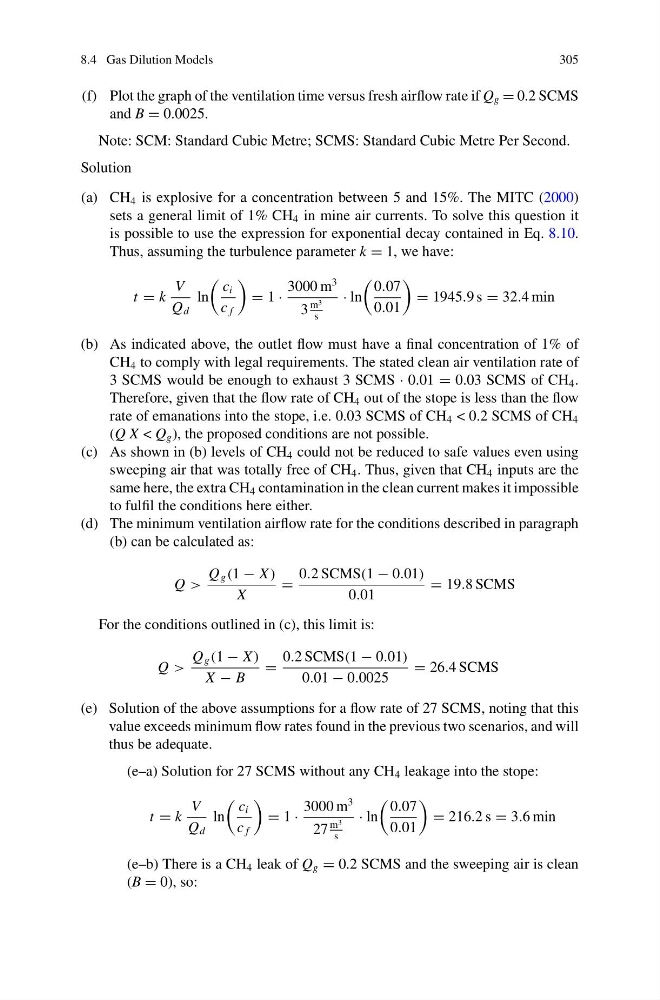
(f) Plot the graph of the ventilation time versus fresh airflow rate if Q g = 0.2 SCMS
and B = 0.0025.
Note: SCM: Standard Cubic Metre; SCMS: Standard Cubic Metre Per Second.
Solution
(a) CH 4 is explosive for a concentration between 5 and 15%. The MITC (2000)
sets a general limit of 1% CH 4 in mine air currents. To solve this question it
is possible to use the expression for exponential decay contained in Eq. 8.10.
Thus, assuming the turbulence parameter k = 1, we have:
t = k
V
Q d
ln
c i
c f
= 1 ·
3000 m
3
3
m 3
s
· ln
0.07
0.01
= 1945.9 s = 32.4 min
(b) As indicated above, the outlet flow must have a final concentration of 1% of
CH 4 to comply with legal requirements. The stated clean air ventilation rate of
3 SCMS would be enough to exhaust 3 SCMS · 0.01 = 0.03 SCMS of CH 4 .
Therefore, given that the flow rate of CH 4 out of the stope is less than the flow
rate of emanations into the stope, i.e. 0.03 SCMS of CH 4 < 0.2 SCMS of CH 4
(Q X < Q g ), the proposed conditions are not possible.
(c) As shown in (b) levels of CH 4 could not be reduced to safe values even using
sweeping air that was totally free of CH 4 . Thus, given that CH 4 inputs are the
same here, the extra CH 4 contamination in the clean current makes it impossible
to fulfil the conditions here either.
(d) The minimum ventilation airflow rate for the conditions described in paragraph
(b) can be calculated as:
Q >
Q g (1 − X )
X
=
0.2 SCMS(1 − 0.01)
0.01
= 19.8 SCMS
For the conditions outlined in (c), this limit is:
Q >
Q g (1 − X )
X − B
=
0.2 SCMS(1 − 0.01)
0.01 − 0.0025
= 26.4 SCMS
(e) Solution of the above assumptions for a flow rate of 27 SCMS, noting that this
value exceeds minimum flow rates found in the previous two scenarios, and will
thus be adequate.
(e–a) Solution for 27 SCMS without any CH 4 leakage into the stope:
t = k
V
Q d
ln
c i
c f
= 1 ·
3000 m
3
27
m 3
s
· ln
0.07
0.01
= 216.2 s = 3.6 min
(e–b) There is a CH 4 leak of Q g = 0.2 SCMS and the sweeping air is clean
(B = 0), so:
305
(f) Plot the graph of the ventilation time versus fresh airflow rate if Q g = 0.2 SCMS
and B = 0.0025.
Note: SCM: Standard Cubic Metre; SCMS: Standard Cubic Metre Per Second.
Solution
(a) CH 4 is explosive for a concentration between 5 and 15%. The MITC (2000)
sets a general limit of 1% CH 4 in mine air currents. To solve this question it
is possible to use the expression for exponential decay contained in Eq. 8.10.
Thus, assuming the turbulence parameter k = 1, we have:
t = k
V
Q d
ln
c i
c f
= 1 ·
3000 m
3
3
m 3
s
· ln
0.07
0.01
= 1945.9 s = 32.4 min
(b) As indicated above, the outlet flow must have a final concentration of 1% of
CH 4 to comply with legal requirements. The stated clean air ventilation rate of
3 SCMS would be enough to exhaust 3 SCMS · 0.01 = 0.03 SCMS of CH 4 .
Therefore, given that the flow rate of CH 4 out of the stope is less than the flow
rate of emanations into the stope, i.e. 0.03 SCMS of CH 4 < 0.2 SCMS of CH 4
(Q X < Q g ), the proposed conditions are not possible.
(c) As shown in (b) levels of CH 4 could not be reduced to safe values even using
sweeping air that was totally free of CH 4 . Thus, given that CH 4 inputs are the
same here, the extra CH 4 contamination in the clean current makes it impossible
to fulfil the conditions here either.
(d) The minimum ventilation airflow rate for the conditions described in paragraph
(b) can be calculated as:
Q >
Q g (1 − X )
X
=
0.2 SCMS(1 − 0.01)
0.01
= 19.8 SCMS
For the conditions outlined in (c), this limit is:
Q >
Q g (1 − X )
X − B
=
0.2 SCMS(1 − 0.01)
0.01 − 0.0025
= 26.4 SCMS
(e) Solution of the above assumptions for a flow rate of 27 SCMS, noting that this
value exceeds minimum flow rates found in the previous two scenarios, and will
thus be adequate.
(e–a) Solution for 27 SCMS without any CH 4 leakage into the stope:
t = k
V
Q d
ln
c i
c f
= 1 ·
3000 m
3
27
m 3
s
· ln
0.07
0.01
= 216.2 s = 3.6 min
(e–b) There is a CH 4 leak of Q g = 0.2 SCMS and the sweeping air is clean
(B = 0), so: