

1.3 Fluid Dynamics
19
1.3.9 Friction Losses
As air flows through a duct or gallery, it loses energy due to friction between fluid
layers, as well as friction between air and walls. In the particular case of mining,
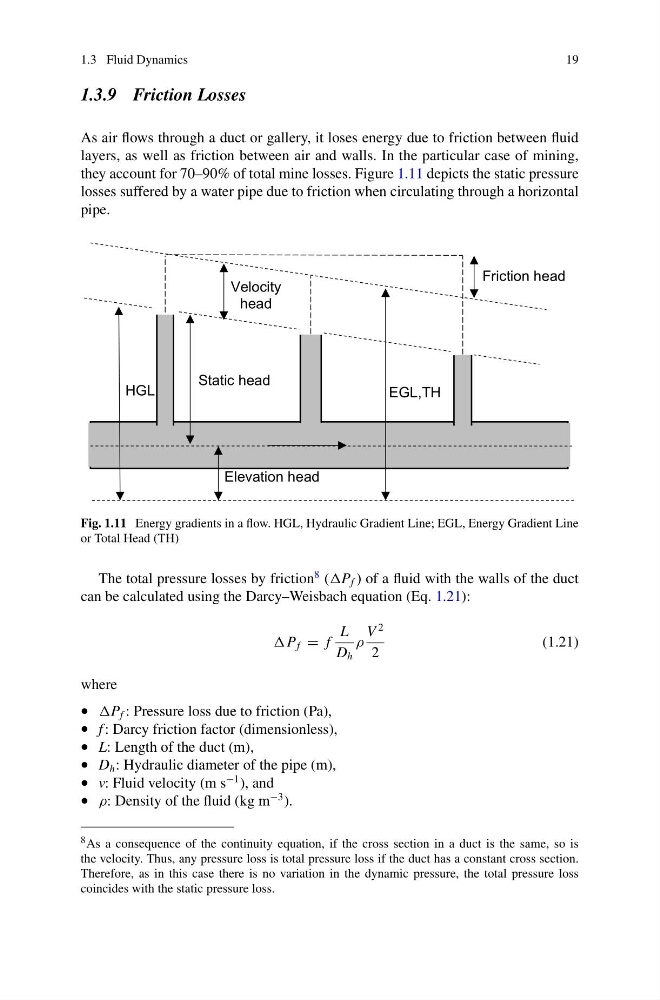
they account for 70–90% of total mine losses. Figure 1.11 depicts the static pressure
losses suffered by a water pipe due to friction when circulating through a horizontal
pipe.
Velocity
head
Friction head
Static head
HGL
EGL,TH
Elevation head
Fig. 1.11 Energy gradients in a flow. HGL, Hydraulic Gradient Line; EGL, Energy Gradient Line
or Total Head (TH)
The total pressure losses by friction
8 ( f ) of a fluid with the walls of the duct
can be calculated using the Darcy–Weisbach equation (Eq. 1.21):
f = f
L
D h
ρ
V
2
2
(1.21)
where
• f : Pressure loss due to friction (Pa),
• f : Darcy friction factor (dimensionless),
• L: Length of the duct (m),
• D h : Hydraulic diameter of the pipe (m),
• v: Fluid velocity (m s
−1 ), and
• ρ: Density of the fluid (kg m
−3 ).
8 As a consequence of the continuity equation, if the cross section in a duct is the same, so is
the velocity. Thus, any pressure loss is total pressure loss if the duct has a constant cross section.
Therefore, as in this case there is no variation in the dynamic pressure, the total pressure loss
coincides with the static pressure loss.
19
1.3.9 Friction Losses
As air flows through a duct or gallery, it loses energy due to friction between fluid
layers, as well as friction between air and walls. In the particular case of mining,
they account for 70–90% of total mine losses. Figure 1.11 depicts the static pressure
losses suffered by a water pipe due to friction when circulating through a horizontal
pipe.
Velocity
head
Friction head
Static head
HGL
EGL,TH
Elevation head
Fig. 1.11 Energy gradients in a flow. HGL, Hydraulic Gradient Line; EGL, Energy Gradient Line
or Total Head (TH)
The total pressure losses by friction
8 ( f ) of a fluid with the walls of the duct
can be calculated using the Darcy–Weisbach equation (Eq. 1.21):
f = f
L
D h
ρ
V
2
2
(1.21)
where
• f : Pressure loss due to friction (Pa),
• f : Darcy friction factor (dimensionless),
• L: Length of the duct (m),
• D h : Hydraulic diameter of the pipe (m),
• v: Fluid velocity (m s
−1 ), and
• ρ: Density of the fluid (kg m
−3 ).
8 As a consequence of the continuity equation, if the cross section in a duct is the same, so is
the velocity. Thus, any pressure loss is total pressure loss if the duct has a constant cross section.
Therefore, as in this case there is no variation in the dynamic pressure, the total pressure loss
coincides with the static pressure loss.