

18
1 Fundamental Concepts of Fluid Mechanics for Mine Ventilation
indicate that if Re < 2000 the flow is in the laminar regime and if Re > 4000 the flow
is turbulent. Between 2000 and 4000 is the transition regime. Novitzky (1962) notes
that the change of regime from laminar to turbulent in mining stopes occurs at Re
around 1000 to 1500.
It will be seen below that most principal ventilation circuits operate in a turbulent
regime. This is more a consequence of the large diameters of the galleries than the
high speeds at which the air moves in them. The turbulent regime, characterized by
the formation of internal eddies, is desirable in mine ventilation, since it improves
the mixture of clean gases with toxic gases, favouring their evacuation.
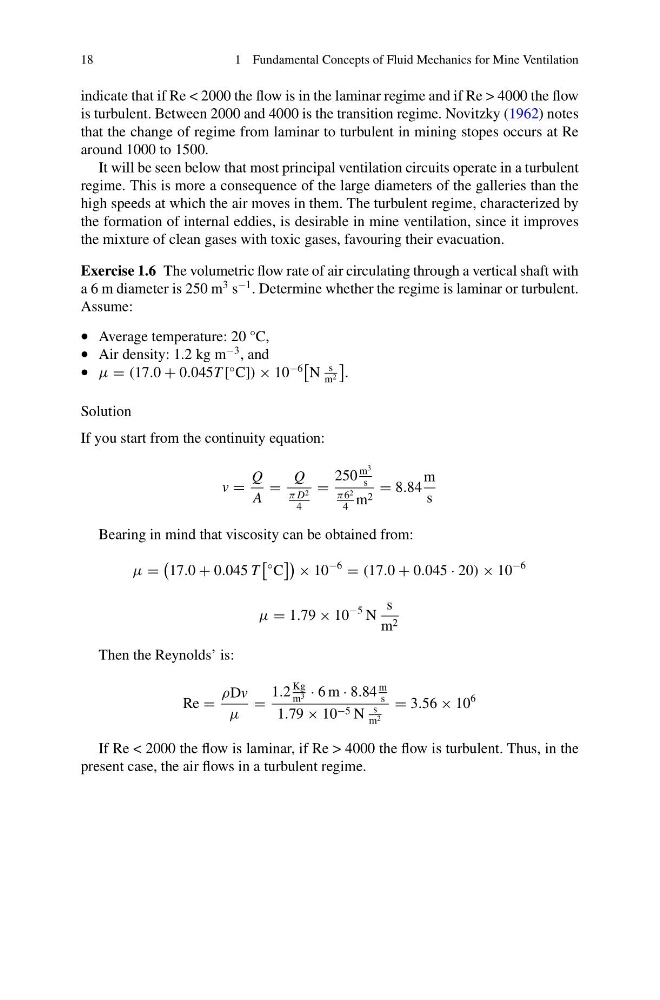
Exercise 1.6 The volumetric flow rate of air circulating through a vertical shaft with
a 6 m diameter is 250 m
3 s
−1 . Determine whether the regime is laminar or turbulent.
Assume:
• Average temperature: 20 °C,
• Air density: 1.2 kg m
−3 , and
• μ = (17.0 + 0.045T [
◦ C]) × 10
−6
N
s
m 2
.
Solution
If you start from the continuity equation:
v =
Q
A
=
Q
π D 2
4
=
250
m
3
s
π6 2
4
m 2
= 8.84
m
s
Bearing in mind that viscosity can be obtained from:
μ =
17.0 + 0.045 T
◦ C
× 10
−6
= (17.0 + 0.045 · 20) × 10
−6
μ = 1.79 × 10
−5 N
s
m 2
Then the Reynolds’ is:
Re =
ρDv
μ
=
1.2
Kg
m 3 · 6 m · 8.84
m
s
1.79 × 10 −5 N
s
m 2
= 3.56 × 10
6
If Re < 2000 the flow is laminar, if Re > 4000 the flow is turbulent. Thus, in the
present case, the air flows in a turbulent regime.
1 Fundamental Concepts of Fluid Mechanics for Mine Ventilation
indicate that if Re < 2000 the flow is in the laminar regime and if Re > 4000 the flow
is turbulent. Between 2000 and 4000 is the transition regime. Novitzky (1962) notes
that the change of regime from laminar to turbulent in mining stopes occurs at Re
around 1000 to 1500.
It will be seen below that most principal ventilation circuits operate in a turbulent
regime. This is more a consequence of the large diameters of the galleries than the
high speeds at which the air moves in them. The turbulent regime, characterized by
the formation of internal eddies, is desirable in mine ventilation, since it improves
the mixture of clean gases with toxic gases, favouring their evacuation.
Exercise 1.6 The volumetric flow rate of air circulating through a vertical shaft with
a 6 m diameter is 250 m
3 s
−1 . Determine whether the regime is laminar or turbulent.
Assume:
• Average temperature: 20 °C,
• Air density: 1.2 kg m
−3 , and
• μ = (17.0 + 0.045T [
◦ C]) × 10
−6
N
s
m 2
.
Solution
If you start from the continuity equation:
v =
Q
A
=
Q
π D 2
4
=
250
m
3
s
π6 2
4
m 2
= 8.84
m
s
Bearing in mind that viscosity can be obtained from:
μ =
17.0 + 0.045 T
◦ C
× 10
−6
= (17.0 + 0.045 · 20) × 10
−6
μ = 1.79 × 10
−5 N
s
m 2
Then the Reynolds’ is:
Re =
ρDv
μ
=
1.2
Kg
m 3 · 6 m · 8.84
m
s
1.79 × 10 −5 N
s
m 2
= 3.56 × 10
6
If Re < 2000 the flow is laminar, if Re > 4000 the flow is turbulent. Thus, in the
present case, the air flows in a turbulent regime.