

292
8 Secondary Ventilation
Table 8.1 Gases emitted according to the type of explosive. Taken from Greig (1982)
Explosive
Gas emitted
(m 3 kg
−1
explosive )
CO
NO + NO 2
CO 2
NH 3
Ammon dynamite
0.03
0.004
0.06
0.003
Ammon gelignites
0.05
0.006
0.07
0.003
ANFO
0.03
0.007
0.05
0.009
Dynagel
0.03
0.005
0.07
0.003
Watergel
0.09
0.002
0.05
–
2015). Using this criterion NO 2 has a toxicity 6.5 times greater than that of CO. This
index is expressed as (Eq. 8.6):
L CO = CO + 6.5 NO X
(8.6)
where
• CO: Volume emitted per unit mass of explosive (l kg
−1 ), and
• NO X : Volume emitted per unit mass of explosive (l kg
−1 ).
The composition of blasting fumes varies greatly depending on the composition
of the explosive, so it is always best to refer to any data supplied by the manufacturer.
However, these data are not always comprehensive, and so great disparities can be
expected between these and practice. This is because tests on explosives are often
carried out in special chambers with only small masses of explosives. This results in a
reduction in the efficiency of the explosion reaction and means that some explosives
are tested at sizes below the critical diameter thus no detonation reaction takes place.
In this case, stoichiometric estimations are frequent.
In addition, many differences exist between the conditions of humidity and
temperature in the test chamber compared to the locations where an explosive will
be used. Not only this, unlike in a test chamber, within a mine, there is the possibility
of the gases reacting with the rock and escaping through cracks. Here, the classic
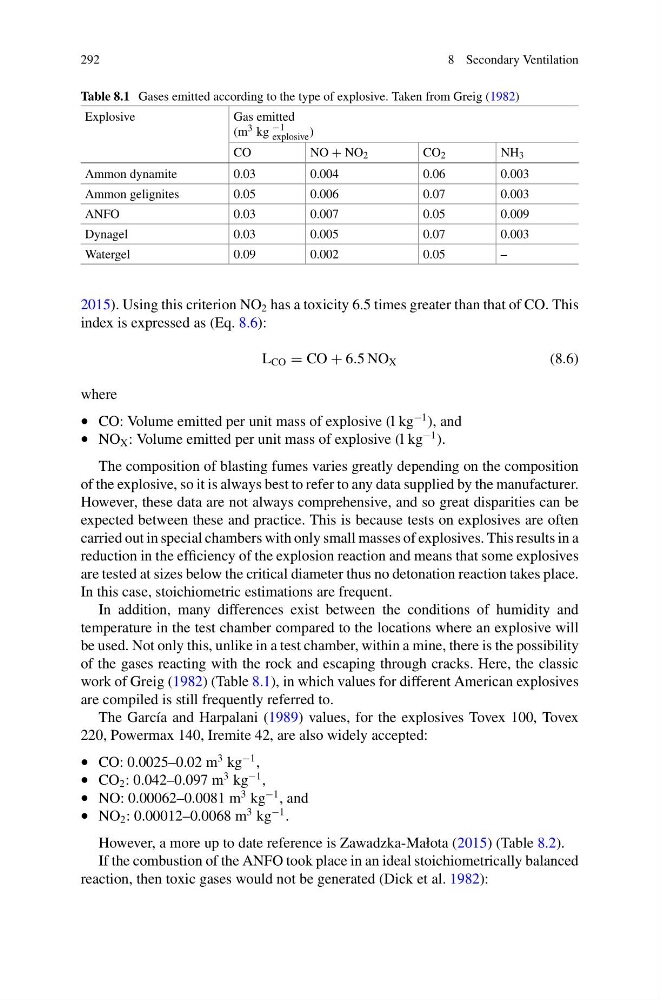
work of Greig (1982) (Table 8.1), in which values for different American explosives
are compiled is still frequently referred to.
The García and Harpalani (1989) values, for the explosives Tovex 100, Tovex
220, Powermax 140, Iremite 42, are also widely accepted:
• CO: 0.0025–0.02 m
3 kg
−1 ,
• CO 2 : 0.042–0.097 m
3 kg
−1 ,
• NO: 0.00062–0.0081 m
3 kg
−1 , and
• NO 2 : 0.00012–0.0068 m
3 kg
−1 .
However, a more up to date reference is Zawadzka-Małota (2015) (Table 8.2).
If the combustion of the ANFO took place in an ideal stoichiometrically balanced
reaction, then toxic gases would not be generated (Dick et al. 1982):
8 Secondary Ventilation
Table 8.1 Gases emitted according to the type of explosive. Taken from Greig (1982)
Explosive
Gas emitted
(m 3 kg
−1
explosive )
CO
NO + NO 2
CO 2
NH 3
Ammon dynamite
0.03
0.004
0.06
0.003
Ammon gelignites
0.05
0.006
0.07
0.003
ANFO
0.03
0.007
0.05
0.009
Dynagel
0.03
0.005
0.07
0.003
Watergel
0.09
0.002
0.05
–
2015). Using this criterion NO 2 has a toxicity 6.5 times greater than that of CO. This
index is expressed as (Eq. 8.6):
L CO = CO + 6.5 NO X
(8.6)
where
• CO: Volume emitted per unit mass of explosive (l kg
−1 ), and
• NO X : Volume emitted per unit mass of explosive (l kg
−1 ).
The composition of blasting fumes varies greatly depending on the composition
of the explosive, so it is always best to refer to any data supplied by the manufacturer.
However, these data are not always comprehensive, and so great disparities can be
expected between these and practice. This is because tests on explosives are often
carried out in special chambers with only small masses of explosives. This results in a
reduction in the efficiency of the explosion reaction and means that some explosives
are tested at sizes below the critical diameter thus no detonation reaction takes place.
In this case, stoichiometric estimations are frequent.
In addition, many differences exist between the conditions of humidity and
temperature in the test chamber compared to the locations where an explosive will
be used. Not only this, unlike in a test chamber, within a mine, there is the possibility
of the gases reacting with the rock and escaping through cracks. Here, the classic
work of Greig (1982) (Table 8.1), in which values for different American explosives
are compiled is still frequently referred to.
The García and Harpalani (1989) values, for the explosives Tovex 100, Tovex
220, Powermax 140, Iremite 42, are also widely accepted:
• CO: 0.0025–0.02 m
3 kg
−1 ,
• CO 2 : 0.042–0.097 m
3 kg
−1 ,
• NO: 0.00062–0.0081 m
3 kg
−1 , and
• NO 2 : 0.00012–0.0068 m
3 kg
−1 .
However, a more up to date reference is Zawadzka-Małota (2015) (Table 8.2).
If the combustion of the ANFO took place in an ideal stoichiometrically balanced
reaction, then toxic gases would not be generated (Dick et al. 1982):