

8.3 Required Airflow Rate at the Face
293
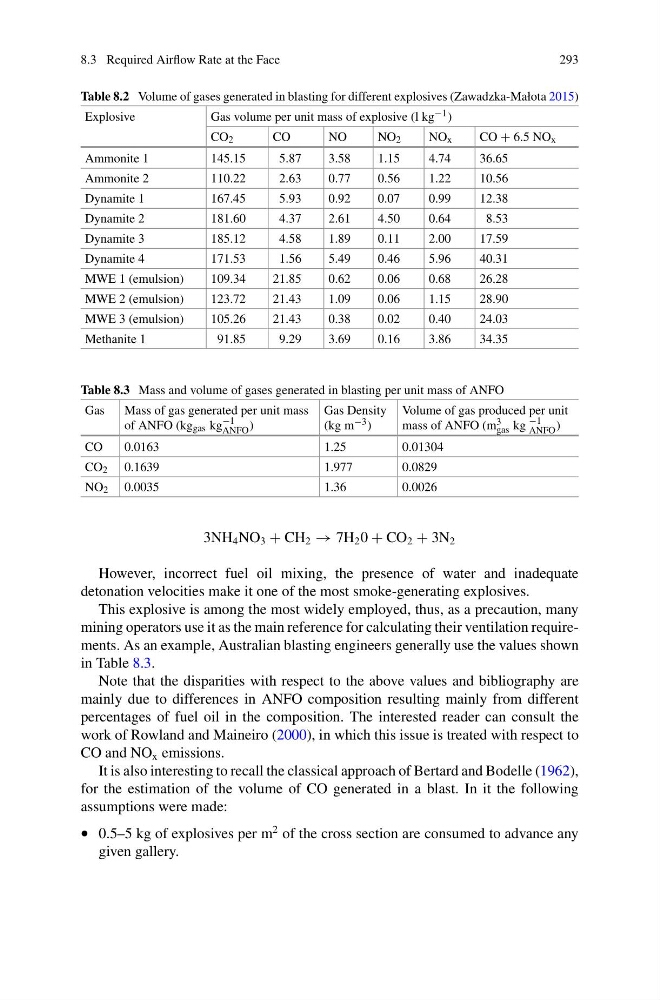
Table 8.2 Volume of gases generated in blasting for different explosives (Zawadzka-Małota 2015)
Explosive
Gas volume per unit mass of explosive (l kg −1 )
CO 2
CO
NO
NO 2
NO x
CO + 6.5 NO x
Ammonite 1
145.15
5.87
3.58
1.15
4.74
36.65
Ammonite 2
110.22
2.63
0.77
0.56
1.22
10.56
Dynamite 1
167.45
5.93
0.92
0.07
0.99
12.38
Dynamite 2
181.60
4.37
2.61
4.50
0.64
8.53
Dynamite 3
185.12
4.58
1.89
0.11
2.00
17.59
Dynamite 4
171.53
1.56
5.49
0.46
5.96
40.31
MWE 1 (emulsion)
109.34
21.85
0.62
0.06
0.68
26.28
MWE 2 (emulsion)
123.72
21.43
1.09
0.06
1.15
28.90
MWE 3 (emulsion)
105.26
21.43
0.38
0.02
0.40
24.03
Methanite 1
91.85
9.29
3.69
0.16
3.86
34.35
Table 8.3 Mass and volume of gases generated in blasting per unit mass of ANFO
Gas
Mass of gas generated per unit mass
of ANFO (kg gas kg
−1
ANFO )
Gas Density
(kg m −3 )
Volume of gas produced per unit
mass of ANFO (m 3
gas kg
−1
ANFO )
CO
0.0163
1.25
0.01304
CO 2 0.1639
1.977
0.0829
NO 2 0.0035
1.36
0.0026
3NH 4 NO 3 + CH 2 → 7H 2 0 + CO 2 + 3N 2
However, incorrect fuel oil mixing, the presence of water and inadequate
detonation velocities make it one of the most smoke-generating explosives.
This explosive is among the most widely employed, thus, as a precaution, many
mining operators use it as the main reference for calculating their ventilation requirements. As an example, Australian blasting engineers generally use the values shown
in Table 8.3.
Note that the disparities with respect to the above values and bibliography are
mainly due to differences in ANFO composition resulting mainly from different
percentages of fuel oil in the composition. The interested reader can consult the
work of Rowland and Maineiro (2000), in which this issue is treated with respect to
CO and NO x emissions.
It is also interesting to recall the classical approach of Bertard and Bodelle (1962),
for the estimation of the volume of CO generated in a blast. In it the following
assumptions were made:
• 0.5–5 kg of explosives per m
2 of the cross section are consumed to advance any
given gallery.
293
Table 8.2 Volume of gases generated in blasting for different explosives (Zawadzka-Małota 2015)
Explosive
Gas volume per unit mass of explosive (l kg −1 )
CO 2
CO
NO
NO 2
NO x
CO + 6.5 NO x
Ammonite 1
145.15
5.87
3.58
1.15
4.74
36.65
Ammonite 2
110.22
2.63
0.77
0.56
1.22
10.56
Dynamite 1
167.45
5.93
0.92
0.07
0.99
12.38
Dynamite 2
181.60
4.37
2.61
4.50
0.64
8.53
Dynamite 3
185.12
4.58
1.89
0.11
2.00
17.59
Dynamite 4
171.53
1.56
5.49
0.46
5.96
40.31
MWE 1 (emulsion)
109.34
21.85
0.62
0.06
0.68
26.28
MWE 2 (emulsion)
123.72
21.43
1.09
0.06
1.15
28.90
MWE 3 (emulsion)
105.26
21.43
0.38
0.02
0.40
24.03
Methanite 1
91.85
9.29
3.69
0.16
3.86
34.35
Table 8.3 Mass and volume of gases generated in blasting per unit mass of ANFO
Gas
Mass of gas generated per unit mass
of ANFO (kg gas kg
−1
ANFO )
Gas Density
(kg m −3 )
Volume of gas produced per unit
mass of ANFO (m 3
gas kg
−1
ANFO )
CO
0.0163
1.25
0.01304
CO 2 0.1639
1.977
0.0829
NO 2 0.0035
1.36
0.0026
3NH 4 NO 3 + CH 2 → 7H 2 0 + CO 2 + 3N 2
However, incorrect fuel oil mixing, the presence of water and inadequate
detonation velocities make it one of the most smoke-generating explosives.
This explosive is among the most widely employed, thus, as a precaution, many
mining operators use it as the main reference for calculating their ventilation requirements. As an example, Australian blasting engineers generally use the values shown
in Table 8.3.
Note that the disparities with respect to the above values and bibliography are
mainly due to differences in ANFO composition resulting mainly from different
percentages of fuel oil in the composition. The interested reader can consult the
work of Rowland and Maineiro (2000), in which this issue is treated with respect to
CO and NO x emissions.
It is also interesting to recall the classical approach of Bertard and Bodelle (1962),
for the estimation of the volume of CO generated in a blast. In it the following
assumptions were made:
• 0.5–5 kg of explosives per m
2 of the cross section are consumed to advance any
given gallery.