

8.3 Required Airflow Rate at the Face
291
• South Africa: 0.063 m
3 s
−1 · Pw (kW), and
• Spain: 0.066 m
3 s
−1 · Pw (kW) (ITC 04.7.02 [MITC 2000]).
The main criticism that can be made of this approach is that, in the case of
mines located at high altitude, gaseous emissions from diesel engines are much
more dangerous. In any case, the above values should be taken as a minimum.
Overall, the Mine Safety and Health Administration (MSHA) states that a twofold
increase in airflow sweeping a face will half Diesel Particulate Matter (DPM). The
same authority publishes a Particulate Index (PI) for all diesel equipment approved
for use in mines, which establishes the minimum air quantity required to lower the
DPM concentration to 1000 μg m
−3 (800 TC μg m
−3 ).
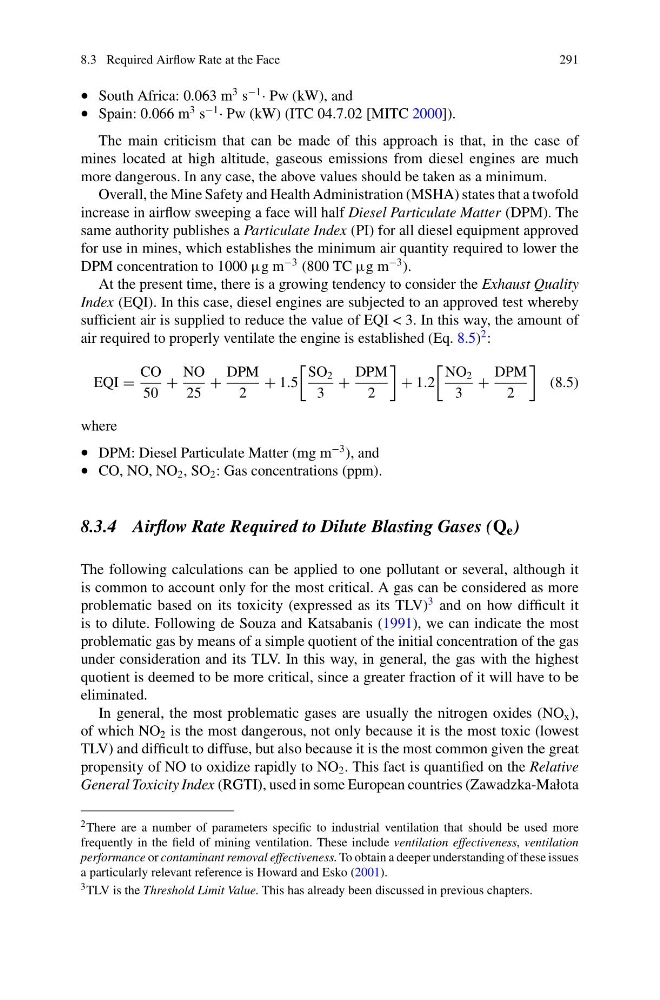
At the present time, there is a growing tendency to consider the Exhaust Quality
Index (EQI). In this case, diesel engines are subjected to an approved test whereby
sufficient air is supplied to reduce the value of EQI < 3. In this way, the amount of
air required to properly ventilate the engine is established (Eq. 8.5)
2 :
EQI =
CO
50
+
NO
25
+
DPM
2
+ 1.5
SO 2
3
+
DPM
2
+ 1.2
NO 2
3
+
DPM
2
(8.5)
where
• DPM: Diesel Particulate Matter (mg m
−3 ), and
• CO, NO, NO 2 , SO 2 : Gas concentrations (ppm).
8.3.4 Airflow Rate Required to Dilute Blasting Gases (Q e )
The following calculations can be applied to one pollutant or several, although it
is common to account only for the most critical. A gas can be considered as more
problematic based on its toxicity (expressed as its TLV)
3 and on how difficult it
is to dilute. Following de Souza and Katsabanis (1991), we can indicate the most
problematic gas by means of a simple quotient of the initial concentration of the gas
under consideration and its TLV. In this way, in general, the gas with the highest
quotient is deemed to be more critical, since a greater fraction of it will have to be
eliminated.
In general, the most problematic gases are usually the nitrogen oxides (NO x ),
of which NO 2 is the most dangerous, not only because it is the most toxic (lowest
TLV) and difficult to diffuse, but also because it is the most common given the great
propensity of NO to oxidize rapidly to NO 2 . This fact is quantified on the Relative
General Toxicity Index (RGTI), used in some European countries (Zawadzka-Małota
2 There are a number of parameters specific to industrial ventilation that should be used more
frequently in the field of mining ventilation. These include ventilation effectiveness, ventilation
performance or contaminant removal effectiveness. To obtain a deeper understanding of these issues
a particularly relevant reference is Howard and Esko (2001).
3 TLV is the Threshold Limit Value. This has already been discussed in previous chapters.
291
• South Africa: 0.063 m
3 s
−1 · Pw (kW), and
• Spain: 0.066 m
3 s
−1 · Pw (kW) (ITC 04.7.02 [MITC 2000]).
The main criticism that can be made of this approach is that, in the case of
mines located at high altitude, gaseous emissions from diesel engines are much
more dangerous. In any case, the above values should be taken as a minimum.
Overall, the Mine Safety and Health Administration (MSHA) states that a twofold
increase in airflow sweeping a face will half Diesel Particulate Matter (DPM). The
same authority publishes a Particulate Index (PI) for all diesel equipment approved
for use in mines, which establishes the minimum air quantity required to lower the
DPM concentration to 1000 μg m
−3 (800 TC μg m
−3 ).
At the present time, there is a growing tendency to consider the Exhaust Quality
Index (EQI). In this case, diesel engines are subjected to an approved test whereby
sufficient air is supplied to reduce the value of EQI < 3. In this way, the amount of
air required to properly ventilate the engine is established (Eq. 8.5)
2 :
EQI =
CO
50
+
NO
25
+
DPM
2
+ 1.5
SO 2
3
+
DPM
2
+ 1.2
NO 2
3
+
DPM
2
(8.5)
where
• DPM: Diesel Particulate Matter (mg m
−3 ), and
• CO, NO, NO 2 , SO 2 : Gas concentrations (ppm).
8.3.4 Airflow Rate Required to Dilute Blasting Gases (Q e )
The following calculations can be applied to one pollutant or several, although it
is common to account only for the most critical. A gas can be considered as more
problematic based on its toxicity (expressed as its TLV)
3 and on how difficult it
is to dilute. Following de Souza and Katsabanis (1991), we can indicate the most
problematic gas by means of a simple quotient of the initial concentration of the gas
under consideration and its TLV. In this way, in general, the gas with the highest
quotient is deemed to be more critical, since a greater fraction of it will have to be
eliminated.
In general, the most problematic gases are usually the nitrogen oxides (NO x ),
of which NO 2 is the most dangerous, not only because it is the most toxic (lowest
TLV) and difficult to diffuse, but also because it is the most common given the great
propensity of NO to oxidize rapidly to NO 2 . This fact is quantified on the Relative
General Toxicity Index (RGTI), used in some European countries (Zawadzka-Małota
2 There are a number of parameters specific to industrial ventilation that should be used more
frequently in the field of mining ventilation. These include ventilation effectiveness, ventilation
performance or contaminant removal effectiveness. To obtain a deeper understanding of these issues
a particularly relevant reference is Howard and Esko (2001).
3 TLV is the Threshold Limit Value. This has already been discussed in previous chapters.