

7.3 Gas Movements During Fires
255
In the case of descending ventilation (Fig. 7.3b), at point D 1 the air cross section is
reduced by throttling. From D 1 to D 2 rollback increases, until it reaches a maximum
at D 2 , where interruptions of the airflow (stagnation) are possible. At D 4 it undergoes
rollback similar to the previous point. Finally, at D 5 throttling takes place once again,
with consequences similar to D 1 .
It should be noted that the severity of a fire, as long as no action is taken against
it, is conditioned by the point in the mine where it originates. Thus, the closer it
occurs to the downcast shaft, the worse it will be, as fumes and gases will affect
more areas of the mine. Conversely, a fire in the vicinity of the upcast shaft would
have a lesser capacity to spread gases through the mine, so its effects will be more
limited. If the fire takes place in a stope or steeply inclined excavation, it can be much
more problematic because, as a result of the type of work carried out in such areas,
it can be difficult to put fire barriers in place. In such cases, appropriate channelling
of ventilation flows through them is of vital importance.
7.4 Estimating Fire Pressures
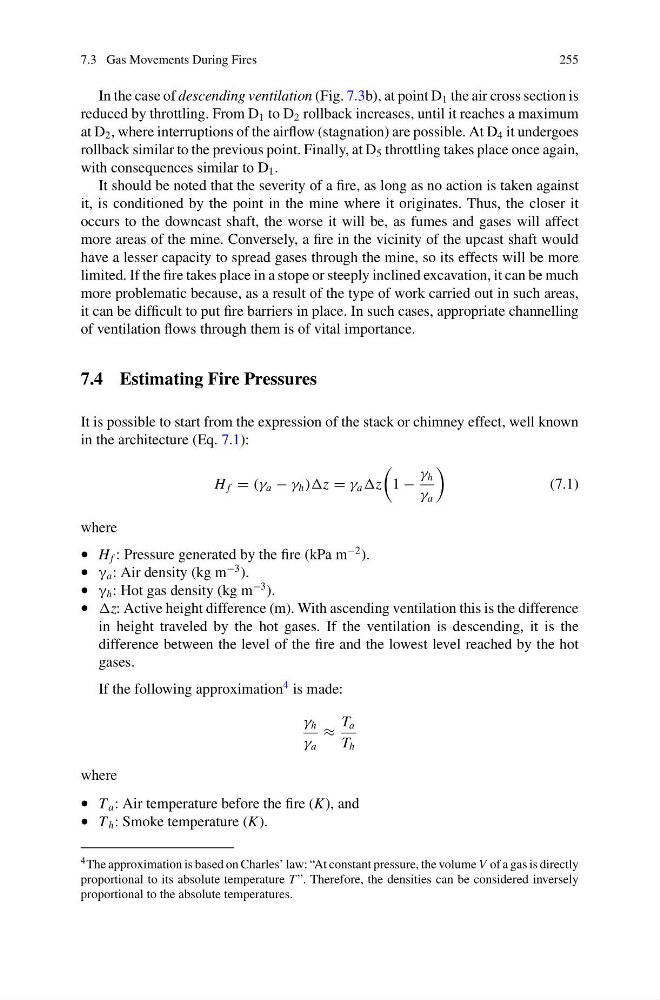
It is possible to start from the expression of the stack or chimney effect, well known
in the architecture (Eq. 7.1):
H f = (γ a − γ h ))z = γ a z
1 −
γ h
γ a
(7.1)
where
• H f : Pressure generated by the fire (kPa m
−2 ).
• γ a : Air density (kg m
−3 ).
• γ h : Hot gas density (kg m
−3 ).
• z: Active height difference (m). With ascending ventilation this is the difference
in height traveled by the hot gases. If the ventilation is descending, it is the
difference between the level of the fire and the lowest level reached by the hot
gases.
If the following approximation
4 is made:
γ h
γ a
≈
T a
T h
where
• T a : Air temperature before the fire (K), and
• T h : Smoke temperature (K).
4 The approximation is based on Charles’ law: “At constant pressure, the volume V of a gas is directly
proportional to its absolute temperature T ”. Therefore, the densities can be considered inversely
proportional to the absolute temperatures.
255
In the case of descending ventilation (Fig. 7.3b), at point D 1 the air cross section is
reduced by throttling. From D 1 to D 2 rollback increases, until it reaches a maximum
at D 2 , where interruptions of the airflow (stagnation) are possible. At D 4 it undergoes
rollback similar to the previous point. Finally, at D 5 throttling takes place once again,
with consequences similar to D 1 .
It should be noted that the severity of a fire, as long as no action is taken against
it, is conditioned by the point in the mine where it originates. Thus, the closer it
occurs to the downcast shaft, the worse it will be, as fumes and gases will affect
more areas of the mine. Conversely, a fire in the vicinity of the upcast shaft would
have a lesser capacity to spread gases through the mine, so its effects will be more
limited. If the fire takes place in a stope or steeply inclined excavation, it can be much
more problematic because, as a result of the type of work carried out in such areas,
it can be difficult to put fire barriers in place. In such cases, appropriate channelling
of ventilation flows through them is of vital importance.
7.4 Estimating Fire Pressures
It is possible to start from the expression of the stack or chimney effect, well known
in the architecture (Eq. 7.1):
H f = (γ a − γ h ))z = γ a z
1 −
γ h
γ a
(7.1)
where
• H f : Pressure generated by the fire (kPa m
−2 ).
• γ a : Air density (kg m
−3 ).
• γ h : Hot gas density (kg m
−3 ).
• z: Active height difference (m). With ascending ventilation this is the difference
in height traveled by the hot gases. If the ventilation is descending, it is the
difference between the level of the fire and the lowest level reached by the hot
gases.
If the following approximation
4 is made:
γ h
γ a
≈
T a
T h
where
• T a : Air temperature before the fire (K), and
• T h : Smoke temperature (K).
4 The approximation is based on Charles’ law: “At constant pressure, the volume V of a gas is directly
proportional to its absolute temperature T ”. Therefore, the densities can be considered inversely
proportional to the absolute temperatures.