

254
7 The Role of Ventilation in Fires and Explosions
be to direct fogging sprays towards the roof so that an air induction effect will aid
downwards circulation.
Mine fires cause an increase in the volume of gases downstream of the fire. This
is the consequence of both gas expansion and the incorporation of combustion products –gases and water– into the airflow. This gas expansion increases the speed of
the dowstream air, which, in turn, is responsible for an increase in pressure shock
losses as they depend on the square of the air speed. In other words, what takes place
is a local increase in the resistance of the airway. This phenomenon is termed the
choke or throttling effect. Airflow reduction due to this effect can range from around
10–25% relative to conditions before the fire started (Gillies et al. 2004).
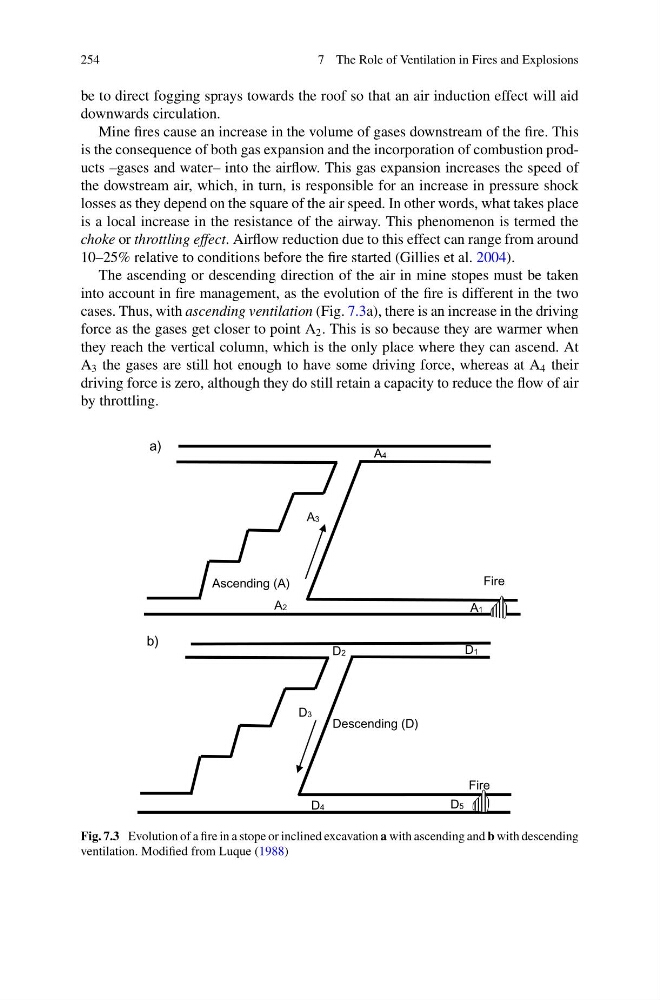
The ascending or descending direction of the air in mine stopes must be taken
into account in fire management, as the evolution of the fire is different in the two
cases. Thus, with ascending ventilation (Fig. 7.3a), there is an increase in the driving
force as the gases get closer to point A 2 . This is so because they are warmer when
they reach the vertical column, which is the only place where they can ascend. At
A 3 the gases are still hot enough to have some driving force, whereas at A 4 their
driving force is zero, although they do still retain a capacity to reduce the flow of air
by throttling.
Ascending (A)
A1
A2
A3
A4
Descending (D)
D5
D4
D3
D1
D2
a)
b)
Fire
Fire
Fig. 7.3 Evolution of a fire in a stope or inclined excavation a with ascending and b with descending
ventilation. Modified from Luque (1988)
7 The Role of Ventilation in Fires and Explosions
be to direct fogging sprays towards the roof so that an air induction effect will aid
downwards circulation.
Mine fires cause an increase in the volume of gases downstream of the fire. This
is the consequence of both gas expansion and the incorporation of combustion products –gases and water– into the airflow. This gas expansion increases the speed of
the dowstream air, which, in turn, is responsible for an increase in pressure shock
losses as they depend on the square of the air speed. In other words, what takes place
is a local increase in the resistance of the airway. This phenomenon is termed the
choke or throttling effect. Airflow reduction due to this effect can range from around
10–25% relative to conditions before the fire started (Gillies et al. 2004).
The ascending or descending direction of the air in mine stopes must be taken
into account in fire management, as the evolution of the fire is different in the two
cases. Thus, with ascending ventilation (Fig. 7.3a), there is an increase in the driving
force as the gases get closer to point A 2 . This is so because they are warmer when
they reach the vertical column, which is the only place where they can ascend. At
A 3 the gases are still hot enough to have some driving force, whereas at A 4 their
driving force is zero, although they do still retain a capacity to reduce the flow of air
by throttling.
Ascending (A)
A1
A2
A3
A4
Descending (D)
D5
D4
D3
D1
D2
a)
b)
Fire
Fire
Fig. 7.3 Evolution of a fire in a stope or inclined excavation a with ascending and b with descending
ventilation. Modified from Luque (1988)