

7.2 Conditions for the Occurrence of Fire
253
With regard to combustible materials (fuels), they can be found in:
• Gas accumulation zones;
• Explosive dust accumulation areas;
• Rubber conveyor belts;
2
• Wooden supports for mine slopes and access shafts, boarded areas and underground pumping stations;
• Diesel engines;
• Places where spontaneous combustion of coal may take place; and
• Oxidation zones of pyrites.
An important reference document for the selection of suitable equipment in explosive
atmospheres is Directive 2014/EU-ATEX.
7.3 Gas Movements During Fires
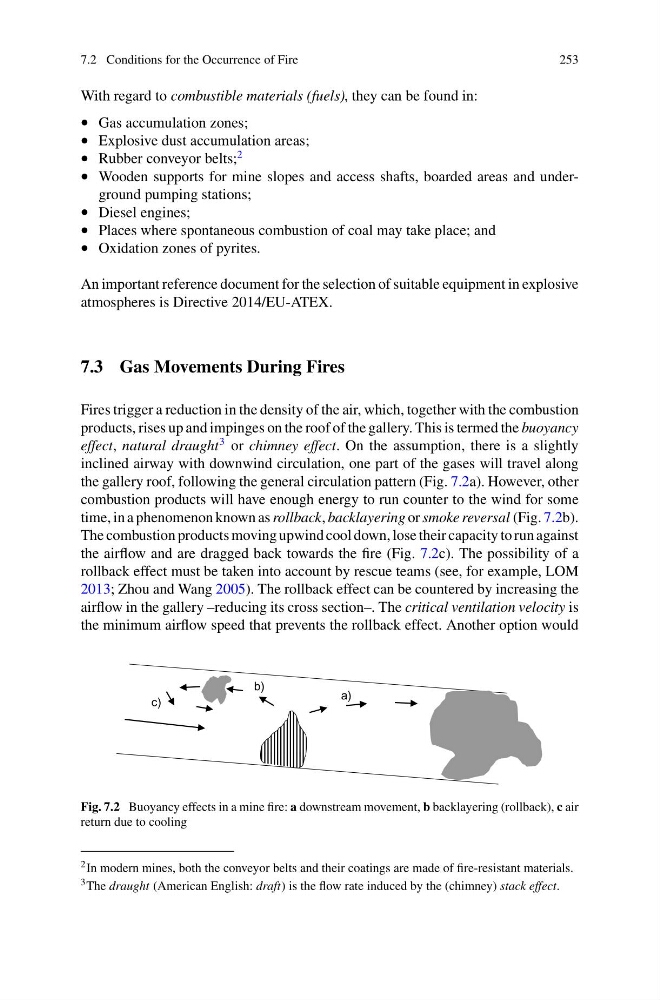
Fires trigger a reduction in the density of the air, which, together with the combustion
products, rises up and impinges on the roof of the gallery. This is termed the buoyancy
effect, natural draught
3 or chimney effect. On the assumption, there is a slightly
inclined airway with downwind circulation, one part of the gases will travel along
the gallery roof, following the general circulation pattern (Fig. 7.2a). However, other
combustion products will have enough energy to run counter to the wind for some
time, in a phenomenon known as rollback, backlayering or smoke reversal (Fig. 7.2b).
The combustion products moving upwind cool down, lose their capacity to run against
the airflow and are dragged back towards the fire (Fig. 7.2c). The possibility of a
rollback effect must be taken into account by rescue teams (see, for example, LOM
2013; Zhou and Wang 2005). The rollback effect can be countered by increasing the
airflow in the gallery –reducing its cross section–. The critical ventilation velocity is
the minimum airflow speed that prevents the rollback effect. Another option would
a)
b)
c)
Fig. 7.2 Buoyancy effects in a mine fire: a downstream movement, b backlayering (rollback), c air
return due to cooling
2 In modern mines, both the conveyor belts and their coatings are made of fire-resistant materials.
3 The draught (American English: draft) is the flow rate induced by the (chimney) stack effect.
253
With regard to combustible materials (fuels), they can be found in:
• Gas accumulation zones;
• Explosive dust accumulation areas;
• Rubber conveyor belts;
2
• Wooden supports for mine slopes and access shafts, boarded areas and underground pumping stations;
• Diesel engines;
• Places where spontaneous combustion of coal may take place; and
• Oxidation zones of pyrites.
An important reference document for the selection of suitable equipment in explosive
atmospheres is Directive 2014/EU-ATEX.
7.3 Gas Movements During Fires
Fires trigger a reduction in the density of the air, which, together with the combustion
products, rises up and impinges on the roof of the gallery. This is termed the buoyancy
effect, natural draught
3 or chimney effect. On the assumption, there is a slightly
inclined airway with downwind circulation, one part of the gases will travel along
the gallery roof, following the general circulation pattern (Fig. 7.2a). However, other
combustion products will have enough energy to run counter to the wind for some
time, in a phenomenon known as rollback, backlayering or smoke reversal (Fig. 7.2b).
The combustion products moving upwind cool down, lose their capacity to run against
the airflow and are dragged back towards the fire (Fig. 7.2c). The possibility of a
rollback effect must be taken into account by rescue teams (see, for example, LOM
2013; Zhou and Wang 2005). The rollback effect can be countered by increasing the
airflow in the gallery –reducing its cross section–. The critical ventilation velocity is
the minimum airflow speed that prevents the rollback effect. Another option would
a)
b)
c)
Fig. 7.2 Buoyancy effects in a mine fire: a downstream movement, b backlayering (rollback), c air
return due to cooling
2 In modern mines, both the conveyor belts and their coatings are made of fire-resistant materials.
3 The draught (American English: draft) is the flow rate induced by the (chimney) stack effect.