

240
6 Fans and Flow Control Devices
2
1
Q
M
Solution
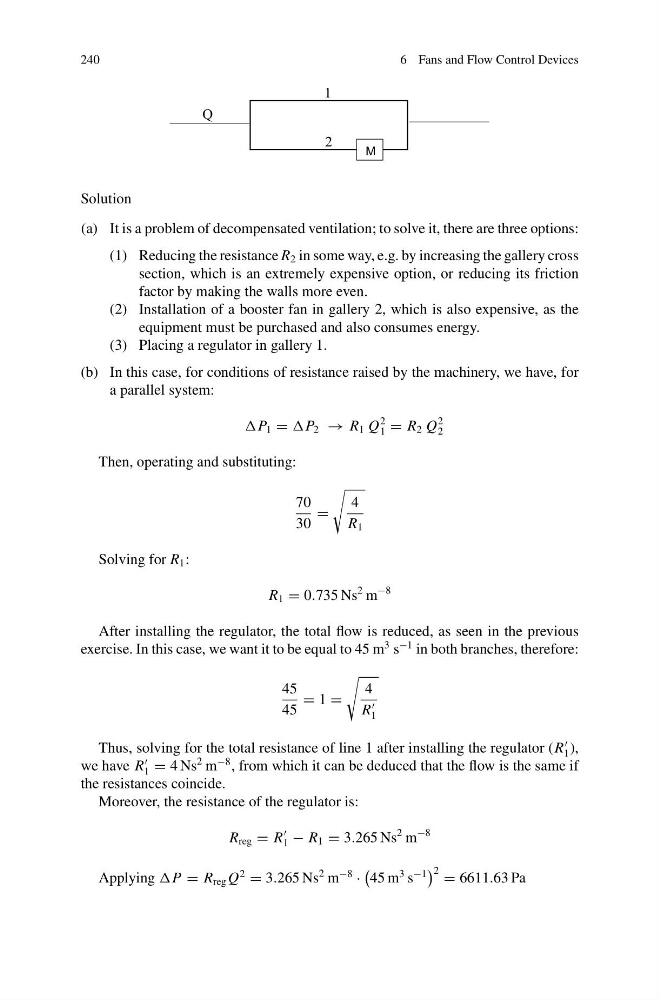
(a) It is a problem of decompensated ventilation; to solve it, there are three options:
(1) Reducing the resistance R 2 in some way, e.g. by increasing the gallery cross
section, which is an extremely expensive option, or reducing its friction
factor by making the walls more even.
(2) Installation of a booster fan in gallery 2, which is also expensive, as the
equipment must be purchased and also consumes energy.
(3) Placing a regulator in gallery 1.
(b) In this case, for conditions of resistance raised by the machinery, we have, for
a parallel system:
1 = 2 → R 1 Q
2
1 = R 2 Q
2
2
Then, operating and substituting:
70
30
=
4
R 1
Solving for R 1 :
R 1 = 0.735 Ns
2 m
−8
After installing the regulator, the total flow is reduced, as seen in the previous
exercise. In this case, we want it to be equal to 45 m
3 s
−1 in both branches, therefore:
45
45
= 1 =
4
R
1
Thus, solving for the total resistance of line 1 after installing the regulator (R
1 ),
we have R
1 = 4 Ns
2 m
−8 , from which it can be deduced that the flow is the same if
the resistances coincide.
Moreover, the resistance of the regulator is:
R reg = R
1 − R 1 = 3.265 Ns
2 m
−8
Applying = R reg Q
2
= 3.265 Ns
2 m
−8
·
45 m
3 s
−1
2 = 6611.63 Pa
6 Fans and Flow Control Devices
2
1
Q
M
Solution
(a) It is a problem of decompensated ventilation; to solve it, there are three options:
(1) Reducing the resistance R 2 in some way, e.g. by increasing the gallery cross
section, which is an extremely expensive option, or reducing its friction
factor by making the walls more even.
(2) Installation of a booster fan in gallery 2, which is also expensive, as the
equipment must be purchased and also consumes energy.
(3) Placing a regulator in gallery 1.
(b) In this case, for conditions of resistance raised by the machinery, we have, for
a parallel system:
1 = 2 → R 1 Q
2
1 = R 2 Q
2
2
Then, operating and substituting:
70
30
=
4
R 1
Solving for R 1 :
R 1 = 0.735 Ns
2 m
−8
After installing the regulator, the total flow is reduced, as seen in the previous
exercise. In this case, we want it to be equal to 45 m
3 s
−1 in both branches, therefore:
45
45
= 1 =
4
R
1
Thus, solving for the total resistance of line 1 after installing the regulator (R
1 ),
we have R
1 = 4 Ns
2 m
−8 , from which it can be deduced that the flow is the same if
the resistances coincide.
Moreover, the resistance of the regulator is:
R reg = R
1 − R 1 = 3.265 Ns
2 m
−8
Applying = R reg Q
2
= 3.265 Ns
2 m
−8
·
45 m
3 s
−1
2 = 6611.63 Pa