

6.4 Calculation by the Simplified Expression of the Regulator Area
239
t
a)
a´)
R1´
R1
R 2
R 2´
t´
Q
Q´
Modified from Passaro et al. (1994)
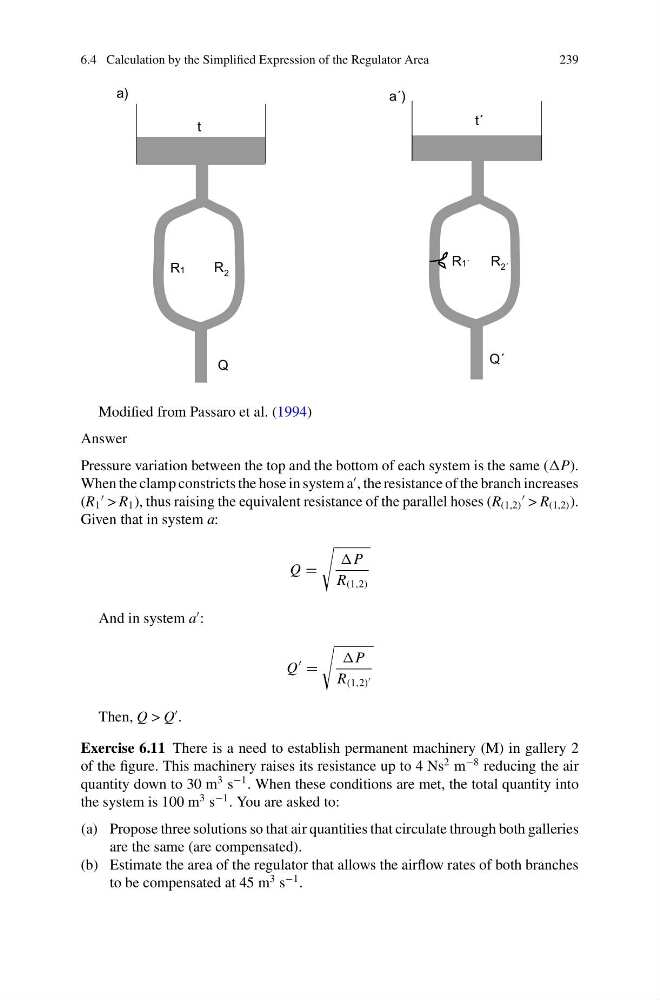
Answer
Pressure variation between the top and the bottom of each system is the same (
When the clamp constricts the hose in system a
, the resistance of the branch increases
(R 1
> R 1 ), thus raising the equivalent resistance of the parallel hoses (R (1,2)
> R (1,2) ).
Given that in system a:
Q =
R (1,2)
And in system a
:
Q
=
P
R (1,2)
Then, Q > Q
.
Exercise 6.11 There is a need to establish permanent machinery (M) in gallery 2
of the figure. This machinery raises its resistance up to 4 Ns
2 m
−8 reducing the air
quantity down to 30 m
3 s
−1 . When these conditions are met, the total quantity into
the system is 100 m
3 s
−1 . You are asked to:
(a) Propose three solutions so that air quantities that circulate through both galleries
are the same (are compensated).
(b) Estimate the area of the regulator that allows the airflow rates of both branches
to be compensated at 45 m
3 s
−1 .
239
t
a)
a´)
R1´
R1
R 2
R 2´
t´
Q
Q´
Modified from Passaro et al. (1994)
Answer
Pressure variation between the top and the bottom of each system is the same (
When the clamp constricts the hose in system a
, the resistance of the branch increases
(R 1
> R 1 ), thus raising the equivalent resistance of the parallel hoses (R (1,2)
> R (1,2) ).
Given that in system a:
Q =
R (1,2)
And in system a
:
Q
=
P
R (1,2)
Then, Q > Q
.
Exercise 6.11 There is a need to establish permanent machinery (M) in gallery 2
of the figure. This machinery raises its resistance up to 4 Ns
2 m
−8 reducing the air
quantity down to 30 m
3 s
−1 . When these conditions are met, the total quantity into
the system is 100 m
3 s
−1 . You are asked to:
(a) Propose three solutions so that air quantities that circulate through both galleries
are the same (are compensated).
(b) Estimate the area of the regulator that allows the airflow rates of both branches
to be compensated at 45 m
3 s
−1 .