

206
6 Fans and Flow Control Devices
Q1, P1, v1, z1
Q2, P2, v2, z2
Motor
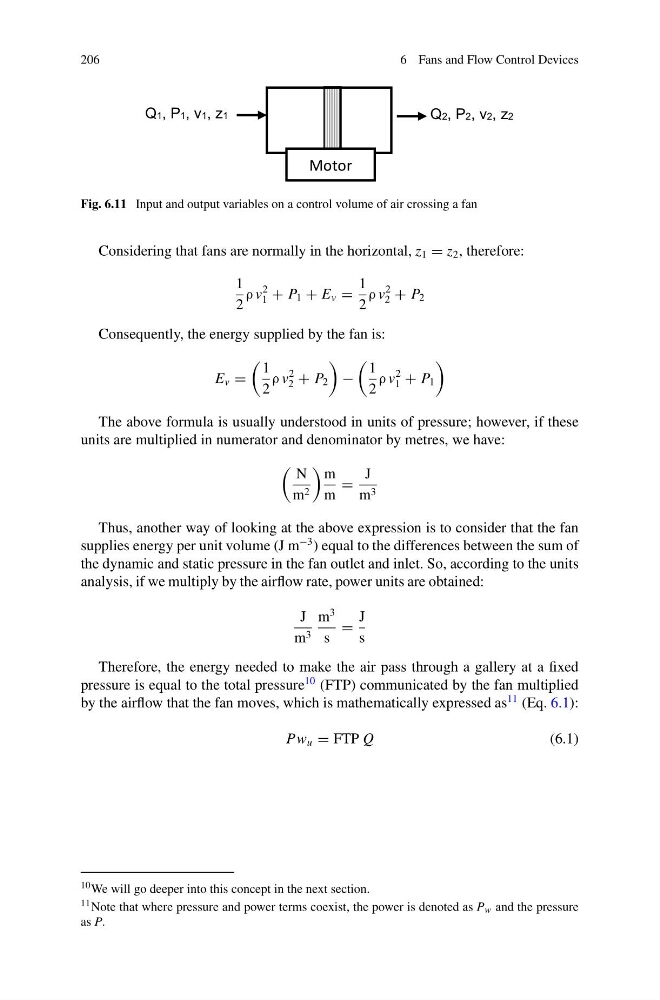
Fig. 6.11 Input and output variables on a control volume of air crossing a fan
Considering that fans are normally in the horizontal, z 1 = z 2 , therefore:
1
2
ρ v
2
1 + P 1 + E v =
1
2
ρ v
2
2 + P 2
Consequently, the energy supplied by the fan is:
E v =
1
2
ρ v
2
2 + P 2
−
1
2
ρ v
2
1 + P 1
The above formula is usually understood in units of pressure; however, if these
units are multiplied in numerator and denominator by metres, we have:
N
m 2
m
m
=
J
m 3
Thus, another way of looking at the above expression is to consider that the fan
supplies energy per unit volume (J m
−3 ) equal to the differences between the sum of
the dynamic and static pressure in the fan outlet and inlet. So, according to the units
analysis, if we multiply by the airflow rate, power units are obtained:
J
m 3
m
3
s
=
J
s
Therefore, the energy needed to make the air pass through a gallery at a fixed
pressure is equal to the total pressure
10 (FTP) communicated by the fan multiplied
by the airflow that the fan moves, which is mathematically expressed as
11 (Eq. 6.1):
Pw u = FTP Q
(6.1)
10 We will go deeper into this concept in the next section.
11 Note that where pressure and power terms coexist, the power is denoted as P w and the pressure
as P.
6 Fans and Flow Control Devices
Q1, P1, v1, z1
Q2, P2, v2, z2
Motor
Fig. 6.11 Input and output variables on a control volume of air crossing a fan
Considering that fans are normally in the horizontal, z 1 = z 2 , therefore:
1
2
ρ v
2
1 + P 1 + E v =
1
2
ρ v
2
2 + P 2
Consequently, the energy supplied by the fan is:
E v =
1
2
ρ v
2
2 + P 2
−
1
2
ρ v
2
1 + P 1
The above formula is usually understood in units of pressure; however, if these
units are multiplied in numerator and denominator by metres, we have:
N
m 2
m
m
=
J
m 3
Thus, another way of looking at the above expression is to consider that the fan
supplies energy per unit volume (J m
−3 ) equal to the differences between the sum of
the dynamic and static pressure in the fan outlet and inlet. So, according to the units
analysis, if we multiply by the airflow rate, power units are obtained:
J
m 3
m
3
s
=
J
s
Therefore, the energy needed to make the air pass through a gallery at a fixed
pressure is equal to the total pressure
10 (FTP) communicated by the fan multiplied
by the airflow that the fan moves, which is mathematically expressed as
11 (Eq. 6.1):
Pw u = FTP Q
(6.1)
10 We will go deeper into this concept in the next section.
11 Note that where pressure and power terms coexist, the power is denoted as P w and the pressure
as P.