

6.2 Fans
207
6.2.5 Fan Pressures
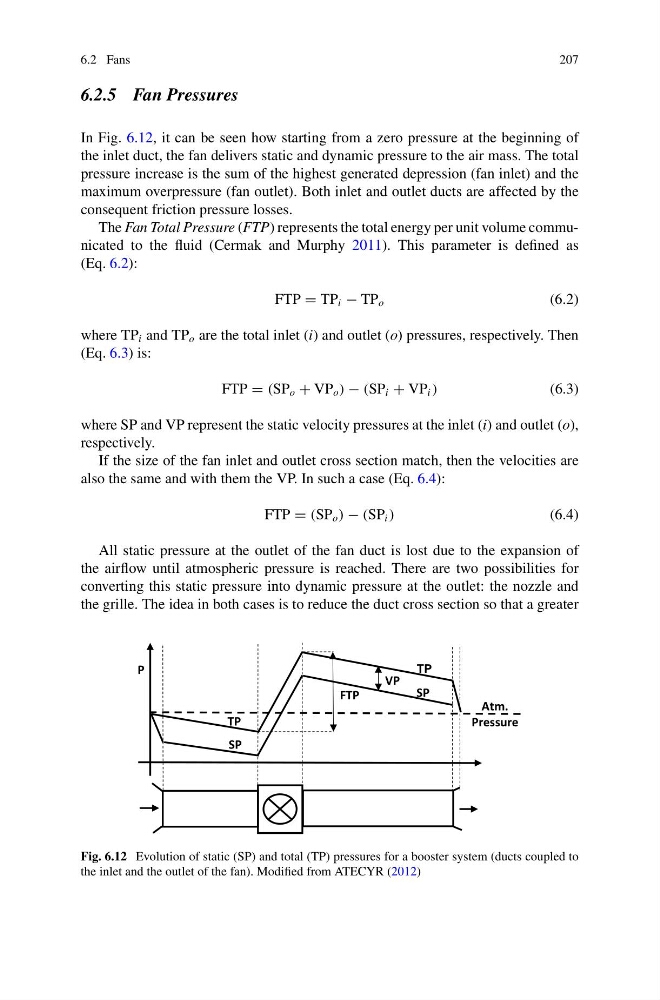
In Fig. 6.12, it can be seen how starting from a zero pressure at the beginning of
the inlet duct, the fan delivers static and dynamic pressure to the air mass. The total
pressure increase is the sum of the highest generated depression (fan inlet) and the
maximum overpressure (fan outlet). Both inlet and outlet ducts are affected by the
consequent friction pressure losses.
The Fan Total Pressure (FTP) represents the total energy per unit volume communicated to the fluid (Cermak and Murphy 2011). This parameter is defined as
(Eq. 6.2):
FTP = TP i − TP o
(6.2)
where TP i and TP o are the total inlet (i) and outlet (o) pressures, respectively. Then
(Eq. 6.3) is:
FTP = (SP o + VP o ) − (SP i + VP i )
(6.3)
where SP and VP represent the static velocity pressures at the inlet (i) and outlet (o),
respectively.
If the size of the fan inlet and outlet cross section match, then the velocities are
also the same and with them the VP. In such a case (Eq. 6.4):
FTP = (SP o ) − (SP i )
(6.4)
All static pressure at the outlet of the fan duct is lost due to the expansion of
the airflow until atmospheric pressure is reached. There are two possibilities for
converting this static pressure into dynamic pressure at the outlet: the nozzle and
the grille. The idea in both cases is to reduce the duct cross section so that a greater
TP
SP
Atm.
Pressure
P
FTP
TP
SP
VP
Fig. 6.12 Evolution of static (SP) and total (TP) pressures for a booster system (ducts coupled to
the inlet and the outlet of the fan). Modified from ATECYR (2012)
207
6.2.5 Fan Pressures
In Fig. 6.12, it can be seen how starting from a zero pressure at the beginning of
the inlet duct, the fan delivers static and dynamic pressure to the air mass. The total
pressure increase is the sum of the highest generated depression (fan inlet) and the
maximum overpressure (fan outlet). Both inlet and outlet ducts are affected by the
consequent friction pressure losses.
The Fan Total Pressure (FTP) represents the total energy per unit volume communicated to the fluid (Cermak and Murphy 2011). This parameter is defined as
(Eq. 6.2):
FTP = TP i − TP o
(6.2)
where TP i and TP o are the total inlet (i) and outlet (o) pressures, respectively. Then
(Eq. 6.3) is:
FTP = (SP o + VP o ) − (SP i + VP i )
(6.3)
where SP and VP represent the static velocity pressures at the inlet (i) and outlet (o),
respectively.
If the size of the fan inlet and outlet cross section match, then the velocities are
also the same and with them the VP. In such a case (Eq. 6.4):
FTP = (SP o ) − (SP i )
(6.4)
All static pressure at the outlet of the fan duct is lost due to the expansion of
the airflow until atmospheric pressure is reached. There are two possibilities for
converting this static pressure into dynamic pressure at the outlet: the nozzle and
the grille. The idea in both cases is to reduce the duct cross section so that a greater
TP
SP
Atm.
Pressure
P
FTP
TP
SP
VP
Fig. 6.12 Evolution of static (SP) and total (TP) pressures for a booster system (ducts coupled to
the inlet and the outlet of the fan). Modified from ATECYR (2012)