

144
4 Mine Ventilation Networks
Mesh
Branch
R ij
Q ij
19 iter.
20 iter.
700 iter.
M 1
14
0.400
−69.30
−69.30
−69.30
12
0.300
80.70
80.70
80.70
24
0.800
−6.40
−6.40
−6.40
M 2
34
0.200
−62.90
−62.90
−62.90
23
0.100
87.10
87.10
87.10
24
0.800
6.40
6.40
6.40
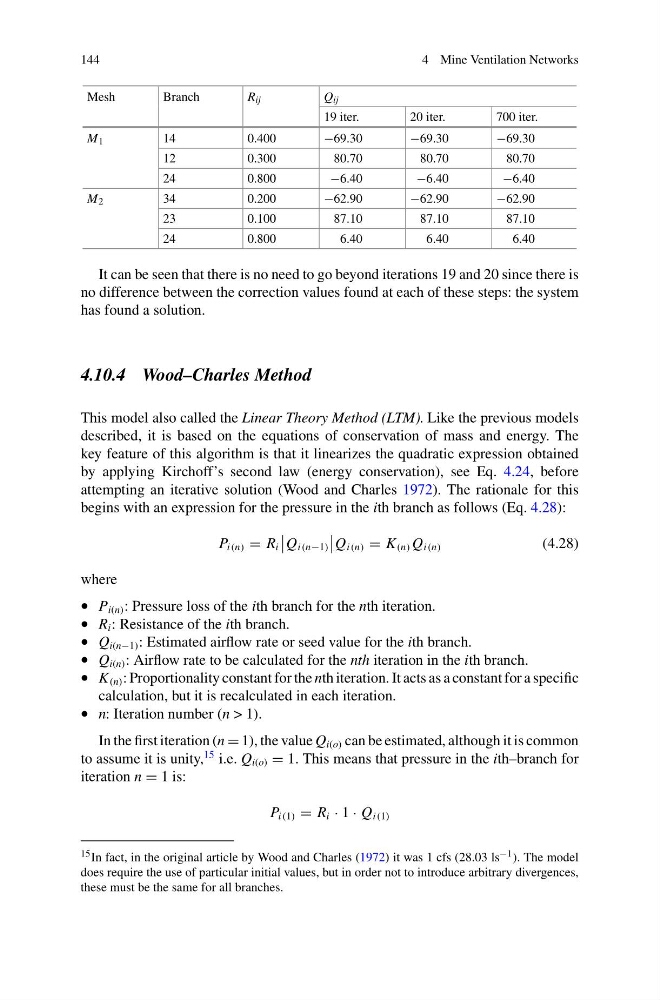
It can be seen that there is no need to go beyond iterations 19 and 20 since there is
no difference between the correction values found at each of these steps: the system
has found a solution.
4.10.4 Wood–Charles Method
This model also called the Linear Theory Method (LTM). Like the previous models
described, it is based on the equations of conservation of mass and energy. The
key feature of this algorithm is that it linearizes the quadratic expression obtained
by applying Kirchoff’s second law (energy conservation), see Eq. 4.24, before
attempting an iterative solution (Wood and Charles 1972). The rationale for this
begins with an expression for the pressure in the ith branch as follows (Eq. 4.28):
P i(n) = R i
Q i(n−1)
Q i(n) = K (n) Q i(n)
(4.28)
where
• P i(n) : Pressure loss of the ith branch for the nth iteration.
• R i : Resistance of the ith branch.
• Q i(n−1) : Estimated airflow rate or seed value for the ith branch.
• Q i(n) : Airflow rate to be calculated for the nth iteration in the ith branch.
• K (n) : Proportionality constant for the nth iteration. It acts as a constant for a specific
calculation, but it is recalculated in each iteration.
• n: Iteration number (n > 1).
In the first iteration (n = 1), the value Q i(o) can be estimated, although it is common
to assume it is unity,
15 i.e. Q i(o) = 1. This means that pressure in the ith–branch for
iteration n = 1 is:
P i(1) = R i · 1 · Q i(1)
15 In fact, in the original article by Wood and Charles (1972) it was 1 cfs (28.03 ls −1 ). The model
does require the use of particular initial values, but in order not to introduce arbitrary divergences,
these must be the same for all branches.
4 Mine Ventilation Networks
Mesh
Branch
R ij
Q ij
19 iter.
20 iter.
700 iter.
M 1
14
0.400
−69.30
−69.30
−69.30
12
0.300
80.70
80.70
80.70
24
0.800
−6.40
−6.40
−6.40
M 2
34
0.200
−62.90
−62.90
−62.90
23
0.100
87.10
87.10
87.10
24
0.800
6.40
6.40
6.40
It can be seen that there is no need to go beyond iterations 19 and 20 since there is
no difference between the correction values found at each of these steps: the system
has found a solution.
4.10.4 Wood–Charles Method
This model also called the Linear Theory Method (LTM). Like the previous models
described, it is based on the equations of conservation of mass and energy. The
key feature of this algorithm is that it linearizes the quadratic expression obtained
by applying Kirchoff’s second law (energy conservation), see Eq. 4.24, before
attempting an iterative solution (Wood and Charles 1972). The rationale for this
begins with an expression for the pressure in the ith branch as follows (Eq. 4.28):
P i(n) = R i
Q i(n−1)
Q i(n) = K (n) Q i(n)
(4.28)
where
• P i(n) : Pressure loss of the ith branch for the nth iteration.
• R i : Resistance of the ith branch.
• Q i(n−1) : Estimated airflow rate or seed value for the ith branch.
• Q i(n) : Airflow rate to be calculated for the nth iteration in the ith branch.
• K (n) : Proportionality constant for the nth iteration. It acts as a constant for a specific
calculation, but it is recalculated in each iteration.
• n: Iteration number (n > 1).
In the first iteration (n = 1), the value Q i(o) can be estimated, although it is common
to assume it is unity,
15 i.e. Q i(o) = 1. This means that pressure in the ith–branch for
iteration n = 1 is:
P i(1) = R i · 1 · Q i(1)
15 In fact, in the original article by Wood and Charles (1972) it was 1 cfs (28.03 ls −1 ). The model
does require the use of particular initial values, but in order not to introduce arbitrary divergences,
these must be the same for all branches.