

4.10 Complex Networks
143
Example for Q 24
Initial flow rate: 30.0 m
3 s
−1
Correction for M 1 : Q 1 = −11.4 m
3 s
−1
Correction for M 2 : Q 2 = 20.625 m
3 s
−1
Corrected flow rate: 30.0 m
3 s
−1
+ (−11.4) m
3 s
−1
− (20.625) m
3 s
−1
= −2.0 m
3
s
−1
The sign (+ or −) is related to the direction of travel around the mesh. Thus,
a branch shared by two meshes will have normally positive flow rates in one and
negative in the adjacent one. This is so because the same direction of travel is given
to all the meshes (normally clockwise).
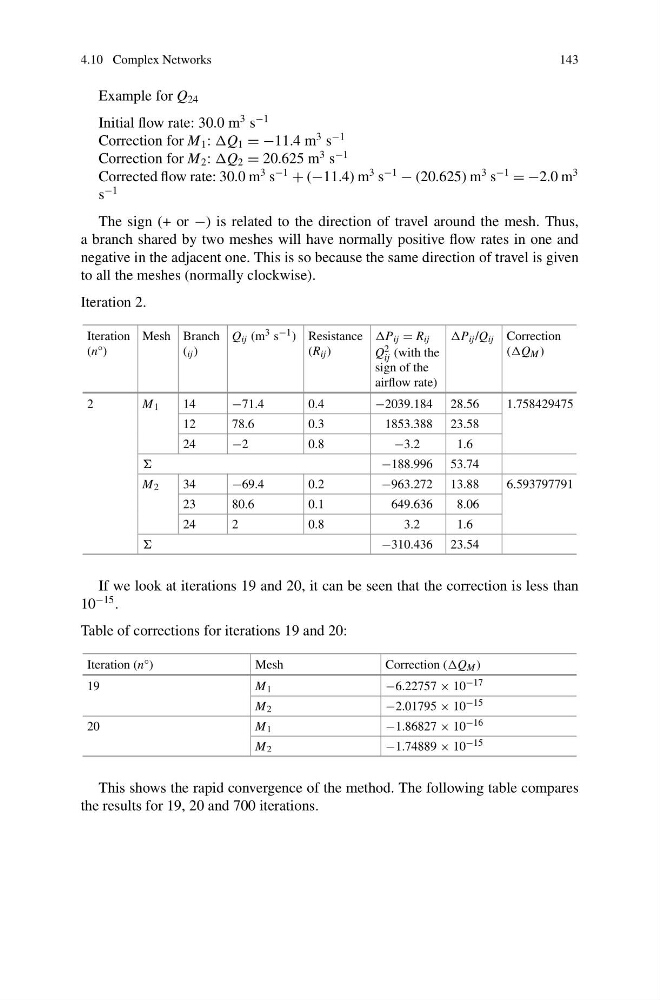
Iteration 2.
Iteration
(n°)
Mesh Branch
( ij )
Q ij (m 3 s −1 ) Resistance
(R ij )
P ij = R ij
Q 2
ij (with the
sign of the
airflow rate)
P ij /Q ij Correction
(Q M )
2
M 1
14
−71.4
0.4
−2039.184 28.56
1.758429475
12
78.6
0.3
1853.388 23.58
24
−2
0.8
−3.2
1.6
−188.996 53.74
M 2
34
−69.4
0.2
−963.272 13.88
6.593797791
23
80.6
0.1
649.636
8.06
24
2
0.8
3.2
1.6
−310.436 23.54
If we look at iterations 19 and 20, it can be seen that the correction is less than
10
−15 .
Table of corrections for iterations 19 and 20:
Iteration (n°)
Mesh
Correction (Q M )
19
M 1
−6.22757 × 10 −17
M 2
−2.01795 × 10 −15
20
M 1
−1.86827 × 10 −16
M 2
−1.74889 × 10 −15
This shows the rapid convergence of the method. The following table compares
the results for 19, 20 and 700 iterations.
143
Example for Q 24
Initial flow rate: 30.0 m
3 s
−1
Correction for M 1 : Q 1 = −11.4 m
3 s
−1
Correction for M 2 : Q 2 = 20.625 m
3 s
−1
Corrected flow rate: 30.0 m
3 s
−1
+ (−11.4) m
3 s
−1
− (20.625) m
3 s
−1
= −2.0 m
3
s
−1
The sign (+ or −) is related to the direction of travel around the mesh. Thus,
a branch shared by two meshes will have normally positive flow rates in one and
negative in the adjacent one. This is so because the same direction of travel is given
to all the meshes (normally clockwise).
Iteration 2.
Iteration
(n°)
Mesh Branch
( ij )
Q ij (m 3 s −1 ) Resistance
(R ij )
P ij = R ij
Q 2
ij (with the
sign of the
airflow rate)
P ij /Q ij Correction
(Q M )
2
M 1
14
−71.4
0.4
−2039.184 28.56
1.758429475
12
78.6
0.3
1853.388 23.58
24
−2
0.8
−3.2
1.6
−188.996 53.74
M 2
34
−69.4
0.2
−963.272 13.88
6.593797791
23
80.6
0.1
649.636
8.06
24
2
0.8
3.2
1.6
−310.436 23.54
If we look at iterations 19 and 20, it can be seen that the correction is less than
10
−15 .
Table of corrections for iterations 19 and 20:
Iteration (n°)
Mesh
Correction (Q M )
19
M 1
−6.22757 × 10 −17
M 2
−2.01795 × 10 −15
20
M 1
−1.86827 × 10 −16
M 2
−1.74889 × 10 −15
This shows the rapid convergence of the method. The following table compares
the results for 19, 20 and 700 iterations.