

130
4 Mine Ventilation Networks
2. Establish an arbitrary direction for the airflows in the network respecting
Kirchhoff’s first law and using the values stated in the initial problem:
3. Apply Kirchhoff’s first law:
Node N 1 :
Q e = Q 12 + Q 14
• Q 14 = 150 − Q 12
Node N 2 :
• Q 23 = Q 12 + 50
Node N 4 :
50 = Q 14 + Q 34 ; 50 = (150 − Q 12 ) + Q 34
• Q 34 = Q 12 − 100
Node N 3
11 :
Q 23 = 150 + Q 34
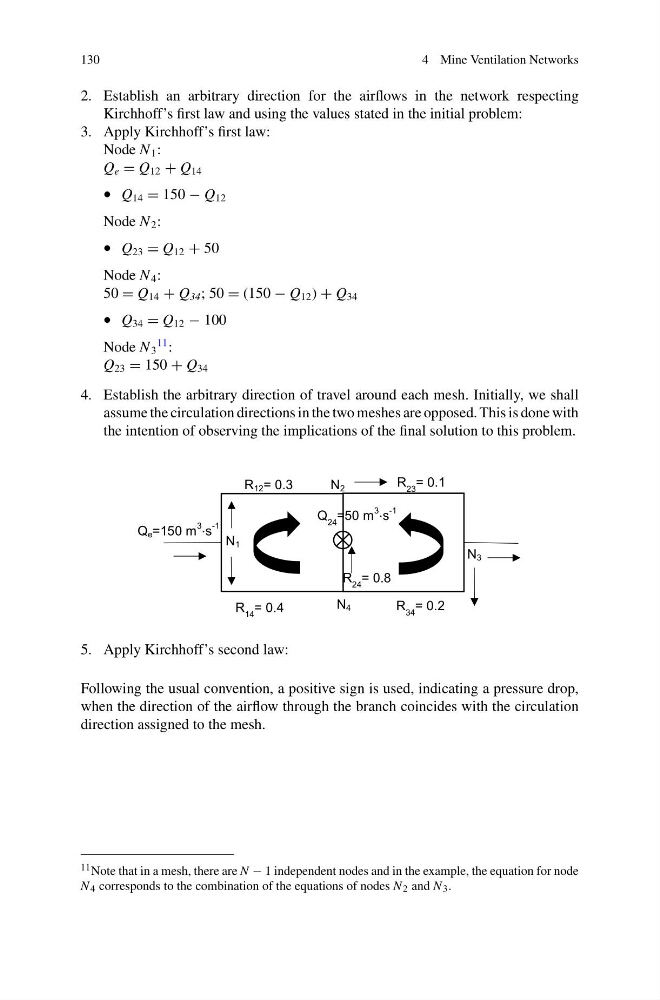
4. Establish the arbitrary direction of travel around each mesh. Initially, we shall
assume the circulation directions in the two meshes are opposed. This is done with
the intention of observing the implications of the final solution to this problem.
N 1
N 2
N 4
N 3
Q e =150 m
3 s
-1
R 12 = 0.3
R 14 = 0.4
R 23 = 0.1
R 34 = 0.2
R 24 = 0.8
Q 24 =50 m
3 s
-1
5. Apply Kirchhoff’s second law:
Following the usual convention, a positive sign is used, indicating a pressure drop,
when the direction of the airflow through the branch coincides with the circulation
direction assigned to the mesh.
11 Note that in a mesh, there are N − 1 independent nodes and in the example, the equation for node
N 4 corresponds to the combination of the equations of nodes N 2 and N 3 .
4 Mine Ventilation Networks
2. Establish an arbitrary direction for the airflows in the network respecting
Kirchhoff’s first law and using the values stated in the initial problem:
3. Apply Kirchhoff’s first law:
Node N 1 :
Q e = Q 12 + Q 14
• Q 14 = 150 − Q 12
Node N 2 :
• Q 23 = Q 12 + 50
Node N 4 :
50 = Q 14 + Q 34 ; 50 = (150 − Q 12 ) + Q 34
• Q 34 = Q 12 − 100
Node N 3
11 :
Q 23 = 150 + Q 34
4. Establish the arbitrary direction of travel around each mesh. Initially, we shall
assume the circulation directions in the two meshes are opposed. This is done with
the intention of observing the implications of the final solution to this problem.
N 1
N 2
N 4
N 3
Q e =150 m
3 s
-1
R 12 = 0.3
R 14 = 0.4
R 23 = 0.1
R 34 = 0.2
R 24 = 0.8
Q 24 =50 m
3 s
-1
5. Apply Kirchhoff’s second law:
Following the usual convention, a positive sign is used, indicating a pressure drop,
when the direction of the airflow through the branch coincides with the circulation
direction assigned to the mesh.
11 Note that in a mesh, there are N − 1 independent nodes and in the example, the equation for node
N 4 corresponds to the combination of the equations of nodes N 2 and N 3 .