

4.10 Complex Networks
129
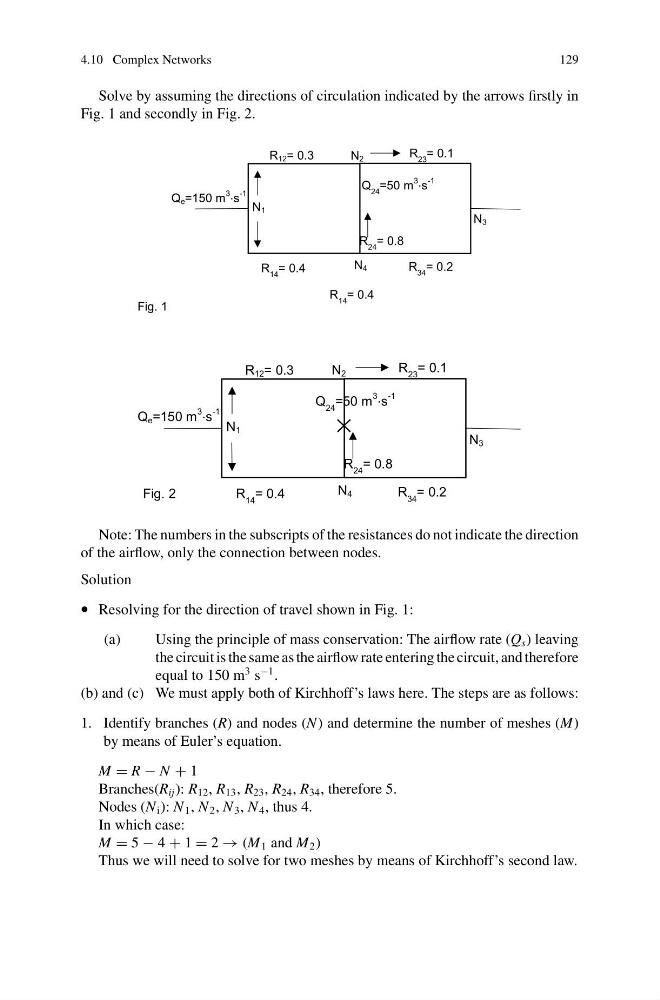
Solve by assuming the directions of circulation indicated by the arrows firstly in
Fig. 1 and secondly in Fig. 2.
N 1
N 2
N 4
N 3
Q e =150 m
3 s
-1
R 12 = 0.3
R 14 = 0.4
R 23 = 0.1
R 34 = 0.2
R 24 = 0.8
Q 24 =50 m
3 s
-1
R 14 = 0.4
Fig. 1
N 1
N 2
N 4
N 3
Q e =150 m
3 s
-1
R 12 = 0.3
R 14 = 0.4
R 23 = 0.1
R 34 = 0.2
R 24 = 0.8
Q 24 =50 m
3 s
-1
Fig. 2
Note: The numbers in the subscripts of the resistances do not indicate the direction
of the airflow, only the connection between nodes.
Solution
• Resolving for the direction of travel shown in Fig. 1:
(a)
Using the principle of mass conservation: The airflow rate (Q s ) leaving
the circuit is the same as the airflow rate entering the circuit, and therefore
equal to 150 m
3 s
−1 .
(b) and (c) We must apply both of Kirchhoff’s laws here. The steps are as follows:
1. Identify branches (R) and nodes (N) and determine the number of meshes (M)
by means of Euler’s equation.
M = R − N + 1
Branches(R ij ): R 12 , R 13 , R 23 , R 24 , R 34 , therefore 5.
Nodes (N i ): N 1 , N 2 , N 3 , N 4 , thus 4.
In which case:
M = 5 − 4 + 1 = 2 → (M 1 and M 2 )
Thus we will need to solve for two meshes by means of Kirchhoff’s second law.
129
Solve by assuming the directions of circulation indicated by the arrows firstly in
Fig. 1 and secondly in Fig. 2.
N 1
N 2
N 4
N 3
Q e =150 m
3 s
-1
R 12 = 0.3
R 14 = 0.4
R 23 = 0.1
R 34 = 0.2
R 24 = 0.8
Q 24 =50 m
3 s
-1
R 14 = 0.4
Fig. 1
N 1
N 2
N 4
N 3
Q e =150 m
3 s
-1
R 12 = 0.3
R 14 = 0.4
R 23 = 0.1
R 34 = 0.2
R 24 = 0.8
Q 24 =50 m
3 s
-1
Fig. 2
Note: The numbers in the subscripts of the resistances do not indicate the direction
of the airflow, only the connection between nodes.
Solution
• Resolving for the direction of travel shown in Fig. 1:
(a)
Using the principle of mass conservation: The airflow rate (Q s ) leaving
the circuit is the same as the airflow rate entering the circuit, and therefore
equal to 150 m
3 s
−1 .
(b) and (c) We must apply both of Kirchhoff’s laws here. The steps are as follows:
1. Identify branches (R) and nodes (N) and determine the number of meshes (M)
by means of Euler’s equation.
M = R − N + 1
Branches(R ij ): R 12 , R 13 , R 23 , R 24 , R 34 , therefore 5.
Nodes (N i ): N 1 , N 2 , N 3 , N 4 , thus 4.
In which case:
M = 5 − 4 + 1 = 2 → (M 1 and M 2 )
Thus we will need to solve for two meshes by means of Kirchhoff’s second law.