

128
4 Mine Ventilation Networks
• A pressure source (fan or natural ventilation) is said to be negative if the direction
of the airflow that it creates in the branch coincides with the direction of travel
around the mesh. This must be so since pressure losses and pressure gains in the
system must have opposite signs. Therefore, in each branch with a fan whose
arbitrary airflow direction coincides with the direction of travel (Eq. 4.25):
N r
i=1
(R i Q i |Q i | − P v ) = 0
(4.25)
where
• N r : Number of branches in each mesh,
• P v : Pressure created by the fan (or natural ventilation in each branch),
• R i : Resistance of each branch, and
• Q i : Airflow rate in each branch.
Note that in the expression, Q
2
i appears as Q i · |Q i | in order to preserve the sign associated with the airflow Q i An alternative approach would be to give the sign directly
to the whole term R i Q
2
i . This option, however, generates errors during iterative
calculations as signs can change.
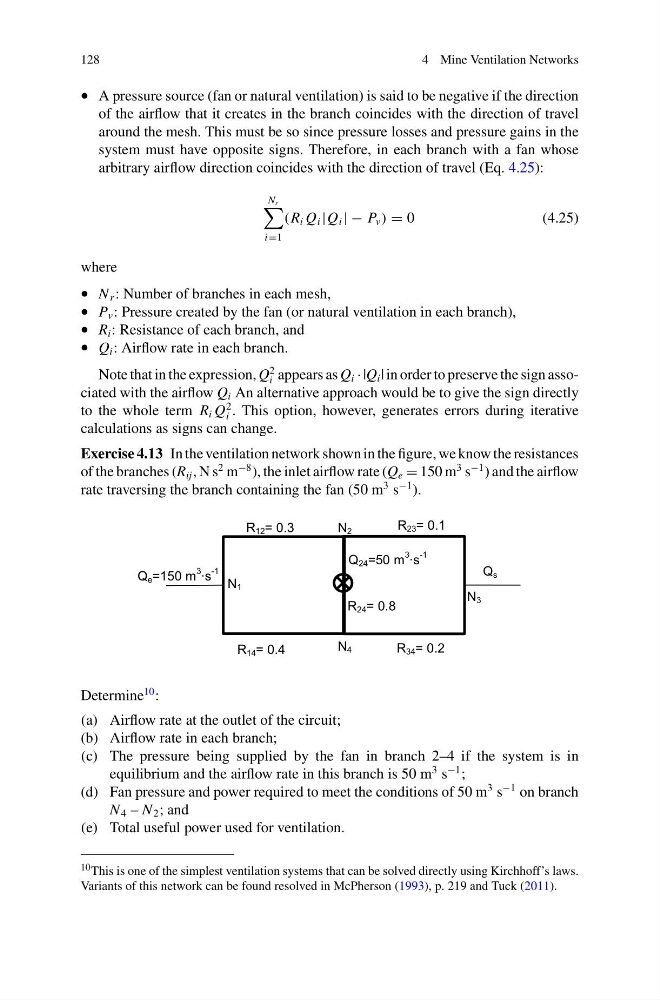
Exercise 4.13 In the ventilation network shown in the figure, we know the resistances
of the branches (R ij , N s
2 m
−8 ), the inlet airflow rate (Q e = 150 m
3 s
−1 ) and the airflow
rate traversing the branch containing the fan (50 m
3 s
−1 ).
N 1
N 2
N 4
N 3
Q e =150 m
3
·s
-1
R 12 = 0.3
R 14 = 0.4
R 23 = 0.1
R 34 = 0.2
R 24 = 0.8
Q 24 =50 m
3
·s
-1
Q s
Determine
10 :
(a) Airflow rate at the outlet of the circuit;
(b) Airflow rate in each branch;
(c) The pressure being supplied by the fan in branch 2–4 if the system is in
equilibrium and the airflow rate in this branch is 50 m
3 s
−1 ;
(d) Fan pressure and power required to meet the conditions of 50 m
3 s
−1 on branch
N 4 – N 2 ; and
(e) Total useful power used for ventilation.
10 This is one of the simplest ventilation systems that can be solved directly using Kirchhoff’s laws.
Variants of this network can be found resolved in McPherson (1993), p. 219 and Tuck (2011).
4 Mine Ventilation Networks
• A pressure source (fan or natural ventilation) is said to be negative if the direction
of the airflow that it creates in the branch coincides with the direction of travel
around the mesh. This must be so since pressure losses and pressure gains in the
system must have opposite signs. Therefore, in each branch with a fan whose
arbitrary airflow direction coincides with the direction of travel (Eq. 4.25):
N r
i=1
(R i Q i |Q i | − P v ) = 0
(4.25)
where
• N r : Number of branches in each mesh,
• P v : Pressure created by the fan (or natural ventilation in each branch),
• R i : Resistance of each branch, and
• Q i : Airflow rate in each branch.
Note that in the expression, Q
2
i appears as Q i · |Q i | in order to preserve the sign associated with the airflow Q i An alternative approach would be to give the sign directly
to the whole term R i Q
2
i . This option, however, generates errors during iterative
calculations as signs can change.
Exercise 4.13 In the ventilation network shown in the figure, we know the resistances
of the branches (R ij , N s
2 m
−8 ), the inlet airflow rate (Q e = 150 m
3 s
−1 ) and the airflow
rate traversing the branch containing the fan (50 m
3 s
−1 ).
N 1
N 2
N 4
N 3
Q e =150 m
3
·s
-1
R 12 = 0.3
R 14 = 0.4
R 23 = 0.1
R 34 = 0.2
R 24 = 0.8
Q 24 =50 m
3
·s
-1
Q s
Determine
10 :
(a) Airflow rate at the outlet of the circuit;
(b) Airflow rate in each branch;
(c) The pressure being supplied by the fan in branch 2–4 if the system is in
equilibrium and the airflow rate in this branch is 50 m
3 s
−1 ;
(d) Fan pressure and power required to meet the conditions of 50 m
3 s
−1 on branch
N 4 – N 2 ; and
(e) Total useful power used for ventilation.
10 This is one of the simplest ventilation systems that can be solved directly using Kirchhoff’s laws.
Variants of this network can be found resolved in McPherson (1993), p. 219 and Tuck (2011).