

4.10 Complex Networks
127
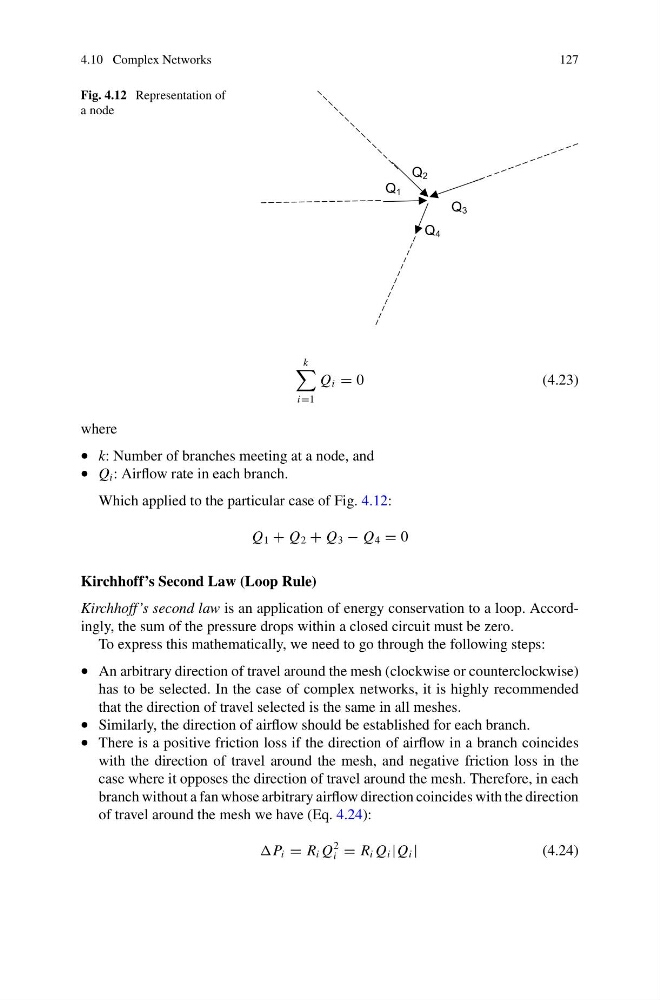
Fig. 4.12 Representation of
a node
Q 1
Q 2
Q 3
Q 4
k
i=1
Q i = 0
(4.23)
where
• k: Number of branches meeting at a node, and
• Q i : Airflow rate in each branch.
Which applied to the particular case of Fig. 4.12:
Q 1 + Q 2 + Q 3 − Q 4 = 0
Kirchhoff’s Second Law (Loop Rule)
Kirchhoff’s second law is an application of energy conservation to a loop. Accordingly, the sum of the pressure drops within a closed circuit must be zero.
To express this mathematically, we need to go through the following steps:
• An arbitrary direction of travel around the mesh (clockwise or counterclockwise)
has to be selected. In the case of complex networks, it is highly recommended
that the direction of travel selected is the same in all meshes.
• Similarly, the direction of airflow should be established for each branch.
• There is a positive friction loss if the direction of airflow in a branch coincides
with the direction of travel around the mesh, and negative friction loss in the
case where it opposes the direction of travel around the mesh. Therefore, in each
branch without a fan whose arbitrary airflow direction coincides with the direction
of travel around the mesh we have (Eq. 4.24):
i = R i Q
2
i = R i Q i |Q i |
(4.24)
127
Fig. 4.12 Representation of
a node
Q 1
Q 2
Q 3
Q 4
k
i=1
Q i = 0
(4.23)
where
• k: Number of branches meeting at a node, and
• Q i : Airflow rate in each branch.
Which applied to the particular case of Fig. 4.12:
Q 1 + Q 2 + Q 3 − Q 4 = 0
Kirchhoff’s Second Law (Loop Rule)
Kirchhoff’s second law is an application of energy conservation to a loop. Accordingly, the sum of the pressure drops within a closed circuit must be zero.
To express this mathematically, we need to go through the following steps:
• An arbitrary direction of travel around the mesh (clockwise or counterclockwise)
has to be selected. In the case of complex networks, it is highly recommended
that the direction of travel selected is the same in all meshes.
• Similarly, the direction of airflow should be established for each branch.
• There is a positive friction loss if the direction of airflow in a branch coincides
with the direction of travel around the mesh, and negative friction loss in the
case where it opposes the direction of travel around the mesh. Therefore, in each
branch without a fan whose arbitrary airflow direction coincides with the direction
of travel around the mesh we have (Eq. 4.24):
i = R i Q
2
i = R i Q i |Q i |
(4.24)